When comparing GB steel with ASTM specifications, buyers need more than a simple grade conversion. They need clarity on properties, tolerances, compliance, and project fit.
For international sourcing, the difference between GB steel and ASTM steel affects cost, fabrication, certification, and delivery risk. A wrong assumption can create approval delays or performance gaps.
This guide explains key spec differences through real application scenarios. It helps evaluate where GB steel works well, where ASTM is preferred, and how to compare them correctly.
When Structural Projects Need Clear GB Steel vs ASTM Judgments
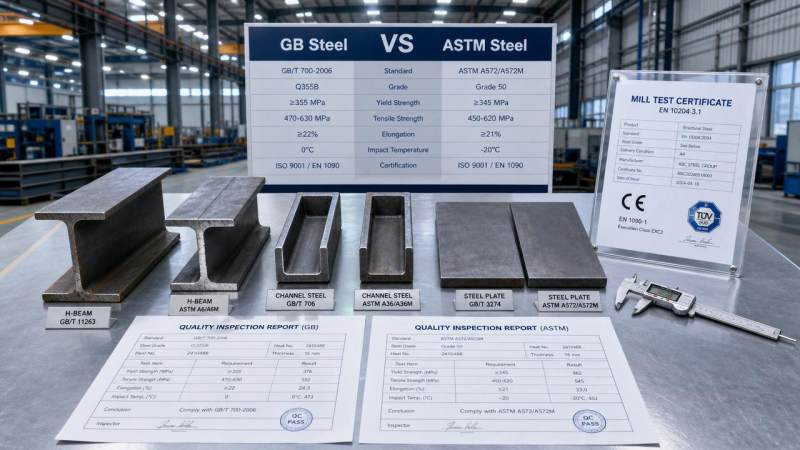
GB steel is widely used in China-based production and export supply chains. ASTM steel is common in North America and in projects following US-based engineering documents.
The challenge starts when drawings, contracts, and mill supply come from different standards. A grade that looks similar may differ in chemistry, yield strength, or impact testing.
That is why GB steel evaluation should begin with the project scenario. Structure type, service environment, approval method, and fabrication route all influence material choice.
Scenario 1: Building Frames Need Strength Equivalence, Not Name Matching
For steel buildings, the first question is usually grade equivalence. Many teams compare Q235 to ASTM A36, or Q355 to ASTM A572, and stop there too early.
In practice, GB steel and ASTM steel may align only partially. Yield strength ranges, tensile strength bands, and thickness-based requirements can differ by product form.
What to verify in frame applications
- Minimum yield strength by thickness
- Tensile strength range
- Elongation requirement
- Section tolerances for beams, channels, and angles
- Impact test requirements, if any
For example, GB steel may satisfy strength targets but still differ in carbon equivalent or notch toughness. That can affect welding procedures and cold-weather service.
Scenario 2: Industrial Fabrication Focuses on Chemistry and Weldability
Fabricated components often involve cutting, bending, welding, and surface treatment. Here, chemistry matters as much as nominal strength.
GB steel grades can have different limits for carbon, manganese, sulfur, phosphorus, and alloying elements. ASTM specifications may also separate requirements by shape, plate, or coil.
If a project includes screens, filtration units, or corrosion-prone assemblies, related material selection becomes even more precise. In such cases, products like Stainless Steel Welded Mesh may be paired with structural steel frames.
This welded mesh option is available in SS 201, 304, 304L, 316, 316L, and 430. It supports filters, sieve systems, chemical plants, mining, architecture, and residential uses.
Its diameter range is 0.0008″-0.12″, with 2-635 mesh, open area from 25-84.6, and roll width up to 240″. Corrosion, acid, alkali, and heat resistance are key advantages.
The comparison matters because ASTM or GB structural supports may need compatible corrosion performance with attached stainless assemblies. Mixed-material design should never rely on grade names alone.
Scenario 3: Export Projects Depend on Certification and Inspection Path
Some projects accept GB steel with technical review. Others require direct ASTM compliance shown on mill test certificates, third-party inspection records, or contract specifications.
This is a frequent issue in cross-border supply. Even if GB steel has comparable performance, approval may fail if the contract requires an ASTM designation without substitution language.
Documents that should be checked early
- Project material specification
- Drawing notes and code references
- Inspection and test plan
- Mill certificate format
- Third-party witnessing requirements
Reliable suppliers reduce risk by mapping GB steel data to international requirements, while clearly stating where equivalence is exact, partial, or not recommended.
Key Spec Differences Between GB Steel and ASTM Steel
The following comparison helps identify where GB steel evaluation should go deeper. It is especially useful for structural and fabrication decisions.
How Different Project Needs Change the GB Steel Decision
Not every project values the same criteria. GB steel can be cost-effective and reliable, but the decision depends on actual use conditions.
Typical demand differences by scenario
- Warehouse structures prioritize section availability and stable strength.
- Bridge or cold-region work may require stricter toughness validation.
- Heavy fabrication needs controlled chemistry for welding quality.
- Export EPC projects often prioritize certificate recognition over price.
- Corrosive sites require system-level material matching, not isolated grade checks.
This is why GB steel assessment should combine design values, code references, fabrication method, and approval route in one review process.
Practical Matching Advice for GB Steel Sourcing
A useful approach is to compare standard by standard, then batch by batch. Material substitution should be documented, not assumed.
- Start from the exact ASTM or GB specification on the drawing.
- Check mechanical properties by thickness and product type.
- Review chemistry limits, especially carbon equivalent.
- Confirm tolerance standards for shape, weight, and straightness.
- Verify if impact testing or supplementary tests are required.
- Match mill certificates to contract language before production.
Experienced structural steel suppliers can support this process with conversion references, production traceability, and customized export documentation.
Hongteng Fengda, a structural steel manufacturer and exporter from China, supplies angle steel, channel steel, steel beams, cold formed profiles, and customized components under major international standards.
With modern facilities and strict quality control, the company supports global construction and industrial projects with stable production, dependable lead times, and lower sourcing risk.
Common GB Steel Misjudgments That Cause Project Delays
Several mistakes appear repeatedly in steel procurement. Each one can create hidden cost or compliance problems.
- Assuming one GB steel grade always equals one ASTM grade
- Ignoring product form differences between plate and section standards
- Checking strength but skipping chemistry and weldability
- Using mill data without confirming certificate acceptance
- Missing low-temperature or seismic performance requirements
These issues are preventable when GB steel review happens before ordering, not after fabrication begins or inspection is scheduled.
Next Step: Build a Safer GB Steel Comparison Process
The best GB steel decision is not based on a quick grade chart. It is based on application, specification, fabrication, and documentation together.
For building frames, compare strength and tolerances carefully. For fabricated systems, review chemistry and weldability. For export projects, confirm certificate acceptance from the start.
If a project involves international sourcing, request a detailed GB steel to ASTM review before production. That step improves compliance, protects timelines, and supports better total cost control.
Please give us a message


Please enter what you want to find