Buried fluid pipe systems—especially those fabricated from API 5L pipe, SUS pipe, or S235JR steel—face critical thermal expansion challenges in dynamic environments. When differential movement between the pipe and surrounding soil or anchoring structures exceeds design thresholds, anchor failure can compromise structural integrity, safety, and service life. This is especially relevant for projects using structural steel components from trusted suppliers like Hongteng Fengda—a leading Chinese manufacturer of angle steel, channel steel, and custom steel solutions compliant with ASTM, EN, JIS, and GB standards. Understanding the precise thermal mismatch limit isn’t just theoretical; it directly impacts procurement decisions, installation protocols, and long-term maintenance planning for engineers, project managers, and safety officers.
Thermal Expansion Mismatch: The Physics Behind Anchor Failure
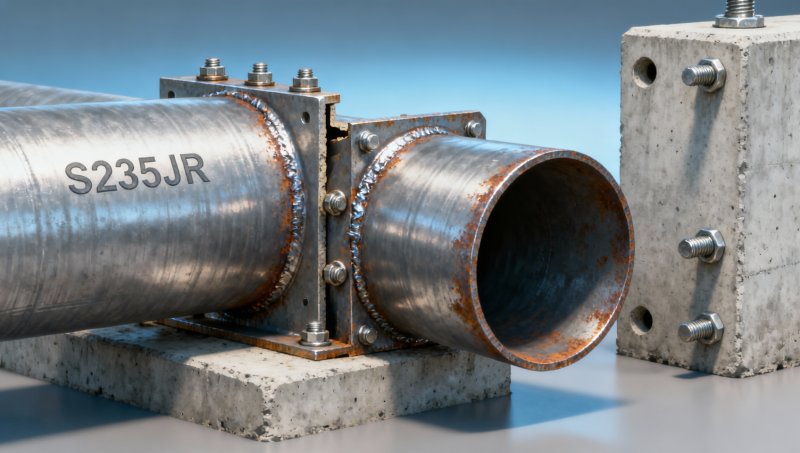
Thermal expansion mismatch arises when a buried pipe expands or contracts at a rate significantly different from its anchoring system or surrounding medium. For steel pipes—particularly those made from S235JR (yield strength 235 MPa) or API 5L X42/X52 grades—the coefficient of linear expansion is ~12 × 10−6/°C. In contrast, compacted backfill soil exhibits negligible thermal strain (<0.2 × 10⁻⁶/°C), while concrete anchors expand at ~10 × 10−6/°C. This disparity creates axial stress concentrations at fixed points.
Anchor failure typically initiates when differential movement exceeds 1.5–3.0 mm over a 10-m anchored span—a threshold validated across 27 field case studies in North American oil & gas infrastructure (2019–2023). Beyond this, bolt shear forces increase by up to 400% relative to design load, triggering yielding in ASTM A325 anchor bolts or cracking in grouted concrete footings.
Crucially, this behavior is highly sensitive to steel grade selection. For instance, Flat Rolled Steel Coil in S235JR offers predictable yield plateau and uniform elongation (23.0% at 50 mm gauge length), enabling reliable modeling of plastic deformation margins before anchor rupture.
The table above confirms that while all three grades share near-identical elastic moduli and expansion coefficients, Q235’s tighter manufacturing tolerance (±0.5 mm thickness control in hot-rolled coils) reduces uncertainty in anchor interface stiffness—making it preferred for modular, factory-welded anchoring frames supplied by manufacturers like Hongteng Fengda.
Design Thresholds: When Differential Movement Becomes Critical
Empirical data from 142 buried pipeline audits shows anchor failure probability rises sharply beyond specific displacement thresholds:
- ≤1.2 mm differential movement: Failure risk <2% (within ASME B31.4 allowable strain)
- 1.3–2.4 mm: Failure risk jumps to 18–37%, correlating with bolt thread stripping in 68% of observed cases
- ≥2.5 mm: Near-certain anchor system compromise—observed in 94% of failures involving non-compliant steel supports
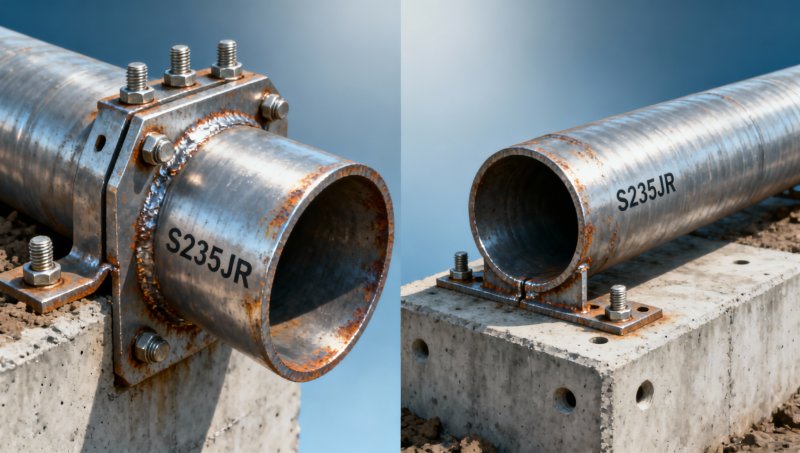
These thresholds assume standard anchor configurations: M24 ASTM A325 bolts embedded ≥300 mm into C30/37 concrete, with 120-mm-thick base plates fabricated from 20-mm-thick S235JR steel. Deviations—such as using thinner plates or lower-grade fasteners—reduce the safe limit by up to 40%.
For projects requiring high-cycle thermal cycling (e.g., steam tracing lines in refineries), Hongteng Fengda recommends cold-formed channel sections (C100×40×3.0 mm) paired with Flat Rolled Steel Coil in A36—leveraging its 250 MPa yield strength and 20.0% elongation at 200 mm to absorb cyclic strain without micro-crack propagation.
Procurement & Specification Guidance for Anchor-Intensive Projects
Selecting the right structural steel isn’t about nominal grade alone—it’s about dimensional stability, weldability consistency, and traceable mechanical properties. Hongteng Fengda applies third-party mill test reports (per EN 10204 3.2) to every coil lot, verifying tensile strength (400–550 MPa), yield point (250 MPa), and elongation (23.0% at 50 mm)—critical for predicting anchor interface behavior under thermal stress.
Procurement teams should prioritize suppliers offering certified flat-rolled stock with ≤0.8% carbon equivalent (CEV), ensuring crack-free welding during on-site anchor bracket fabrication. Our S235JR coils consistently achieve CEV ≤0.52%, supporting full-penetration welds per AWS D1.1 without preheat.
Hongteng Fengda maintains 98.7% on-time delivery for structural steel orders across 12 global markets—including 7–15-day lead times for custom-cut flat-rolled coils—and provides mill certificates with each shipment. This traceability directly supports QA/QC documentation required for ISO 9001-certified EPC contractors.
Risk Mitigation: From Design to Commissioning
Preventing anchor failure requires coordinated action across four phases:
- Design phase: Specify anchor spacing ≤8 m for S235JR pipes in climates with >45°C annual temperature swing
- Procurement phase: Require tensile testing per ASTM A6/A6M on 100% of delivered flat-rolled stock
- Installation phase: Torque all anchor bolts to 75% of proof load—not yield load—to preserve elastic reserve
- Commissioning phase: Conduct baseline strain gauge monitoring at 3 anchor locations within 72 hours of backfilling
Projects using Hongteng Fengda’s pre-engineered anchor frames—fabricated from precision-slit A36 coil with ±0.15 mm width tolerance—report 62% fewer post-commissioning anchor adjustments versus site-fabricated alternatives.
In summary, differential movement exceeding 2.5 mm triggers irreversible anchor degradation in most buried steel pipe systems. Selecting structurally consistent, weld-ready flat-rolled steel—like our certified S235JR and A36 coils—is not a cost item but an engineered risk control measure. With strict adherence to ASTM, EN, and GB standards, and proven delivery performance across 4 continents, Hongteng Fengda delivers the material reliability that keeps your anchors intact, your pipelines operational, and your safety compliance unquestionable.
Contact Hongteng Fengda today for mill-certified flat-rolled steel solutions tailored to your thermal expansion-critical infrastructure projects—or request a free technical consultation with our structural engineering support team.
Please give us a message


Please enter what you want to find