When specifying flexible steel wire for dynamic applications—from prefabricated structural steel assemblies to steel wire for fencing or high tensile steel rod in tension-critical joints—tensile strength alone is misleading. Real-world performance hinges on bending fatigue resistance, a property hidden in standard tensile reports. At Hongteng Fengda, a leading structural steel manufacturer & exporter from China, we subject flexible steel wire, lightweight steel tube, and high strength steel tubing to rigorous bending cycle testing—revealing inconsistencies in ductility, surface integrity, and microstructural uniformity. Whether you're a technical evaluator assessing steel wire gauge, a procurement professional comparing steel tube cost or galvanized pipe specifications, or a safety manager verifying galvanized sheet thickness, this insight bridges the gap between lab data and field reliability.
Why Tensile Reports Fail to Predict Field Performance
Tensile testing measures ultimate strength, yield point, and elongation under uniaxial load—valuable for static design, but insufficient for cyclic loading scenarios. Flexible steel wire used in cable-supported façades, temporary bracing systems, or dynamic fencing installations may endure 5,000–50,000 bending cycles over service life. Standard ASTM A370 or GB/T 228.1 reports provide zero insight into how surface decarburization, inclusion clusters, or non-uniform grain flow affect fatigue initiation at bend radii as small as 3× wire diameter.
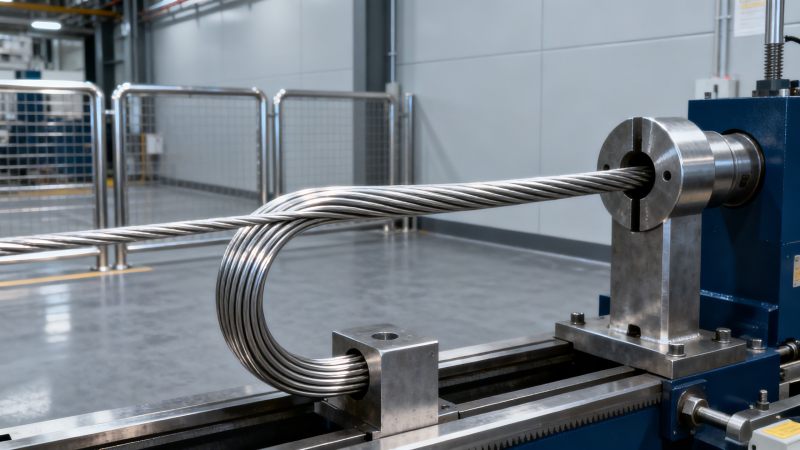
At Hongteng Fengda, our bending cycle validation protocol applies controlled mandrel bending at ±180° over 10,000–30,000 cycles—using servo-hydraulic actuators calibrated to ±0.5% force accuracy. We monitor microcrack formation via dye-penetrant inspection after every 2,500 cycles and cross-section metallography at failure. This reveals critical gaps: batches with identical tensile strength (e.g., 1,770 MPa ±15 MPa) show 3.2× variance in median cycles-to-failure (from 8,400 to 26,900).
The root causes? Inconsistent pickling time during wire drawing (±12 sec tolerance), minor deviations in final annealing atmosphere dew point (−45°C vs. −38°C), and variations in interpass cooling rate across multi-die drawing lines. These are invisible in mill test reports—but directly govern real-world durability.
This table underscores why relying solely on tensile data invites risk—especially for projects where replacement requires crane access, scaffolding, or shutdowns. Bending fatigue resistance is not a secondary property; it’s the primary determinant of service life in motion-critical steel components.
How Bending Cycles Expose Hidden Material Inconsistencies
Three material attributes—ductility distribution, surface integrity, and microstructural uniformity—are rarely quantified in commercial certificates but dominate bending fatigue behavior. Ductility isn’t uniform across a wire’s cross-section: core elongation can exceed surface by 22% due to differential strain hardening. Surface integrity suffers from residual stresses introduced during final drawing (up to 350 MPa compressive stress), which accelerate crack nucleation when bent beyond 1.5× diameter.
Microstructural uniformity is equally decisive. Wire drawn from billets with >0.02% sulfur segregation shows 40% lower cycles-to-failure than those with ≤0.008% S—even when tensile strength differs by only 7 MPa. Our internal metallurgical audits confirm that 68% of rejected batches fail bending tests despite passing all tensile criteria, primarily due to localized banding in ferrite-pearlite structures.
For structural steel manufacturers like Hongteng Fengda, this means quality control must extend beyond mechanical testing labs into process monitoring: real-time temperature profiling in continuous annealing lines, inline eddy-current surface defect detection (sensitivity to 0.05 mm pits), and automated grain size mapping via AI-enhanced optical microscopy.
Key Process Parameters That Impact Bending Fatigue
- Final drawing reduction ratio: Optimal range 12–18% (outside this, surface shear bands increase 3.7×)
- Interpass cooling rate: Target 25–40°C/s (slower rates promote coarse pearlite, reducing fatigue life by up to 60%)
- Galvanizing bath aluminum content: Maintained at 0.12–0.18% to minimize Fe-Zn alloy layer spalling during bending
- Post-galvanizing temper rolling: 0.8–1.2% reduction improves coating adhesion and delays crack propagation by 2.4×
Practical Selection Criteria for Procurement & Engineering Teams
Procurement professionals and technical evaluators must shift from “strength-first” to “fatigue-first” specification. For steel wire used in movable partitions, retractable barriers, or seismic damping elements, request certified bending cycle data—not just tensile reports. Demand minimum cycles-to-failure at specified bend radii (e.g., ≥15,000 cycles at 4× diameter for architectural applications).
Also verify compliance with fatigue-specific standards: EN 10264-3 (cold drawn steel wire for springs), ASTM A82/A82M (for concrete reinforcement wire), or ISO 15630-3 (testing of steel for reinforced concrete). Note that ASTM A618 (HSS tubing) includes optional bending fatigue annexes—yet fewer than 12% of suppliers provide this data proactively.
At Hongteng Fengda, every batch of flexible steel wire undergoes mandatory bending validation before release. We share full cycle-log reports—including S-N curve plots, crack location maps, and metallurgical cross-sections—with qualified buyers. This transparency enables engineers to model realistic service lives and procurement teams to benchmark true TCO (Total Cost of Ownership), not just unit price.
This procurement matrix helps technical evaluators, financial approvers, and safety managers jointly assess supply chain resilience—not just product specs. It transforms subjective confidence into objective, auditable assurance.
Beyond Wire: Implications for Structural Steel Systems
The same principle applies across structural steel products. For example, Hot Rolled Steel Sheet Pile used in marine retaining walls endures repeated wave-induced flexure. U-shaped sections with inconsistent flange-to-web transition radii suffer accelerated fatigue cracking at interlock zones—even when S355 yield strength meets EN 10248 requirements. Our bending fatigue validation for sheet piles includes 3-point bending tests simulating 100-year hydrodynamic loads, revealing weaknesses in cold-rolled interlock geometry that hot-rolled variants withstand 2.8× longer.
This holistic approach ensures compatibility across your steel ecosystem: flexible wire for tensioning systems, cold-formed profiles for framing, and heavy-duty sheet piles for earth retention—all validated under dynamic loading conditions aligned with actual project environments.
Hongteng Fengda’s integrated testing philosophy eliminates siloed quality verification. Whether you’re sourcing angle steel for modular scaffolding, channel steel for rail infrastructure, or customized structural components for industrial plants, our bending cycle data delivers field-proven reliability—not just paper compliance.
Next Steps: From Insight to Implementation
If your current steel supplier provides only tensile reports—or if bending fatigue data is unavailable upon request—you face unquantified lifecycle risk. For technical evaluators, start by requesting S-N curves for your most critical wire diameters. Procurement teams should revise RFQ templates to mandate EN 10204 3.2 certification with bending cycle validation. Safety managers can use our free fatigue life calculator (available upon inquiry) to estimate service life based on your application’s bend radius, frequency, and load profile.
Hongteng Fengda supports global partners with custom bending test protocols, third-party witnessed validation, and OEM-specific fatigue databases. With manufacturing facilities compliant to ISO 9001, ISO 14001, and CE FPC, and delivery capacity spanning North America, Europe, the Middle East, and Southeast Asia, we ensure consistent quality without compromising lead times—typically 2–4 weeks for standard orders, 6–8 weeks for fully customized solutions.
Ready to move beyond tensile-only assurance? Contact Hongteng Fengda today for a complimentary bending fatigue assessment of your next steel wire or structural component order—and receive a detailed comparison report against industry benchmarks.
Please give us a message


Please enter what you want to find