Estimating the Total Weight of a 12 mm Steel Wire Rope Reel
Estimating the total weight of a 12 mm steel wire rope reel is essential for planning transport, lifting operations, storage, and project costs. For project managers, the calculation starts with the 12mm steel wire rope weight per meter, but rope length and reel weight must also be considered. This guide explains how to estimate the combined weight, identify factors that can affect the result, and obtain reliable figures for safer handling and more accurate procurement planning.
The distinction that matters is between the weight of the rope alone and the weight of the complete load. A rope supplier may quote a nominal mass per metre, while a freight provider needs the gross weight of the packaged reel. A lifting plan may need a different figure again if a spindle, lifting beam or other equipment travels with the load.
Start with the rope, then add everything that moves with it
For an initial estimate, use the following relationship:
Estimated packaged reel weight = rope length × rope weight per metre + empty reel weight + packaging and attached items
Keep the units consistent: length in metres, rope mass in kilograms per metre and the remaining items in kilograms. The result is an estimated mass in kilograms. In everyday freight and site discussions, this is commonly called the reel’s weight.
The rope calculation is straightforward once the inputs are known. The difficult part is making sure that the quoted weight per metre belongs to the actual rope construction and that the reel figure includes everything intended to travel with it.
If several reels are being shipped, calculate each one separately where lengths, reel designs or packaging differ. Multiplying the weight of one reel by the number of reels is convenient, but it can miss a shorter final length or a different drum supplied to complete the order.
A worked planning example
Assume, purely for illustration, a 500 m length of rope with a supplier-stated nominal mass of 0.55 kg/m. Also assume an empty reel weighing 80 kg and 10 kg of packaging and attached items:
- Rope: 500 m × 0.55 kg/m = 275 kg
- Empty reel: 80 kg
- Packaging and attached items: 10 kg
- Estimated packaged weight: 365 kg
These figures demonstrate the method, not a standard weight for every 12 mm rope or reel. Replace each assumption with project-specific information before arranging transport or selecting handling equipment. In particular, an empty reel weight of 80 kg should not be carried forward simply because it appears in the example.
Why 12 mm diameter does not give one exact weight
A steel wire rope is an assembly of wires and strands, not a solid steel bar. The space between wires, the arrangement of strands and the type of core all affect the mass within a given outside diameter. Two ropes specified as 12 mm can therefore have different nominal weights per metre.
Core construction is one reason to check the data sheet carefully. A fibre-core rope and a steel-core rope of the same nominal diameter do not necessarily contain the same amount of steel. Strand arrangement, compaction, coatings and lubrication can also affect the figure supplied for a particular product.
Avoid estimating rope mass by treating the full 12 mm diameter as a solid steel cylinder. That approach ignores the rope’s internal geometry and can give a misleading result. It is equally risky to borrow a number from a catalogue entry that happens to list the same diameter but a different construction.
The best starting point is the manufacturer’s nominal mass per metre for the exact rope ordered. Confirm the diameter, construction, core, finish and applicable specification against the purchase order. If the rope has already been supplied, check that the reel identification and documentation correspond to those details.
Nominal data is not a scale reading
A calculated value is useful for early planning, but it is not a substitute for a verified gross weight when the load is close to an equipment or transport limit. Manufacturing variation, actual delivered length, reel construction and packaging can all create a difference between the estimate and the measured shipment.
Ask whether the supplier’s figure is nominal, calculated or measured. If the answer is measured, establish exactly what was on the scale: rope only, rope on its reel, or the entire packed unit. A weight without a clear scope can be almost as troublesome as no weight at all.
The reel and packaging can change the handling plan
Reels may be made from timber, steel or other materials, and their dimensions and construction vary. The empty reel is not merely a minor allowance: on a relatively short rope length, it may account for a substantial share of the complete load.
Check for protective boards, wrapping, pallet bases, chocks and metal fastenings. Some items remain with the reel during unloading; others are removed before lifting or installation. Record the weight for each handling stage rather than assuming the same gross figure applies throughout.
A reel’s size matters alongside its mass. A unit can be within a forklift’s rated capacity and still be unsuitable because of its diameter, width, load centre or the attachment being used. Likewise, a crane lift requires consideration of the reel geometry, lifting arrangement and any spindle or beam included in the suspended load.
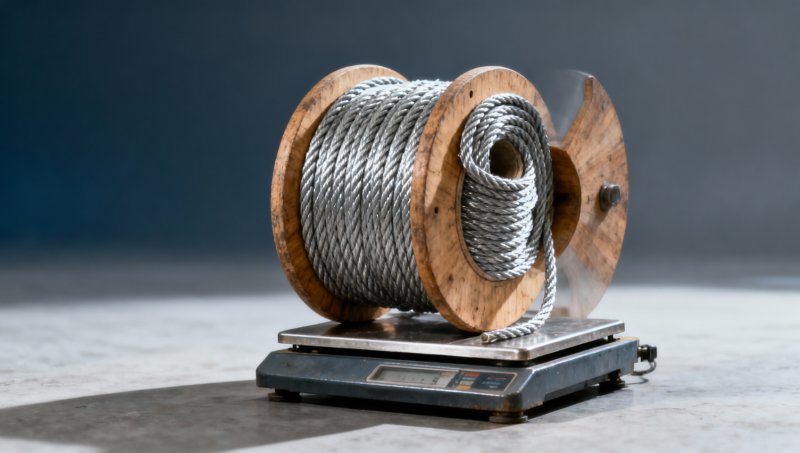
For a lifting calculation, distinguish the packaged reel from the total suspended load. Add the mass of rigging and lifting accessories where applicable, and have a competent person assess the arrangement and equipment ratings. An estimated gross reel weight alone does not establish that a lift is safe.
What to do when the reel has already been partly used
A partly used reel creates a different problem: the original purchase length no longer tells you how much rope remains. If reliable issue records exist, subtract the lengths removed from the original delivered length, then multiply the balance by the applicable rope mass per metre. Add the current reel and any remaining packaging.
That method depends on the quality of the records. Cuts, damaged sections and unrecorded offcuts can make the calculated balance optimistic. If the reel is being moved near a capacity limit, weighing the complete unit is a better basis than relying on an uncertain inventory balance.
Estimating the remaining length from flange diameter and visible layers may be possible, but it requires accurate drum dimensions and assumptions about winding. Rope can be packed unevenly, and gaps or crossover layers make a simple geometric estimate less dependable. Treat such a calculation as provisional unless its accuracy has been checked.
Where a scale is available, the measured gross mass can also help estimate remaining rope length:
Estimated remaining length = (measured gross mass − empty reel and other included items) ÷ rope mass per metre
This is only as reliable as the empty-reel figure and the measurement of the items still attached. It is useful for inventory planning, but it should not be treated as a precise measurement of rope length where the project requires one.
Translate the estimate into a site and transport decision
Different teams need different details. A freight quotation may require gross weight, reel dimensions and the number of packages. The unloading team needs to know how the reel is oriented, where it can be picked up and whether suitable equipment can reach it. The installation team needs the winding direction and a workable arrangement for paying out the rope without damaging it.
Storage deserves the same attention. A reel that is stable in transit is not automatically stable after its transport restraints are removed. Confirm how it will be supported, prevented from rolling and protected from ground conditions and contamination, following the rope and reel suppliers’ instructions. Avoid placing loads on reel flanges or stacking units unless the reel design and supplier instructions permit it.
For projects using a dedicated rack, cradle or pay-out frame, structural members need to be selected for more than the static reel weight. The designer should consider how the reel is supported, how load reaches the ground or supporting structure, and the forces introduced during handling and pay-out. A suitable design cannot be chosen from channel dimensions alone.
Hongteng Fengda, a structural steel manufacturer and exporter in China, supplies standard and customised steel sections for construction and industrial applications. Its Channel Steel Supplier offering includes U-channel products in grades such as Q235B and Q345B, with stated lengths of 6–12 m or as requested. For a project-specific support frame, the required grade, dimensions, connections and applicable standard should be confirmed through structural design; the channel product itself is not a rated reel-handling device.
Information worth confirming before the reel ships
A short clarification with the rope supplier can prevent the project team from working with several incompatible figures. Request the following against each reel or package identification:
- Rope details: nominal diameter, construction, core, finish and mass per metre for the supplied product.
- Length: the length wound on each reel, including any permissible variation stated in the order or product documentation.
- Weight breakdown: rope mass, empty reel mass and packaged gross mass, with confirmation of what each figure includes.
- Dimensions and orientation: flange diameter, overall width, relevant centre-hole dimensions and the intended shipping position.
- Handling information: any reel-specific restrictions or instructions for lifting, supporting, transporting and paying out the rope.
Also check that the purchase order, packing list and site lifting documentation use consistent units and terminology. A nominal rope weight in kilograms per metre should not be confused with the gross weight of a loaded drum, and a shipping weight should not silently become the total suspended load.
Use the calculation early to compare transport and handling options. Before committing to a lift or accepting a shipment near an operational limit, replace assumptions with the supplier’s confirmed data or a suitable scale measurement, and have the complete handling arrangement reviewed for the actual site conditions.
Please give us a message


Please enter what you want to find