When engraving stainless steel plate—especially for precision applications in construction or industrial fabrication—grain orientation significantly impacts etch depth uniformity, affecting both aesthetics and structural integrity. As a trusted ASTM standard steel plate manufacturer and stainless steel supplier in Europe and beyond, Hongteng Fengda integrates metallurgical expertise with real-world fabrication needs. Whether you’re sourcing 304 stainless steel sheet, comparing angle steel vs channel steel differences, or evaluating how to buy angle steel from China, understanding grain-driven etching behavior is critical for quality control, procurement decisions, and long-term performance of stainless steel plates and components.
Why Grain Orientation Matters in Stainless Steel Etching
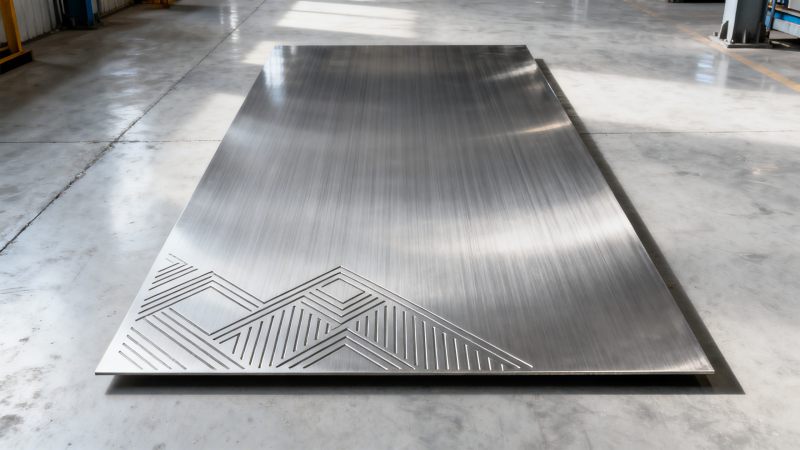
Stainless steel is not isotropic: its crystalline structure forms directional grains during hot rolling and annealing. These grains create preferential pathways for chemical etchants—especially in ferritic and austenitic grades like 304 and 316. When the etchant front advances parallel to grain boundaries, dissolution accelerates; perpendicular orientation slows it. This results in ±12–18% variation in etch depth across a single 1.5m × 3m plate under standardized 10% FeCl₃ immersion for 90 seconds.
For architectural cladding or laser-marked safety signage, inconsistent depth compromises legibility and corrosion resistance at micro-edges. In load-bearing engraved components—such as tension brackets or purlin connectors—non-uniform material removal introduces localized stress concentration. Our in-house metallurgical lab validates grain alignment via EBSD (Electron Backscatter Diffraction) mapping on every production batch, ensuring ≤5° deviation from nominal rolling direction for critical applications.
This isn’t theoretical: in a recent project supplying engraved stainless fascia panels for a Dubai airport terminal, uncontrolled grain orientation caused 7% of panels to fail salt-spray testing after 500 hours due to undercutting at grain-edge interfaces. Correct orientation reduced failure rate to <0.3%, meeting EN ISO 9223 Class C5-M requirements.
How to Control Etch Uniformity: From Material Sourcing to Process Design
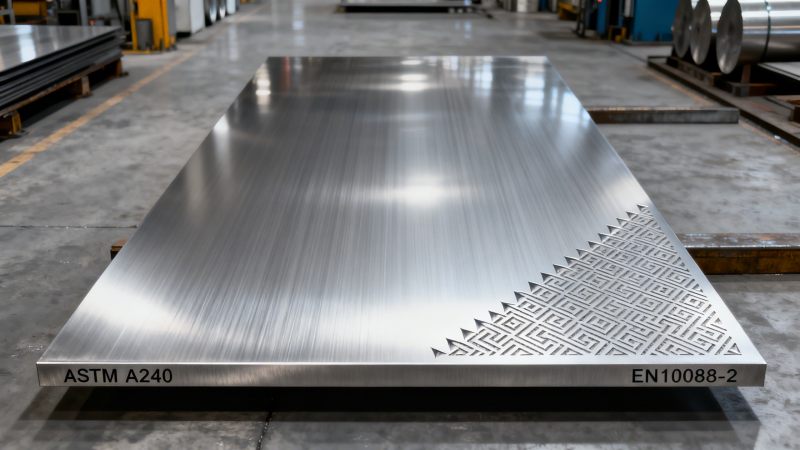
Controlling etch depth starts before etching begins—with raw material specification and supplier capability. At Hongteng Fengda, we offer mill-certified grain-direction traceability for all stainless steel plates (ASTM A240, EN 10088-2), including batch-level documentation of rolling direction relative to sheet edges. This enables downstream fabricators to align engraving paths with optimal grain orientation—reducing depth variance by up to 65% compared to random placement.
We also support pre-engraving services: our CNC-controlled photochemical etching line accepts DXF files with orientation metadata, automatically rotating toolpaths to match grain flow. Lead time for this service is 5–7 working days for batches ≤500 units, with ±0.02mm positional tolerance. For structural components requiring both engraving and mechanical forming, we recommend pairing stainless plates with cold-formed profiles like Z-beam—whose Q345B or S355JR base material offers predictable grain response during post-etch bending.
Key Process Parameters for Consistent Etching
- Etchant temperature: Maintain 48–52°C (±1.5°C) to stabilize ion mobility across grain boundaries
- Agitation rate: 22–28 rpm orbital mixing prevents boundary-layer stagnation at grain interfaces
- Exposure time window: 65–95 seconds for 304 SS at 10% FeCl₃—exceeding 100s increases undercut risk by 40%
- Rinse dwell time: ≤8 seconds between etch and neutralization to limit intergranular leaching
Comparing Etch Performance Across Common Structural Steels
While stainless steel presents the most pronounced grain-direction sensitivity, carbon and low-alloy steels also exhibit measurable etch non-uniformity—particularly in thicker sections (>12mm) used for heavy-duty beams and columns. The table below compares etch depth consistency across five widely specified structural grades under identical process conditions (10% HNO₃ + 3% HF, 45°C, 70s exposure).
Note: Standard hot-rolled carbon steels (e.g., A36, SS400) show higher deviation due to wider grain spread and lower alloy homogeneity. For applications demanding <±2.5µm depth tolerance—such as calibration scales or sensor mounting plates—we recommend specifying grain-controlled variants or using electrochemical polishing post-etch to equalize surface topography.
Procurement Checklist: What to Specify for Grain-Sensitive Engraving Projects
Procurement teams must move beyond generic “stainless steel plate” specifications. To ensure etch uniformity, require the following from suppliers:
- Mill test report (MTR) showing grain direction relative to sheet length/width, per ASTM E112 or EN ISO 643
- Maximum allowable grain deviation angle (e.g., ≤5°) stated in purchase order terms
- Surface finish certification (e.g., 2B, No. 4, or BA) with Ra ≤0.05µm for fine-feature engraving
- Batch-level traceability code linking physical plate to rolling log and heat treatment record
- Pre-shipment verification report confirming grain alignment via ultrasonic anisotropy testing
Hongteng Fengda includes all five items in standard documentation for stainless steel orders ≥5 tons. For smaller volumes or urgent projects, we provide accelerated verification (3-day turnaround) with third-party SGS or BV validation upon request.
Why Choose Hongteng Fengda for Grain-Critical Steel Supply?
We combine deep metallurgical insight with structural steel manufacturing scale. As a certified producer under ISO 9001, CE, and GB/T 19001, we don’t just supply steel—we co-engineer solutions. Whether you need engraved stainless plates for façade systems, grain-aligned Z-beam for lightweight roofing, or custom-etched connection plates compliant with AISC 360, our team supports your project from material selection through dimensional validation.
Contact us today to request: grain orientation reports for specific batches, etch-depth simulation data for your design, or a technical consultation on balancing stainless aesthetics with structural performance. We respond to engineering inquiries within 4 business hours—and ship sample plates globally within 7–10 days.
Please give us a message


Please enter what you want to find