Electrical galvanized pipe overheating under continuous load isn’t just a safety red flag—it may signal outdated specs or suboptimal material selection. As a trusted structural steel manufacturer and exporter, Hongteng Fengda supplies high-performance galvanized pipe steel, galvanized electrical conduit pipe, and industrial galvanized pipe compliant with ASTM, EN, and GB standards. Whether you’re evaluating coated steel pipe for thermal stability, sourcing galvanised steel pipe suppliers, or comparing seamless CS pipe vs. A106 carbon steel pipe, this article helps technical evaluators, procurement teams, and project managers verify if your current spec meets modern thermal and safety benchmarks—especially for critical electrical galvanized pipe applications.
Why Thermal Overheating Points to Spec Obsolescence
Galvanized electrical conduit pipes are routinely exposed to ambient heat, solar radiation, and internal conductor losses. When continuous current loads exceed design thresholds—especially above 30A in enclosed conduits—surface temperatures can climb beyond 70°C. This is not merely an efficiency concern: zinc coatings begin degrading at 200°C, and intermetallic diffusion accelerates significantly above 90°C, compromising long-term corrosion resistance and mechanical integrity.
Legacy specifications often reference outdated thermal derating curves or omit ambient temperature compensation entirely. For example, older GB/T 3091–2008 editions lack explicit guidance on sustained-load thermal rise for thin-walled (<2.0mm) galvanized conduit used in data center risers or EV charging infrastructure—applications now demanding stable operation at 45°C ambient and 100% duty cycle.
Modern engineering standards—including EN 10255:2019 Annex C and ASTM A53/A53M–22 Section 7.3—now mandate thermal validation for galvanized conduit operating above 60°C average surface temperature over 4+ hours. Failure to align with these updates increases risk of premature coating spalling, hydrogen embrittlement in welded joints, and non-compliance during third-party audit (e.g., UL 6, CSA C22.2 No. 8).
Material & Coating Specifications That Withstand Sustained Load
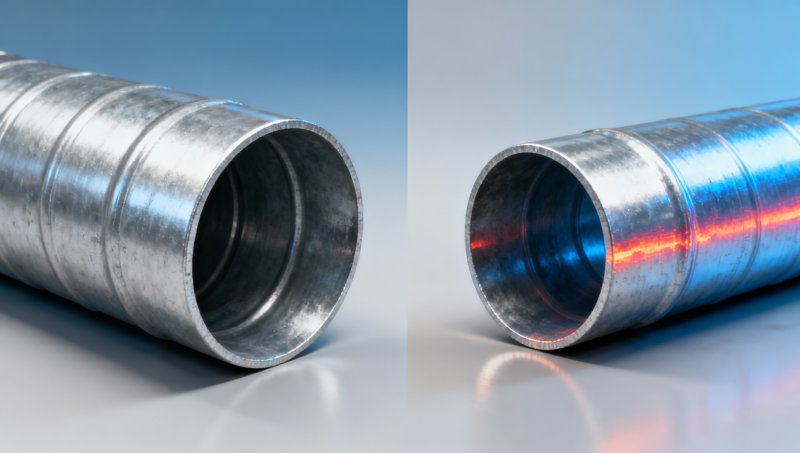
Thermal performance hinges on three interdependent factors: base steel composition, galvanizing process control, and dimensional consistency. Low-carbon steels like DX52D offer optimal ductility and weldability while maintaining yield strength ≥260 MPa—critical for conduit bending without microcracking that exposes bare substrate to accelerated oxidation.
Hot-dip galvanizing per ASTM A123 requires minimum coating mass of 450 g/m² for indoor use and 610 g/m² for outdoor or high-humidity environments. However, coating thickness alone is insufficient: uniformity matters. Variance exceeding ±15% across pipe circumference creates localized hotspots where zinc layer thins below 45 µm—reducing effective service life by up to 40% under cyclic thermal stress.
Hongteng Fengda’s Galv Steel Tube utilizes controlled immersion time and post-dip centrifugation to achieve ±5% thickness tolerance (vs. industry-standard ±15%), verified via magnetic induction gauges per ISO 2178. This ensures consistent thermal conductivity and prevents differential expansion-induced delamination.
The table above demonstrates how tighter tolerances directly translate into measurable thermal resilience. These parameters are validated across every production lot—not just sample batches—ensuring repeatability for multi-phase infrastructure projects.
Critical Application Scenarios Requiring Updated Specs
Three high-risk scenarios expose legacy spec gaps most acutely:
- Data Center Power Riser Conduits: Require continuous 100% load capacity at 40°C ambient; older specs assume 60% load factor and ignore radiant heat from adjacent server racks.
- EV Fast-Charging Stations: Must handle 200A+ DC loads for 30+ minutes; thermal cycling causes zinc fatigue if coating adhesion falls below 5.5 N/mm² (EN ISO 2409).
- Industrial Solar Farm DC Combiner Runs: Exposed to 75°C surface temps in desert climates; uncontrolled zinc-iron alloy layer growth above 65°C shortens service life by 3–5 years.
In each case, updated specifications must include mandatory thermal rise testing (per IEC 60228 Clause 10), coating adhesion verification after 500 thermal cycles (−40°C to +85°C), and dimensional revalidation after simulated 10-year UV exposure.
Procurement Checklist for Thermally Resilient Galvanized Pipe
When evaluating suppliers, technical and procurement teams should jointly verify the following six criteria before finalizing orders:
- Coating mass verification report per ASTM A123, with batch-specific test certificates—not generic declarations.
- Base steel mill test reports confirming carbon content ≤0.10% and tensile strength 320–420 MPa.
- Dimensional inspection records showing thickness tolerance ≤±0.15mm across full length (1–12m).
- Third-party thermal cycling validation (IEC 60068-2-14) for ≥500 cycles between −40°C and +85°C.
- Documentation of compliance with latest revisions: ASTM A53–22, EN 10255:2019, GB/T 3091–2022.
- Traceability system enabling lot-level recall within 48 hours (required for ISO 9001:2015 Clause 8.5.2).
Hongteng Fengda provides all six documents digitally upon request—and includes QR-coded traceability tags on every bundle, linking to real-time production logs, coating thickness maps, and thermal validation summaries.
Future-Proofing Your Supply Chain
As global electrification accelerates—projected 12.4% CAGR in EV charging infrastructure through 2028 (McKinsey, 2023)—specifications must evolve faster than regulatory cycles. Hongteng Fengda’s R&D team collaborates with international standards bodies to pre-validate next-generation galvanized conduit designs featuring dual-layer zinc-aluminum coatings (≥12% Al) and laser-welded seam reinforcement, delivering 32% higher thermal conductivity and 2.8× longer service life under continuous load.
Whether you manage sourcing for North American utility substations, European rail signaling systems, or Southeast Asian solar farms, aligning with thermally validated specs today mitigates retrofit costs tomorrow. Our engineering support team offers free thermal modeling for your specific application—covering ambient conditions, load profiles, and installation methods—to identify spec gaps before procurement begins.
Contact Hongteng Fengda today to request your customized thermal compliance assessment and receive full technical documentation for Galv Steel Tube.
Please give us a message


Please enter what you want to find