For distributors, agents, and steel buyers involved in export projects, understanding EN steel standards is essential for reducing sourcing risks and meeting European market requirements. This guide explains how EN steel specifications affect product selection, quality compliance, and project efficiency, helping you choose the right structural steel solutions from a reliable Chinese manufacturing and export partner.
Why EN Steel Standards Matter in Export Projects
EN steel standards define material grades, tolerances, testing methods, and delivery conditions for steel used across Europe and many international projects.
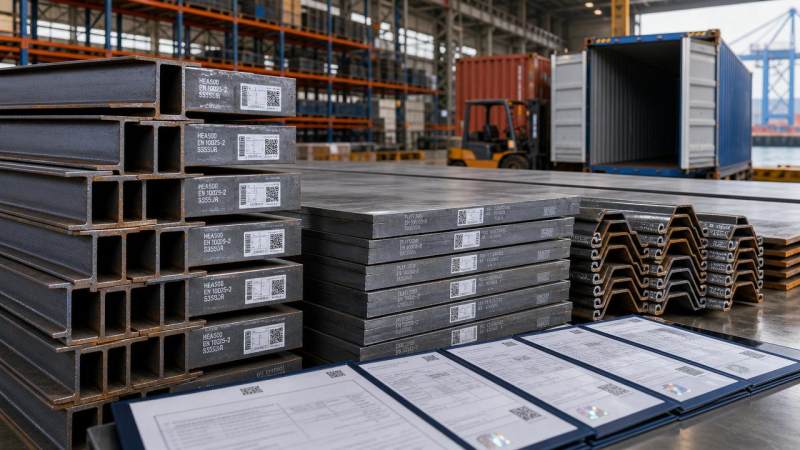
When specifications are unclear, sourcing errors often appear in chemical composition, mechanical properties, marking, or inspection documents.
A clear EN steel review process helps control these issues before production starts, not after cargo arrives at site.
For structural steel exports from China, EN steel compliance also supports customs clearance, third-party inspection, and acceptance by contractors or consultants.
Use This EN Steel Checklist Before Confirming an Order
Apply the following checklist to compare quotations, verify mills, and reduce technical misunderstandings in export projects.
- Confirm the exact EN steel grade, such as S235, S275, or S355, and check whether normalized, hot rolled, or cold formed delivery is required.
- Match the product standard to the item type, because beams, channels, plates, piles, and hollow sections may follow different EN steel specifications.
- Review mechanical property requirements, including yield strength, tensile strength, elongation, and impact testing temperature, before approving production drawings.
- Verify chemical composition limits for carbon, manganese, sulfur, phosphorus, and alloying elements when weldability or corrosion performance affects project safety.
- Request the correct inspection documents, especially EN 10204 certificates, and confirm whether 3.1 or 3.2 certification is required by contract.
- Check dimensional tolerances, straightness, weight deviation, and section shape against the applicable EN steel standard rather than general commercial practice.
- Specify coating, blasting, galvanizing, or painting systems separately, because EN steel material compliance does not automatically cover surface treatment performance.
- Align marking, traceability, bundle labels, and heat number control with shipping documents so each EN steel batch remains identifiable after delivery.
- Assess production capacity and lead time stability, especially for mixed sections or customized structural steel, where standard compliance alone is not enough.
- Plan third-party inspection points early, including raw material review, in-process checks, final testing, and loading supervision for export quality assurance.
Check the Standard Behind the Product, Not Just the Grade
One common mistake is assuming that one grade name covers every product category. In reality, EN steel is organized by both grade and product standard.
For example, structural sections, flat products, and cold formed profiles may share similar strength levels but follow different manufacturing and testing rules.
This matters when comparing offers from different suppliers. A quotation with the right strength class may still fail the required EN steel standard.
When Marine and Foundation Projects Need Extra Attention
Deep excavation, waterfront construction, and temporary retaining structures often require section performance beyond ordinary building steel selection.
In such cases, products like Steel Sheet Piles may be specified for cofferdams or deep water work.
Available grades can include S275, S355, S390, S430, SY295, SY390, and ASTM A690, depending on structural demands and project location.
For EN steel related applications, standards such as EN10248 and EN10249 are especially relevant for checking dimensions, tolerances, and performance.
High strength, waterproof performance, soil penetration, and reuse potential can strongly influence cost efficiency in temporary or repeated installation conditions.
How EN Steel Affects Different Export Scenarios
Building Structures
For building frames, the main concern is usually matching strength class, weldability, and section tolerances with engineering calculations and fabrication needs.
EN steel documentation should also match the fabrication route, especially when parts will be cut, drilled, welded, or assembled off site.
Industrial Equipment Support
Equipment platforms, pipe racks, and machine structures often require more detailed dimensional consistency than general stock supply.
In these projects, EN steel quality control should include section geometry, hole position accuracy, and document traceability for each fabricated component.
Marine, Port, and Temporary Works
Marine environments increase demands on corrosion resistance, durability, and section stability during driving or installation.
Where long lengths and custom dimensions are needed, product capability matters as much as EN steel certification and testing records.
Commonly Overlooked Risks in EN Steel Procurement
Assuming Equivalent Grades Are Automatically Acceptable
ASTM, JIS, GB, and EN steel grades may look comparable on paper, but substitution should never be approved without technical review.
Ignoring Impact Test Requirements
Some export projects need Charpy impact values at specific temperatures. Missing this point can make delivered EN steel unusable in cold regions.
Treating Certificates as a Formality
Material test certificates must match heat numbers, quantities, and actual shipped items. Incomplete paperwork creates compliance and claim problems later.
Separating Price from Total Project Cost
A lower unit price can become expensive if the EN steel supply causes delays, reinspection, fabrication changes, or rejected cargo at destination.
Practical Steps for Better EN Steel Sourcing
- Write the required EN steel grade, standard number, certificate type, and testing scope directly into the inquiry and purchase order.
- Send drawings, technical notes, and end-use conditions together so the supplier can review feasibility before confirming production.
- Ask for sample certificates, previous export references, and quality procedures for similar EN steel orders.
- Confirm packaging, marking, loading method, and shipping sequence to protect traceability during international transport.
- Use suppliers with stable capacity in angle steel, channel steel, beams, cold formed profiles, and customized structural components.
A capable Chinese exporter should support both standard steel supply and tailored processing while maintaining compliance with EN, ASTM, JIS, and GB requirements.
That combination helps reduce sourcing risk, improve lead time reliability, and simplify communication across technical and commercial teams.
Conclusion
EN steel selection is not only about choosing a familiar grade. It requires checking the full standard, test scope, tolerances, certificates, and supplier execution ability.
With a disciplined checklist, export projects can avoid preventable errors and secure steel products that meet European expectations from the start.
For structural steel exports from China, working with a reliable long-term partner brings practical value through consistent quality, dependable lead times, and customized support.
The next step is simple: review your current specifications, identify every EN steel requirement in writing, and confirm supply capability before placing the order.
Please give us a message


Please enter what you want to find