Does Structural Steel Weight Calculation Include Coating Mass—or Is It Always Ignored?
When performing structural steel weight calculation for design, procurement, or logistics planning, a common yet critical question arises: does the coating mass—such as galvanizing, paint, or fireproofing—count toward the total weight? While many engineers default to ignoring it for simplicity, real-world applications demand precision. At Hongteng Fengda, a leading structural steel manufacturer & exporter from China, we ensure accurate weight data across angle steel, beams, channels, and custom profiles—whether you’re sourcing to ASTM, EN, or GB standards. This article clarifies when coating mass matters—and why getting it right impacts cost, safety, and compliance.
Short Answer: It Depends on Context—Not Assumption
The short answer is no—coating mass is *not* automatically included in standard structural steel weight calculations. But it’s also not *always* ignored. The decision hinges on three interdependent factors: the project phase (design vs. fabrication vs. logistics), the coating type and thickness, and the governing specification or contractual requirement.
In preliminary structural design, engineers almost universally exclude coating mass. Why? Because the base steel section properties—area, moment of inertia, radius of gyration—are defined by the bare metal profile. Adding even 2–5% extra mass at this stage could mislead load path analysis or connection design without delivering meaningful accuracy gains. International standards like ASTM A6/A6M and EN 10025 explicitly define nominal weights based on theoretical dimensions of uncoated sections.
However, during procurement, fabrication, and logistics planning—especially for large-scale export projects—the omission becomes risky. A 300-ton shipment of hot-dip galvanized H-beams may carry an additional 1.8–2.5 tons of zinc alone. That’s not negligible when calculating crane capacity, shipping container tare weight, or port handling fees. At Hongteng Fengda, our weight certifications for exported orders include optional coating-adjusted totals—provided clients specify coating method, thickness, and coverage area upfront.
How Much Does Coating Actually Add? Real-World Numbers
Coating mass varies dramatically—not just by type, but by application method, surface geometry, and specification. Here’s what typical industry practice shows:
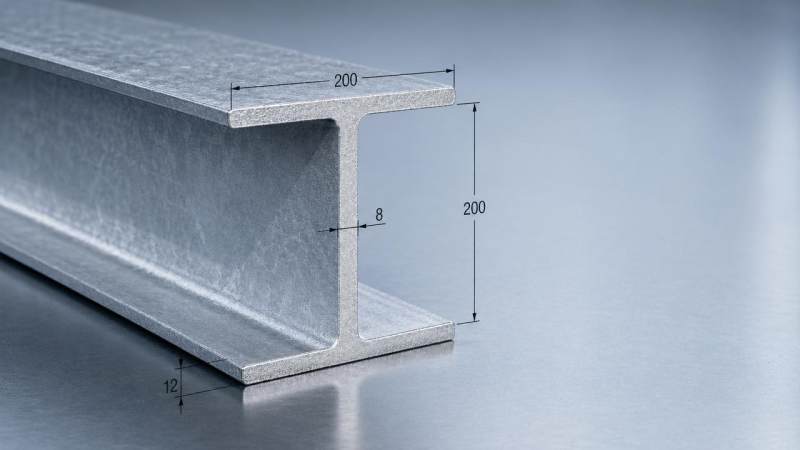
Hot-dip galvanizing adds the most: 45–610 g/m² depending on steel thickness and bath chemistry. For a standard 200×200×8 mm square hollow section (SHS), that translates to ~0.8–1.2 kg per meter—roughly 2.5–4% of the base steel weight. Electro-galvanizing contributes far less (5–30 g/m²), while shop-applied epoxy primers add only 0.1–0.3 kg/m². Fireproofing spray (e.g., intumescent cementitious) can add 5–15 kg/m²—enough to double local section weight in extreme cases.
Crucially, these values assume *uniform coverage*. In practice, internal corners, bolt holes, and welded joints often receive uneven coating—leading to localized mass gain that standard formulas can’t capture. That’s why our engineering team recommends using measured coating thickness (via magnetic gauge or XRF) for final weight verification on critical components—especially for offshore platforms or seismic-resistant structures where dynamic response is sensitive to mass distribution.
When You *Must* Include Coating Mass—And When You Can Safely Exclude It
Include coating mass if your project falls into any of these categories: (1) Logistics planning for sea freight or heavy haul transport; (2) Crane lift planning with tight safety margins; (3) Foundation design where dead load affects overturning or settlement; (4) Compliance with client-specific procurement specs (e.g., certain Middle Eastern EPC contracts require galvanizing mass in Bill of Quantities); (5) Fire-rated assemblies where intumescent coatings are integral to structural performance.
Exclude it—but document the exclusion—if you’re working in early-stage structural modeling, code-checking per AISC 360 or Eurocode 3, or preparing generic supplier RFQs without finalized coating specs. Note: “Excluding” doesn’t mean “forgetting.” Smart procurement teams build a 1.5–3% contingency into weight-based freight quotes specifically to absorb coating variance—especially when sourcing from China, where galvanizing standards (GB/T 13912) permit wider thickness tolerances than ASTM A123.
This is where material traceability matters. At Hongteng Fengda, every batch of Galvanized Pipe ships with certified coating thickness reports, zinc mass per unit area, and adherence to both GB and ASTM coating weight requirements. That transparency lets our global partners decide—confidently—whether to bake coating mass into their final structural steel weight calculation or treat it as a separate line item.
Practical Tips for Accurate Structural Steel Weight Calculation
Start with the right baseline: always use manufacturer-certified dimensional tolerances—not nominal catalog values. A “200×100×9 mm” channel from one mill may weigh 28.7 kg/m; another may be 29.3 kg/m due to rolling tolerance. Hongteng Fengda provides mill test reports (MTRs) showing actual cross-section measurements for every order—critical for high-precision applications like pre-engineered buildings or modular plant modules.
For coated items, apply the “layered mass” method: calculate base steel weight first, then add coating mass separately using verified coating density (zinc = 7.14 g/cm³; epoxy primer ≈ 1.2–1.4 g/cm³). Avoid rule-of-thumb multipliers unless validated for your specific coating process. We’ve seen projects overestimate galvanizing mass by 40% using outdated ASTM A123 Table 1 assumptions—leading to unnecessary oversizing of lifting lugs and transport frames.
Finally, align internally: ensure your design team, procurement team, and logistics provider agree on *which* weight definition applies at each stage—and whether coating is “included,” “excluded but noted,” or “calculated separately.” Misalignment here causes costly rework: one North American infrastructure project delayed installation by 11 days because the site team expected bare-weight deliveries, but the galvanized beams arrived 2.1% heavier than modeled—triggering crane re-certification.
Why This Matters for Global Buyers Sourcing from China
For international buyers, structural steel weight isn’t just about physics—it’s about risk management. Under-declaring weight for customs clearance invites penalties. Over-specifying crane capacity inflates project CAPEX. And inconsistent weight reporting across suppliers makes bid comparison unreliable.
That’s why Hongteng Fengda embeds weight validation into our quality system: all structural steel weight calculations are cross-checked against laser-scanned cross-sections and verified coating thickness data before release. Whether you need ASTM A36 beams for a Dubai data center or EN 10219 cold-formed hollow sections for a German EV battery plant—we deliver weight data calibrated to your use case: design-ready, logistics-optimized, or compliance-certified.
We don’t assume. We measure. And we document—so your structural steel weight calculation reflects reality, not approximation.
Conclusion: Precision Starts with the Right Question
“Does structural steel weight calculation include coating mass?” isn’t a yes/no question—it’s a prompt to clarify scope, responsibility, and consequence. Ignoring coating mass is acceptable in conceptual design—but dangerous in execution. Including it without verification introduces error. The professional approach is contextual awareness: know *why* you need the number, *who* relies on it, and *what tolerance* your application allows.
At Hongteng Fengda, we support that clarity—not with one-size-fits-all answers, but with granular, auditable weight data tailored to your project phase, standard, and supply chain role. Because in structural steel, every kilogram has a purpose—and every gram of uncertainty has a cost.
Please give us a message


Please enter what you want to find