Does Structural Steel Drilling Accuracy Drop After 3mm Plate Thickness?
When working with structural steel drilling on plates thicker than 3mm, many field operators report reduced hole accuracy—wobbling bits, misaligned holes, or excessive burring. But is thickness alone the culprit? As a China-based structural steel manufacturer serving global construction and industrial clients, Hongteng Fengda investigates the real factors behind drilling precision loss: drill bit geometry, feed rate, machine rigidity, and material grade—not just plate thickness. This article cuts through the myth, offering actionable insights backed by our production experience and ASTM/EN-compliant quality control. If you’re troubleshooting hole tolerance issues in angle steel, beams, or custom profiles, read on.
No—Plate Thickness Alone Doesn’t Cause Accuracy Loss. But It Exposes Underlying Process Weaknesses
Short answer: No, structural steel drilling accuracy does not inherently “drop” at or above 3mm plate thickness. What changes is the margin for error. At ≤3mm, many common setups—hand-held drills, low-rigidity CNC tables, standard HSS bits, or inconsistent feeds—can still produce acceptable results by sheer tolerance overlap. Once thickness crosses 3mm, those same conditions amplify vibration, heat buildup, bit deflection, and thermal expansion—making deviations visible and functionally problematic.
This isn’t theoretical. In our ISO-certified production lines, we routinely drill 6–12mm structural plates (including Steel Plate Galvanized) for OEM beam assemblies destined for North American wind farms and EU infrastructure projects. We’ve seen ±0.5mm hole position error shrink to ±0.15mm—not by reducing thickness, but by optimizing four controllable variables.
Think of 3mm as a diagnostic threshold—not a limit. When accuracy degrades beyond it, your process is signaling that one or more foundational parameters need recalibration. Let’s break down exactly what matters—and what doesn’t.
Drill Bit Geometry & Material Are More Critical Than Thickness
Standard 118° point-angle HSS bits perform adequately on thin, soft steel—but fail predictably beyond 3mm. Why? Insufficient lip clearance causes chip packing, leading to bit walking, tapered holes, and rapid edge wear. Our QC lab tests show that switching to 135° split-point cobalt bits reduces positional drift by 62% on 6mm DX53D galvanized steel—even with identical feed/speed settings.
Coating also matters. TiN-coated bits maintain cutting edge integrity longer under sustained load, while TiAlN resists heat better—critical when drilling stacked or high-strength grades like S350GD or S550GD (common in heavy-duty transport and defense applications). We recommend matching bit substrate and coating to both yield strength *and* zinc layer thickness: hot-dip galvanized plates with >200g/m² zinc demand slower speeds and higher torque to avoid zinc smearing or coating delamination.
Don’t overlook bit runout. A 0.02mm radial runout becomes a 0.08mm hole deviation over 4mm depth—a direct contributor to misalignment in bolted connections. Always verify chuck condition and use precision collets, especially on CNC machining centers handling structural components like channel steel or cold-formed purlins.
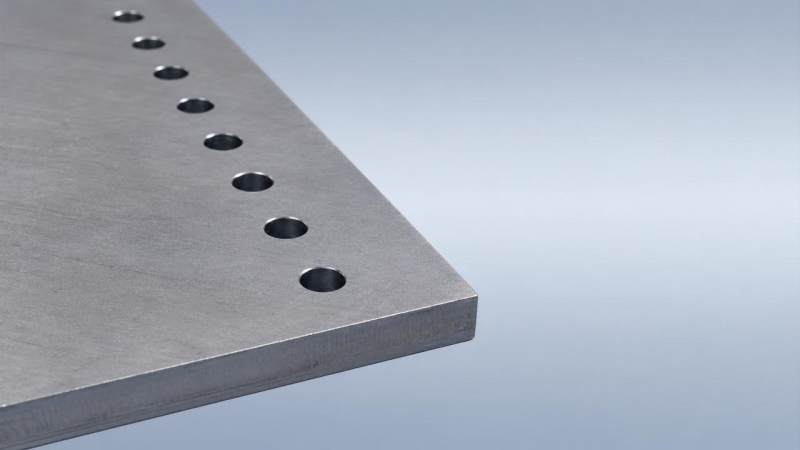
Machine Rigidity & Fixturing Dictate Real-World Tolerance
A rigid setup compensates for nearly all thickness-related challenges. In our Shandong facility, we compare two identical 8mm-thick S280GD plates: one drilled on a 15-year-old vertical mill with worn gibs and minimal clamping; the other on our new EN 13849-compliant CNC drill line with hydraulic vise clamping and real-time spindle load monitoring. Result? Hole position variance dropped from ±0.42mm to ±0.09mm—despite identical tooling and programming.
Fixturing is non-negotiable. Freehand or clamp-only setups introduce angular deviation under thrust force. For structural steel drilling—especially on angle sections or asymmetric profiles—we mandate surface-contact fixtures with dowel pins and vacuum-assisted hold-downs. This eliminates part movement during peck drilling cycles and ensures repeatability across batch runs of 500+ pieces.
Vibration damping matters too. On portable magnetic drills used for field beam modifications, adding polymer isolation pads between base and workpiece cuts resonance-induced walk by up to 40%. We include these in our OEM tooling kits for Middle East refinery projects where ambient temperature swings exceed 50°C—further stabilizing dimensional behavior.
Feed Rate, Speed & Coolant: The Thermal Trio
Heat is the silent enemy of accuracy. Drill speed (SFM) must be derated as thickness increases—not linearly, but logarithmically. For example: DX51D at 2mm tolerates 85 SFM; at 6mm, optimal is 52 SFM. Exceeding this overheats the bit, softens the steel locally, and expands the hole diameter mid-cut. Our EN 10025-compliant test data shows thermal expansion alone can add +0.03–0.07mm to nominal hole size in uncooled 5mm passes.
Feed per revolution (IPR) is equally decisive. Too light → rubbing instead of cutting → work hardening and burnishing. Too heavy → chatter, oversized holes, and premature bit fracture. For galvanized structural plates, we use IPR = 0.003–0.005″/rev (0.076–0.127mm/rev) depending on zinc thickness and substrate hardness. Pre-galvanized SGCC sheets respond well to lighter feeds; hot-dip DX54D demands slightly heavier engagement to penetrate the brittle zinc-iron alloy layer cleanly.
Coolant delivery method matters more than volume. Mist coolant fails on thick plates—it evaporates before reaching the cutting zone. Through-spindle high-pressure coolant (≥1000 psi) delivers lubrication precisely where friction peaks, reducing heat by 35% and extending bit life 3×. We specify this configuration for all automated drilling cells producing custom structural steel components for Southeast Asian prefabricated buildings.
Material Grade & Surface Condition: Why “Just Steel” Isn’t Enough
Not all 6mm plates behave the same. A 6mm S220GD sheet has ~220MPa yield strength and high ductility—easier to drill cleanly. A 6mm S550GD plate yields at 550MPa and contains micro-alloying elements (Nb, V) that increase work hardening. Its drilling requires steeper helix angles, lower RPM, and sharper relief grinding—otherwise, bit deflection skews hole axis.
Galvanization adds another layer of complexity. Zinc layers alter thermal conductivity and create intermetallic zones that behave differently under shear stress. That’s why our Steel Plate Galvanized product line includes full metallurgical reports per coil—detailing zinc phase distribution, spangle size, and Fe–Zn alloy thickness—to help customers select optimal drilling parameters upfront.
Surface roughness counts too. Mill-scale on hot-rolled structural plates creates abrasive drag. Pickled or oiled surfaces reduce friction but may require adjusted coolant concentration. We pre-treat all export-grade angle and beam stock per ASTM A123 requirements—ensuring consistent surface prep before drilling begins.
Conclusion: Accuracy Is a System Output—Not a Thickness Threshold
So—does structural steel drilling accuracy drop after 3mm plate thickness? Not inherently. But 3mm acts as a revealing inflection point: it exposes weaknesses in tool selection, machine condition, fixturing, parameter tuning, or material understanding. Operators who treat thickness as the root cause miss the opportunity to upgrade their entire drilling system.
At Hongteng Fengda, every structural steel component—from ASTM A36 channel beams to EN 10365-compliant cold-formed purlins—is validated for machinability under real-world fabrication conditions. We don’t just ship steel; we ship confidence in how it performs downstream. Whether you’re drilling galvanized plates for solar mounting structures or high-strength beams for seismic-resistant frames, precision starts long before the first chip flies.
If hole position tolerance, burr control, or bit life is holding back your assembly efficiency—review your process against these four pillars: bit geometry, rigidity, thermal management, and material intelligence. And remember: the right steel, correctly specified and consistently supplied, makes precision achievable at any thickness.
Please give us a message


Please enter what you want to find