When operators ask whether 1x19 stainless steel aircraft cable 5/32 inch can bend, the real concern is performance, safety, and long-term reliability in demanding applications.
This cable construction is known for high strength and low stretch, but it is also much stiffer than more flexible wire rope types.
Understanding its bending limits, suitable radius, and proper handling methods helps prevent kinking, fatigue, and premature failure before installation or operation.
Does 1x19 stainless steel aircraft cable 5/32 inch bend in real applications?
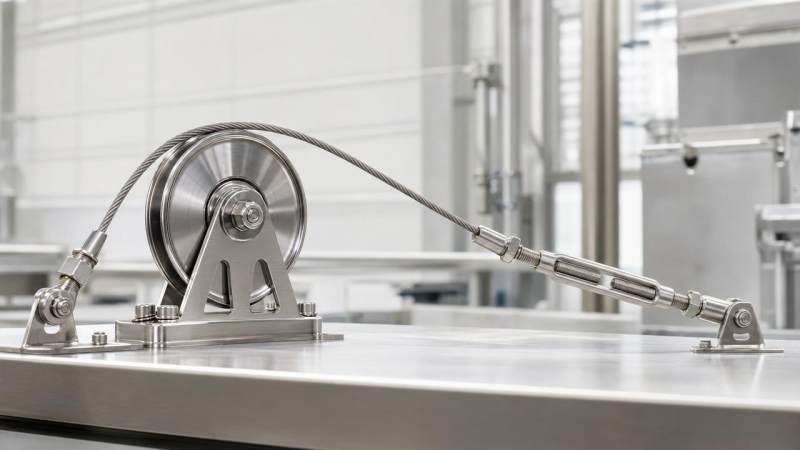
Yes, 1x19 stainless steel aircraft cable 5/32 inch can bend, but it should not be treated like flexible lifting rope.
Its 1x19 structure means one strand contains nineteen wires, creating a compact, rigid, and smooth cable profile.
That structure gives 1x19 stainless steel aircraft cable 5/32 inch excellent tensile performance and low elongation under working loads.
However, the same structure reduces bending flexibility compared with 7x7 or 7x19 stainless aircraft cable.
In practical steel-related assemblies, bending performance depends on radius, load, movement frequency, fittings, and corrosion exposure.
Scenario background: why bending demand changes by use
Bending is not a single requirement. A static architectural cable has different needs from a moving pulley cable.
For 1x19 stainless steel aircraft cable 5/32 inch, the best scenario is usually straight tension or large-radius routing.
If the cable repeatedly flexes around small sheaves, internal wire stress rises quickly and fatigue life decreases.
The 5/32 inch diameter is relatively small, but diameter alone does not make a 1x19 cable highly flexible.
The construction is the main reason 1x19 stainless steel aircraft cable 5/32 inch feels stiff during handling.
Correct scene judgment helps avoid choosing strength while sacrificing service life, safety margin, or installation efficiency.
Architectural railing and balustrade scenarios
Straight cable runs with controlled tension
Cable railing is a common setting for 1x19 stainless steel aircraft cable 5/32 inch because the cable remains mostly straight.
In this scenario, low stretch is useful because the railing stays tight and visually clean after tensioning.
The key judgment point is not whether it can bend slightly through posts.
The key point is whether the hole edges, corner transitions, and end fittings create sharp stress points.
Corners and angled post layouts
For angled railing, 1x19 stainless steel aircraft cable 5/32 inch should use proper corner hardware or gentle routing.
Forcing the cable around a sharp post hole can flatten wires and create hidden fatigue damage.
Where layout includes tight turns, separate cable runs with terminals are usually safer than continuous forced bending.
Marine, outdoor, and corrosion-exposed scenarios
Outdoor use often favors stainless steel because weather resistance matters as much as mechanical strength.
For marine hardware, shade structures, and exterior tension systems, 1x19 stainless steel aircraft cable 5/32 inch performs well when routed correctly.
Bending near fittings deserves special attention because salt, vibration, and cyclic loading can combine into early failure.
Use smooth terminals, proper swage sleeves, and compatible stainless fittings to reduce galvanic risk and local stress.
If movement is expected, inspect contact areas more frequently and avoid any sharp metal edge against the cable.
Industrial tensioning and structural support scenarios
Industrial bracing, signage suspension, guard systems, and light structural restraint often require predictable tension performance.
In these cases, 1x19 stainless steel aircraft cable 5/32 inch is suitable when the load path is direct and stable.
It is less suitable for dynamic hoisting, frequent bending, or small-diameter pulley systems.
The cable should be matched with steel frames, brackets, and end anchors that control alignment accurately.
Hongteng Fengda supports structural steel projects with angle steel, channel steel, beams, and customized profiles for such assemblies.
For adjacent stainless components, 316 Stainless Square steel rod can be considered for fabrication, support, or decorative structures.
Available bar forms include round, hexagon, square, and flat steel, with lengths commonly from 1 to 6 meters.
Surface options include black, bright polished, rough turning, mattness treatment, No. 4, and BA finishes.
Standards such as ASTM, AISI, JIS, GB, DIN, and EN help align procurement with project documentation.
Pulley, control line, and moving cable scenarios
The most common mistake is using 1x19 stainless steel aircraft cable 5/32 inch where repeated bending is unavoidable.
Moving cable systems need high fatigue resistance, not only high breaking strength.
A 7x19 construction is usually more appropriate for pulleys, control lines, and frequent flexing operations.
If 1x19 stainless steel aircraft cable 5/32 inch must pass over a sheave, the sheave diameter should be generous.
A larger D/d ratio reduces bending strain, where D is sheave diameter and d is cable diameter.
Small pulleys, abrupt direction changes, and poor groove geometry should be avoided in any safety-related application.
Different scenario requirements compared
This comparison shows why 1x19 stainless steel aircraft cable 5/32 inch should be selected by scenario, not by diameter alone.
Practical bend radius and handling guidance
There is no universal bend radius for every load case, fitting type, and safety factor.
As a practical rule, larger bend radius is always better for 1x19 stainless steel aircraft cable 5/32 inch.
Avoid hand-forming tight loops, hammering bends, or pulling the cable around square steel edges.
Use thimbles when forming eyes, and make sure the groove supports the cable smoothly.
Do not install cable that shows birdcaging, broken wires, flattening, corrosion pits, or permanent kinks.
A kinked 1x19 stainless steel aircraft cable 5/32 inch has already lost part of its structural integrity.
Recommended installation checks
- Confirm the cable path is straight or uses broad, smooth transitions.
- Match terminals, sleeves, turnbuckles, and anchors to stainless cable size.
- Protect the cable from sharp holes in plates, posts, or brackets.
- Tension gradually, then recheck alignment after initial loading.
- Record inspection intervals for outdoor, marine, or vibrating applications.
Common misjudgments when selecting this cable
One misjudgment is assuming aircraft cable always means flexible cable.
In reality, 1x19 stainless steel aircraft cable 5/32 inch is aircraft-style wire rope with a stiff strand construction.
Another misjudgment is comparing only breaking strength while ignoring fatigue from repeated bending.
A third mistake is using low-quality fittings that damage the wire during crimping or tensioning.
The cable and steel support system must work together, especially in structural or safety-related assemblies.
Hongteng Fengda’s structural steel production experience helps align steel components with international standards and project tolerances.
Scene-based selection advice
Choose 1x19 stainless steel aircraft cable 5/32 inch when the application prioritizes straight tension, clean appearance, and minimal stretch.
Consider 7x7 cable when moderate flexibility is needed and loads are not extremely dynamic.
Consider 7x19 cable when the cable bends repeatedly or passes through pulleys during operation.
For stainless bar, frame, or bracket needs, verify material grade, mechanical properties, finish, and certification before ordering.
The referenced stainless square rod solution offers cold-working hardening potential and formability for multiple industrial fabrication uses.
Next steps for safer bending decisions
Before using 1x19 stainless steel aircraft cable 5/32 inch, define the route, load, movement frequency, environment, and inspection method.
Then select compatible fittings, confirm the bend radius, and avoid any installation method that introduces a permanent kink.
For structural steel assemblies, combine cable decisions with reliable steel brackets, beams, channels, or custom profiles.
Hongteng Fengda provides stable production capacity, international-standard compliance, and customized steel solutions for global construction and industrial projects.
The safest answer is simple: 1x19 stainless steel aircraft cable 5/32 inch bends only within controlled limits and with proper hardware.
Please give us a message


Please enter what you want to find