In reinforced concrete construction, the performance of deformed rebar for concrete depends not only on steel grade but also on rib pattern design. For quality control and safety teams, even small changes in rib geometry can affect bond strength, crack control, and structural reliability. Understanding these differences helps reduce inspection risks, improve compliance, and support safer, more consistent project outcomes.
Why quality and safety teams should assess rib pattern with a checklist mindset
When reviewing deformed rebar for concrete, many inspections focus first on grade, diameter, mill certificate, and heat number. Those are essential, but bond behavior is also strongly influenced by rib height, rib spacing, rib angle, and the uniformity of transverse deformation. In practice, a bar that meets basic strength requirements can still create field issues if its surface geometry does not develop reliable mechanical interlock with concrete.
For quality control personnel, the value of a checklist is speed and consistency. On a project with 3 to 5 bar diameters in circulation, multiple suppliers, and several delivery batches over 4 to 12 weeks, visual similarity can hide meaningful differences. A structured review helps inspectors compare bars by measurable points instead of relying on general appearance alone.
For safety managers, the stakes are broader than material acceptance. Changes in bond strength affect anchorage length, lap splice performance, crack width distribution, and the ability of reinforced concrete to transfer stress under repeated loading. In slabs, beams, columns, retaining elements, and precast parts, weak bond performance can increase repair risk, rework cost, and schedule disruption.
What should be confirmed before deeper evaluation
- Verify the applicable standard, such as ASTM, EN, JIS, or GB, because acceptable deformation geometry may differ by code family.
- Confirm whether the project is governed by cast-in-place, precast, seismic, marine, bridge, or industrial exposure requirements.
- Check whether the design relies on shorter anchorage zones, congested reinforcement, or high-cycle loading, since these conditions make bond behavior more sensitive.
- Review batch consistency across deliveries, especially when orders are split over several production runs or multiple export containers.
This checklist-first approach is especially useful for global sourcing. Structural steel manufacturers and exporters serving North America, Europe, the Middle East, and Southeast Asia often ship products aligned with more than one standard system. That means inspection teams should not assume one rib profile is interchangeable with another simply because nominal diameter and yield strength appear similar.
Core inspection checklist: the rib pattern factors that most affect bond strength
The most practical way to assess deformed rebar for concrete is to break rib pattern evaluation into observable and documentable checkpoints. This supports incoming inspection, vendor approval, and site-level material release decisions. The goal is not to replace laboratory testing, but to identify whether the surface deformation is likely to deliver stable bond performance under project conditions.
The table below summarizes the most important geometric features and why they matter. For quality and safety teams, it can serve as a quick screening tool during supplier qualification or batch comparison. If one or more items show irregularity, the batch should move to a higher review level before installation.
In most inspection workflows, these five items should be checked at three levels: document review, visual verification, and dimensional sampling. A practical sampling approach may involve at least 3 bars per diameter per batch, especially for imported material or first-time suppliers. If the project has high structural sensitivity, that number may increase based on the owner’s quality plan.
Fast screening checklist for incoming material
- Match bar markings, diameter, and mill documentation with the purchase specification.
- Compare surface deformation visually against approved reference samples or prior accepted batches.
- Measure selected rib dimensions if the bar source, standard, or production lot has changed.
- Check for rolling defects, flattening, excessive scale, or local damage that may alter rib engagement.
- Escalate for engineering review when rib geometry looks inconsistent across the same nominal size.
A useful rule for field judgment
If inspectors can see noticeable rib pattern differences from 1 to 2 meters away between bars labeled as the same size and standard, the variation is probably significant enough to document. That does not automatically mean rejection, but it is a strong signal that bond-related performance should not be assumed equivalent without further review.
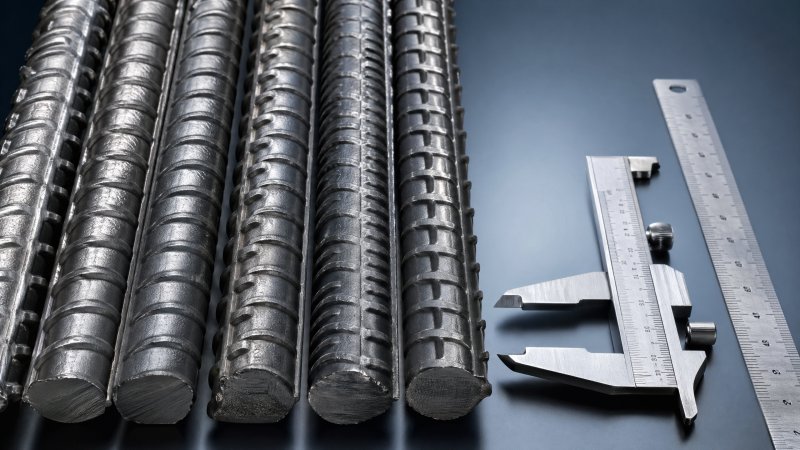
This is also where supplier discipline matters. A manufacturer with modern rolling control and stable quality procedures is generally better positioned to maintain consistent deformation geometry over repeated export orders, reducing the likelihood of mixed field behavior between early and later deliveries.
How rib pattern changes affect different project scenarios
Not every project reacts to rib pattern variation in the same way. Quality control and safety teams should prioritize review where bond reserve is limited or where repair access is difficult after concrete placement. In simple foundations with generous development lengths, minor differences may be less critical. In congested or highly stressed members, they become much more important.
The following comparison helps determine where deformed rebar for concrete requires stricter scrutiny. It is especially useful during preconstruction planning, supplier approval, and hold-point definition. Teams can use it to decide where more sampling, closer receiving inspection, or additional engineering sign-off is justified.
A useful planning threshold is to flag any member where development or splice length is already optimized for congestion or space savings. In those cases, even small changes in bond performance can alter the practical safety margin. This does not mean every variation causes failure, but it does mean less room for complacency in receiving and placement control.
Supplementary material note for mixed-material projects
Some industrial and manufacturing projects source both carbon steel reinforcement and corrosion-resistant flat products for equipment, enclosures, or process-contact parts. In that context, buyers may also evaluate materials such as 304 Stainless Steel Coil for applications including chemical equipment, food processing components, transport equipment, and high-temperature service areas. Typical data for 304 grade include tensile strength of at least 520 MPa, yield strength of at least 275 MPa, elongation around 55% to 60%, and common thickness ranges from 2.5 mm to 10.0 mm.
While that product serves different functions from reinforcing bar, the procurement lesson is similar: surface condition, dimensional consistency, and standard compliance all matter to downstream safety and performance. For multi-package sourcing, coordinated quality review across steel categories can reduce mismatch risk, especially when delivery windows are compressed into 6 to 10 weeks.
For global buyers, working with a supplier that understands ASTM, EN, JIS, and GB requirements across structural steel products can simplify technical communication. That is particularly valuable when the project team must align inspection records, shipping documents, and acceptance criteria across more than one material family.
Common oversight points that can weaken bond performance in the field
Even when deformed rebar for concrete is procured correctly, field conditions can reduce the intended benefit of its rib pattern. Quality control teams should not limit their review to bar geometry alone. Storage, handling, fabrication, and placement all influence whether the designed bond performance is achieved after concrete is poured and cured.
The most common mistake is assuming that visible deformations automatically guarantee good bond. In reality, heavily damaged ribs, oily contamination, severe scaling, or aggressive re-bending can compromise the contact mechanism between bar and concrete. Another issue is mixing accepted and unverified batches in one pour sequence, making traceability difficult if a defect appears later.
A second overlooked issue is concrete quality around the bar. Poor consolidation, honeycombing, excessive water, or inadequate cover can negate the advantages of a well-designed rib pattern. Bond is a system outcome, not a steel-only outcome. For this reason, safety managers should connect rebar inspection records with placement and concrete quality logs.
Frequent field risks to add to inspection reports
- Bars stored outdoors for long periods without separation from mud, standing water, or contaminants.
- Bundles with mixed rolling dates or unclear identification after partial use on site.
- Cutting and bending practices that create local rib flattening near hooks, laps, or anchors.
- Concrete placement in congested reinforcement zones without adequate vibration access.
- Substitution of one rib pattern source for another without documented engineering confirmation.
When should a batch be escalated?
Escalation is advisable when any of the following occurs: visible geometry inconsistency within the same nominal diameter, mismatch between documentation and bar markings, signs of rolling defects in more than a few sampled bars, or project conditions that depend on reduced splice lengths or high confinement efficiency. A 24-hour review delay is often less costly than structural rework after placement.
For imported steel, escalation is also reasonable when the first shipment of a new source arrives, when the supplier changes rolling equipment, or when batch traceability is incomplete. These are routine controls, not signs of distrust. They help preserve installation quality and protect project teams from hidden variability.
Execution guide: how to build a reliable acceptance process for deformed rebar for concrete
The most effective acceptance process combines pre-order alignment, receiving inspection, and feedback to the supplier. For quality control and safety teams, the objective is to create a repeatable workflow that catches rib pattern concerns early, documents decisions clearly, and supports fast release when material is compliant. This is especially important on projects receiving steel over multiple shipments.
A practical process usually starts before purchase. The buyer should define the governing standard, diameter range, intended application, required documentation, and whether visual rib profile comparison samples are needed. If the job includes seismic, bridge, precast, or corrosion-sensitive structures, those conditions should be stated before production rather than after the first delivery reaches site.
After arrival, receiving teams should use a short release checklist. It should take 15 to 30 minutes per batch for basic review, with longer time reserved only for exceptions. This keeps the process efficient while still protecting structural performance.
Recommended acceptance workflow
- Confirm the purchase order, standard, diameter schedule, and mill documentation against the shipment.
- Inspect bar markings, bundle tags, and traceability details before unloading into mixed storage areas.
- Perform visual rib pattern comparison on sampled bars from each diameter and heat or lot.
- Measure selected deformation features if the source is new or if visible differences exist.
- Document findings with photos, measurements, and release status for future audits and dispute prevention.
- Communicate any deviation immediately to procurement, engineering, and the supplier to avoid unapproved installation.
Why supplier capability matters
A dependable structural steel manufacturer and exporter can reduce inspection burden by providing stable production, consistent rolling quality, and documentation that aligns with project requirements. For buyers managing international supply, this matters just as much as price. Late clarifications, mixed lots, or variable deformation patterns can cost more than the initial savings from loosely controlled sourcing.
Hongteng Fengda supports global construction, industrial, and manufacturing projects with structural steel products and customized solutions. With experience serving North America, Europe, the Middle East, and Southeast Asia, the company focuses on stable production capacity, quality control, and dependable lead times. For project teams, that means a better starting point for controlling sourcing risk and keeping acceptance procedures practical.
For deformed rebar for concrete and related structural steel procurement, the strongest results usually come from early technical alignment. That includes confirming standard requirements, inspection points, expected delivery schedule, and any project-specific concerns before manufacturing begins. When those points are clear, QC and safety teams can spend less time resolving avoidable issues after shipment.
Why choose us and what to confirm before you contact us
If your team is reviewing deformed rebar for concrete, the most useful next step is not a generic inquiry but a technical one. A productive discussion should cover bar standard, diameter range, project application, inspection expectations, delivery destination, and whether you need standard supply or customized support. This helps reduce back-and-forth and improves quotation accuracy within the first 1 to 3 business days.
Why choose us: we understand that global buyers need more than steel supply alone. They need consistency across batches, support for ASTM, EN, JIS, and GB-oriented requirements, realistic lead-time coordination, and clear communication on product details. As a China-based structural steel manufacturer and exporter, Hongteng Fengda helps customers control sourcing risk, compare specifications efficiently, and prepare for smoother project execution.
Contact us if you need support with parameter confirmation, product selection, rib pattern review points, delivery cycle planning, customized structural steel solutions, certification requirement discussion, sample support, or quotation communication. If you send your target standard, required sizes, estimated tonnage, destination port, and inspection checklist, we can help you evaluate the most suitable supply approach for your project.
Please give us a message


Please enter what you want to find