DX53D Galvalume Steel Coil is a practical choice for forming because it is designed for better ductility than more general structural grades. In real production, the main changes are not mysterious: the material’s shape changes, local coating stress increases, edge exposure becomes more important, and the final balance between formability, corrosion resistance, and cost depends heavily on bend radius, tooling condition, coating mass, and the service environment. For buyers comparing DX53D Galvalume Steel Coil with AZ150 Galvalume Steel Coil or other imported steel products from China, the key question is simple: will it form reliably without creating downstream quality or corrosion problems? In most cases, the answer is yes—if the grade, coating class, and process route are matched to the application instead of chosen on price alone.
What buyers and processors really need to know before choosing DX53D for forming
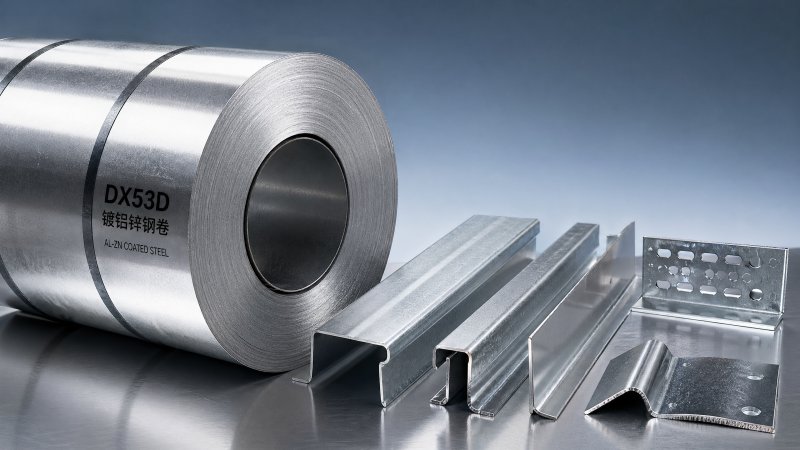
The core search intent behind this topic is usually decision-focused. Readers are not only asking what DX53D Galvalume Steel Coil is, but what actually changes when it goes through bending, roll forming, stamping, or light drawing—and whether those changes affect service life, appearance, rejection rate, or total sourcing cost.
For most target readers, the biggest concerns are:
- Formability: Can the coil handle shaping without cracking, surface damage, or unstable dimensions?
- Coating behavior: Will the aluminum-zinc coating remain protective after forming, especially at bends and cut edges?
- Consistency: Is the material stable enough for batch production with low scrap rates?
- Cost control: Does a more formable grade reduce downstream losses enough to justify the specification?
- Application fit: Is DX53D better than a higher coating class, another metallic coating, or even a different product category?
That means the most useful way to assess DX53D Galvalume Steel Coil is through processing performance, risk points, and purchasing criteria—not through generic steel definitions.
What actually changes when DX53D Galvalume Steel Coil is formed
During forming, several material and surface-level changes happen at the same time:
- The steel substrate deforms as it is bent, drawn, or profiled.
- The coating stretches on outer radii and compresses on inner radii.
- Residual stress increases in shaped areas, especially around tight bends, deep ribs, corners, and punched zones.
- Edge condition becomes more critical after slitting, punching, or cutting.
- Appearance can change if tooling friction, lubrication, or roll alignment is poor.
These changes do not automatically mean failure. They simply mean that formed parts should be judged by realistic performance criteria: no harmful substrate cracking, acceptable coating integrity, controlled springback, consistent profile geometry, and corrosion resistance suited to the final environment.
Compared with less formable grades, DX53D is typically selected because it offers a better processing window. That matters for roofing accessories, wall systems, lightweight profiles, ventilation parts, and other applications where repeated forming consistency affects production efficiency.
How DX53D differs from general Galvalume grades in forming performance
The “DX” designation generally indicates a grade intended for forming applications. In practical terms, DX53D is commonly chosen where the material must tolerate more demanding shaping than a basic structural or commercial quality sheet.
What this usually means for users:
- Better elongation behavior for bends and shaped sections
- Lower risk of forming-related cracking when process conditions are correct
- More stable results in roll forming for profiles with multiple passes
- Improved suitability for tighter geometries compared with less ductile alternatives
However, buyers should avoid a common mistake: assuming that a more formable substrate solves every issue. If bend radii are too tight, dies are worn, surface friction is high, or cut-edge exposure is severe in a corrosive environment, even a suitable grade can still produce problems. Material selection and process control must work together.
Does the coating lose corrosion resistance after bending or profiling?
This is one of the most important questions for quality teams and project buyers. In normal, well-controlled forming, the Galvalume coating does not simply “stop working” after bending. But its condition changes locally, and those local changes matter.
Key points to understand:
- Outer bend areas experience coating tension. Excessive deformation can create micro-stress in the coating layer.
- Inner bend areas experience compression, which can also affect surface appearance depending on the process.
- Cut edges and punched holes are often more vulnerable than flat coated surfaces.
- Storage and installation conditions can accelerate staining or premature corrosion if formed parts stay wet or contaminated.
So the better question is not whether forming changes the coating—it does—but whether the change remains within acceptable performance limits for the intended use. For many building and industrial applications, the answer is yes when the forming severity is appropriate and post-processing handling is correct.
If a project involves marine exposure, aggressive industrial atmospheres, or heavily exposed cut edges, buyers should review coating mass, design details, drainage, and possible supplementary protection rather than focusing only on the base grade name.
DX53D vs AZ150 Galvalume Steel Coil: which matters more, grade or coating mass?
Many sourcing decisions get confused because buyers compare grade and coating class as if they were the same thing. They are not.
- DX53D mainly refers to the steel grade and its formability characteristics.
- AZ150 usually refers to coating mass, which is closely related to corrosion protection performance.
So when comparing DX53D Galvalume Steel Coil with AZ150 Galvalume Steel Coil, the real comparison should be clarified first:
- Are you comparing formability?
- Are you comparing corrosion resistance?
- Are you comparing price per ton or life-cycle cost?
For example, a buyer may need a highly formable substrate for roll-formed sections while also requiring a stronger coating class for outdoor durability. In that case, the right solution may be DX53D with a specified AZ coating mass, not one or the other.
This is exactly why technical clarification before ordering matters. A low initial price can become expensive if poor forming causes scrap, rework, tool adjustment, slower production, or field complaints.
What processing risks should factories and project teams watch for?
If the goal is dependable forming, these are the risk points that matter most in production and acceptance:
- Bend radius too small: increases stress on both substrate and coating.
- Poor roll tooling or die wear: can mark the surface and create unstable dimensions.
- Improper lubrication: raises friction and surface damage risk.
- Coil flatness issues: may affect profile accuracy and line stability.
- Overly aggressive punching or cutting: can worsen edge quality.
- Improper storage after forming: trapped moisture may lead to staining or corrosion initiation.
For procurement teams, this means supplier evaluation should include more than basic certification. Ask about process capability, coating uniformity, thickness tolerance, slitting quality, packing method, and export protection. Those details directly affect whether the coil performs well once it reaches the forming line.
How to evaluate supplier reliability when sourcing from China
For international buyers, the best sourcing decisions usually come from combining commercial review with technical review. A reliable Chinese steel supplier should be able to support both.
Useful checkpoints include:
- Standards compliance: ASTM, EN, JIS, or GB according to project needs
- Mechanical property consistency: especially for forming-sensitive applications
- Coating control: verified coating mass and surface condition
- Export experience: packaging, lead time control, and documentation accuracy
- Customization ability: width, thickness, slitting, and OEM requirements
- Quality traceability: mill test documentation and inspection support
In some projects, buyers also compare metallic-coated coil with other corrosion-resistant material options used in plant systems, architectural features, or auxiliary fabrication. For example, where tubing, water systems, or process equipment are involved, teams may also consider stainless products such as 201 Stainless steel pipe. That product is used across construction, auto parts, food processing, water treatment, and chemical-related applications, with features such as corrosion resistance, smooth surface, toughness, and tensile strength of ≥ 520MPa. This does not replace Galvalume coil in forming applications, but it shows why material selection should follow actual service conditions and fabrication needs rather than category assumptions.
When is DX53D Galvalume Steel Coil the right choice?
DX53D is typically a strong choice when the project requires:
- Good formability for bends, ribs, channels, or light profiles
- Metallic-coated corrosion resistance for building or industrial use
- Stable large-batch processing with controlled rejection rates
- A balanced solution between performance and cost
It may be less ideal if the application involves extremely aggressive corrosion conditions, severe deep drawing beyond the material’s practical range, or a need for a completely different material system. In those cases, buyers should reassess coating class, substrate grade, and possibly alternative materials.
Final decision guide: what should matter most in your purchase?
If you are evaluating DX53D Galvalume Steel Coil for forming, focus on this order of priority:
- Define the forming severity — bend radius, profile complexity, punching, drawing, and line speed.
- Match the steel grade to the forming need — this is where DX53D becomes relevant.
- Match the coating mass to the service environment — this is where AZ class matters.
- Verify supplier process consistency — tolerance, coating quality, packaging, and documentation.
- Consider total cost, not just coil price — scrap, downtime, rework, and service risk often cost more than the material difference.
In short, what changes during forming is not just the shape of the steel. The coating stress state, edge exposure, production risk, and long-term value also change. DX53D Galvalume Steel Coil is often the right answer when forming reliability matters, but only when buyers specify it correctly and source it from a supplier that can deliver consistent quality. For procurement teams, engineers, and project managers, that is the real basis for a sound decision.
Please give us a message


Please enter what you want to find