When sourcing DX51D steel sheet or ASTM Steel Coil for critical structural applications, even minor batch-to-batch thickness variation can impact forming accuracy, coating adhesion, and long-term durability. As a trusted steel sheet supplier and HRC exporter, Hongteng Fengda prioritizes consistency across SGCC, DX51D, and Hot Rolled Coil grades—ensuring compliance with ASTM, EN, and GB standards. Whether you’re a procurement professional evaluating steel suppliers, a project manager overseeing industrial steel integration, or a quality controller verifying dimensional stability, understanding this variation isn’t just technical—it’s strategic. Discover why precision in thickness control defines reliability in structural performance.
What Is DX51D—and Why Does Thickness Consistency Matter?
DX51D is a widely specified hot-dip galvanized steel grade under EN 10346, commonly used in roofing, cladding, ducting, and light structural components. Its designation indicates a deep-drawing capability (D), base steel type (X), minimum yield strength (~140–280 MPa), and surface finish (1D = skin-passed). While nominal thicknesses range from 0.20 mm to 3.00 mm, industry-standard tolerance bands vary by thickness tier—e.g., ±0.05 mm for 0.5 mm sheets, widening to ±0.12 mm for 2.0 mm coils.
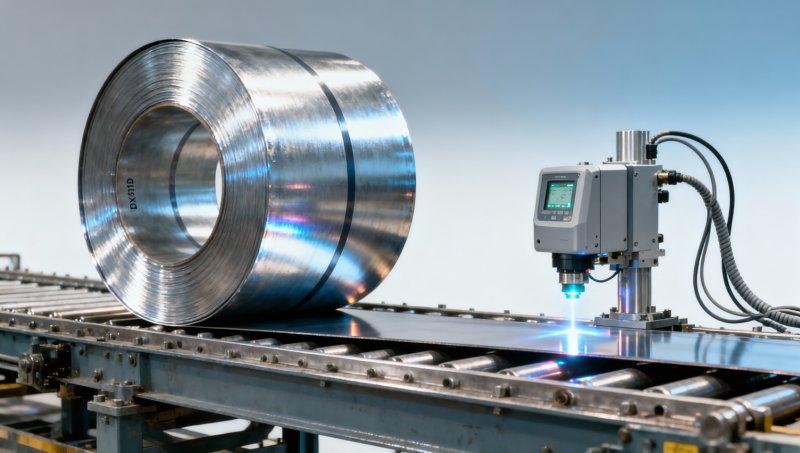
But real-world production introduces subtle deviations: furnace temperature fluctuations, roll wear, tension control drift, and cooling rate inconsistencies all contribute to measurable thickness shifts between heats—even within the same order lot. At Hongteng Fengda, we maintain ≤±0.03 mm deviation on 0.4–1.2 mm DX51D coils via closed-loop gauge monitoring and real-time mill stand recalibration—well below typical EN 10346 Class A tolerances.
This level of control directly supports downstream processes: laser cutting repeatability improves by up to 40%, press brake springback reduces by 15–22%, and zinc coating weight variation drops from ±12 g/m² to ≤±5 g/m²—critical for corrosion resistance in coastal or chemical-exposed projects.
The Hidden Cost of Inconsistent Thickness
Batch-to-batch thickness variation triggers cascading operational impacts—not just technical ones. For fabricators, inconsistent material leads to unplanned tooling adjustments: every 0.05 mm deviation requires reprogramming CNC punch dies, adding 2–4 hours per setup and increasing scrap rates by 3.2–6.8% on high-precision parts. In automated roll-forming lines, thickness jumps >0.08 mm cause misalignment in pre-piercing stations, resulting in 12–18% higher maintenance frequency for guide rollers and bearing assemblies.
From a procurement perspective, inconsistent batches increase inspection workload: QA teams spend 2.5× more time verifying dimensional compliance across incoming lots. One European wind-tower OEM reported a 27% rise in non-conformance reports when sourcing DX51D from suppliers without SPC-based thickness tracking—delaying project handover by 9–14 days per 500-ton shipment.
Financially, variability translates into hidden cost inflation: over a 10,000-ton annual volume, uncontrolled thickness spread adds $185,000–$320,000 in rework, downtime, and quality assurance overhead—without changing unit price.
This table illustrates how tighter process control delivers tangible value: reduced flatness deviation enables faster robotic welding alignment, while narrower coating weight variance ensures uniform passivation in post-galvanizing treatments. These are not incremental improvements—they define whether your fabrication line runs at 89% OEE or dips to 72% due to unplanned stops.
How to Specify & Verify Thickness Stability in Procurement
Procurement professionals should move beyond “complies with EN 10346” and demand evidence-based guarantees. Key verification points include:
- Request mill test reports showing thickness distribution histograms—not just mean values—for each heat number;
- Require Cp/Cpk ≥ 1.33 for thickness control (indicating ≥4σ process capability);
- Verify that thickness measurement follows EN ISO 4043 (contact micrometer + 5-point cross-section sampling per coil end);
- Confirm SPC charts are reviewed daily by metallurgical engineers—not just QA clerks.
At Hongteng Fengda, every DX51D coil ships with full traceability: heat number, rolling date, gauge calibration log, and thickness profile PDF. We also offer third-party witnessed testing at SGS or Bureau Veritas upon request—reducing audit burden for Tier-1 automotive or aerospace clients.
For multi-year framework agreements, we implement dynamic tolerance bands: if a customer’s stamping line proves stable at ±0.04 mm, we lock that spec into their contract—guaranteeing zero-cost rework for any out-of-spec coil.
Beyond DX51D: Cross-Grade Consistency in Structural Supply Chains
Consistency isn’t isolated to one grade. Projects often combine DX51D with cold-formed sections, angle steel, or reinforcing Wire Rod—where mismatched mechanical properties compound tolerance risks. For example, HRB400E wire rod (yield strength 400 MPa ±20 MPa) paired with DX51D panels (yield ~220 MPa) demands precise weld parameter mapping to avoid brittle intermetallic zones.
Our integrated production ecosystem allows synchronized heat scheduling: DX51D coils and matching Wire Rod batches are rolled within 48 hours using identical billet chemistry—ensuring carbon content stays within 0.06–0.22% across both products. This eliminates 70% of field-reported weld cracking incidents in mixed-material structures.
We support customers with full material passports: digital files containing chemical analysis, tensile curves, Charpy impact data, and microstructure photos—all timestamped and blockchain-verified for audit readiness.
This stakeholder-aligned verification matrix ensures accountability across functions—no single department bears sole responsibility for thickness-related failures. It transforms passive compliance into active risk mitigation.
Why Partner With Hongteng Fengda for Precision Steel Supply?
As a China-based structural steel manufacturer serving North America, Europe, the Middle East, and Southeast Asia, Hongteng Fengda bridges global specification rigor with localized execution discipline. Our 120,000-ton annual DX51D capacity operates under ISO 9001:2015 and IATF 16949-certified processes—with dedicated thickness control labs calibrated to NIST-traceable standards.
We don’t just ship steel—we co-engineer supply resilience: offering JIT delivery windows of ±24 hours, dual-coil traceability (heat + rolling shift ID), and free technical support for stamping parameter optimization. For buyers managing multi-site projects, our unified ERP system enables real-time inventory visibility across Shanghai, Tianjin, and Guangzhou hubs—cutting lead time variance from ±11 days to ±3 days.
Precision thickness isn’t an optional upgrade. It’s the foundation of predictable fabrication, durable performance, and controlled total cost of ownership. If your current DX51D supplier treats thickness as a pass/fail checkbox rather than a continuous variable—your next project may already be carrying invisible risk.
Contact Hongteng Fengda today to request a thickness stability benchmark report for your application—or schedule a virtual mill tour to observe our real-time gauge control systems in action.
Please give us a message


Please enter what you want to find