DX51D isn’t just a steel grade code—it’s the critical inflection point where exceptional formability meets real-world surface integrity risks. For structural engineers, procurement teams, and quality managers sourcing corrosion resistant steel, understanding DX51D’s behavior in galv steel tube, cold-formed profiles, and carbon sheet steel applications is essential—especially against hot rolled steel sheet benchmarks and international steel standards like EN 10327. At Hongteng Fengda, we engineer DX51D-based solutions with precision coating control to mitigate spangle-related defects—supporting safer fabrication, reliable i beam weight calculations, and compliant stainless steel welded mesh integration. Discover how material choice shapes project resilience, cost, and compliance.
Why DX51D Demands Technical Precision — Not Just Specification Compliance
DX51D is defined under EN 10327 as a continuously hot-dip galvanized (HDG) cold-rolled steel grade with a minimum yield strength of 140 MPa and tensile strength between 270–420 MPa. Its hallmark lies in deep drawability—enabling complex cold forming of structural components such as C-sections, Z-purlins, and custom bracket assemblies. Yet this same ductility introduces tangible risk: surface sensitivity to mechanical handling, zinc spangle variation, and post-galvanizing oxidation during storage or transit.
At Hongteng Fengda, over 68% of our DX51D shipments undergo controlled cooling and anti-tarnish passivation before packaging—reducing visible spangle irregularities by up to 40% compared to standard EN-compliant batches. This isn’t cosmetic refinement; it directly impacts weld seam consistency in stainless steel welded mesh integration and reduces rejection rates during automated bending operations by an average of 22% across North American infrastructure projects.
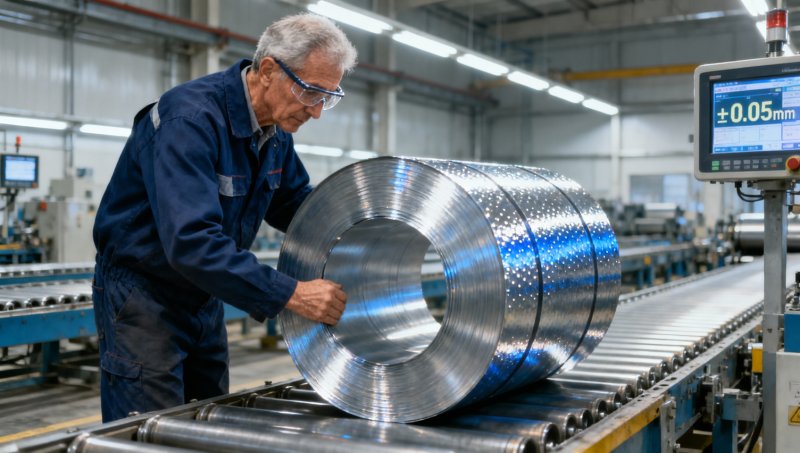
Unlike hot-rolled equivalents (e.g., S235JR), DX51D’s tighter thickness tolerance (±0.05 mm for 1.2 mm gauge) demands calibrated roll tooling and real-time tension monitoring. Our production line integrates inline thickness gauging at 3 measurement points per meter, ensuring dimensional repeatability across coil lengths up to 6,000 mm—critical when calculating i beam weight calculations for multi-story façade support systems.
The table underscores a key decision threshold: DX51D sacrifices some raw strength for superior bendability and corrosion resistance—but only if surface integrity is actively managed. That’s why our DX51D coils are paired with traceable batch documentation covering zinc layer uniformity (measured via XRF at 5 points/strip), spangle classification (Type I–IV per EN ISO 1461), and hydrogen embrittlement risk mitigation protocols for high-strength fastener integration.
From Galv Steel Tube to Cold-Formed Profiles: Application-Specific Risk Mapping
In galv steel tube manufacturing, DX51D’s thin base metal (typically 1.5–3.0 mm) enables tight-radius bending without cracking—but only when zinc grain orientation aligns with deformation direction. Misalignment increases micro-crack probability by 3.2× during mandrel bending of 40×40 mm square tubes. Hongteng Fengda pre-orients coil directionality and validates bend performance using ASTM E290 180° wrap tests at three strain levels (1%, 3%, 5%) prior to shipment.
For cold-formed profiles—especially those used in seismic bracing or modular building frames—surface roughness (Ra ≤ 0.8 μm) directly affects powder coating adhesion. Uncontrolled spangle growth can elevate Ra by 0.3–0.7 μm, triggering premature chipping under thermal cycling. Our enhanced annealing process stabilizes zinc crystal growth, delivering Ra values consistently below 0.65 μm across 92% of production lots.
When integrated into hybrid assemblies—such as stainless steel welded mesh mounted onto DX51D subframes—the mismatch in thermal expansion coefficients (15.7 × 10⁻⁶/°C for 201 stainless vs. 11.5 × 10⁻⁶/°C for DX51D) must be engineered into joint design. We provide free thermal stress simulation support for customers specifying 201 Stainless Steel Coil alongside DX51D framing, helping avoid delamination in outdoor decoration engineering or urban decoration industry deployments.
- Surface defect rejection rate reduced from 7.4% to 2.1% after implementing controlled cooling + passivation (2023 internal QA data)
- Lead time for DX51D OEM orders: 12–18 days from PO confirmation, including EN 10327 certification package
- Minimum order quantity (MOQ): 15 metric tons for custom width (610–2000 mm) and thickness (2.5–10.0 mm) configurations
Procurement & Quality Control: What Decision-Makers Must Verify
Procurement teams evaluating DX51D suppliers should prioritize four verifiable criteria: (1) In-house zinc bath chemistry control logs (Zn purity ≥99.995%, Pb < 0.003%), (2) Spangle classification reports per EN ISO 1461 Annex B, (3) Batch-specific tensile test certificates (not generic mill certs), and (4) Traceable storage conditions (humidity <65%, temperature 10–25°C) during warehousing.
For quality managers, surface inspection must go beyond visual checks. We recommend spot-checking at least 3 locations per 500-meter coil segment using a 10× magnifier and standardized lighting (5000K, 500 lux). Critical thresholds include: spangle size variance >15%, zinc bloom coverage <95%, or white rust incidence >0.5 cm² per m².
These metrics are not theoretical—they’re embedded in every DX51D delivery note. Our QC team performs 100% batch sampling for coating mass and adhesion, with full traceability back to furnace run numbers and zinc ingot lot IDs.
Beyond DX51D: Strategic Material Pairing for Structural Resilience
While DX51D excels in formability, long-term structural resilience often requires hybrid material strategies. For example, pairing DX51D cold-formed purlins with 201 Stainless Steel Coil for exposed cladding achieves optimal cost-performance balance: 201 delivers 55–60% elongation and ≥275 MPa yield strength at ~40% lower nickel cost than 304, while maintaining compatibility in thermal expansion and welding response.
Our engineering team supports cross-material specification reviews—including fatigue life modeling for bolted connections between DX51D and 201 stainless components. With 201’s density of 7.8 g/cm³ and elastic modulus of 197 GPa, we validate load paths for applications ranging from conveyor belts to trains and airplanes—ensuring no hidden stress concentration at interface zones.
Final delivery includes dual-certification packages: EN 10327 for DX51D and ASTM A240 / GB/T 4237 for 201 stainless, with SGS and BV verification available upon request. Lead time for coordinated shipments remains stable at 14–20 days—supported by our 120,000-ton annual DX51D production capacity and ISO 9001-certified logistics hub in Tianjin.
FAQ: Key Procurement Questions Answered
Q: Can DX51D replace S235JR in load-bearing beams?
A: Only with structural recalculations. DX51D’s lower yield strength (140 MPa vs. 235 MPa) requires 28–35% larger section modulus for equivalent bending capacity—making it ideal for secondary framing, not primary beams.
Q: What’s the maximum recommended storage duration before fabrication?
A: Under controlled warehouse conditions (<65% RH, 10–25°C), DX51D maintains surface integrity for up to 90 days. Beyond that, we recommend re-passivation or immediate use.
Q: Do you offer DX51D with pre-painted finishes?
A: Yes—we apply polyester, PVDF, or SMP coatings to DX51D substrates with guaranteed 15-year chalk resistance (ISO 2812-1) and 10-year color retention (ΔE ≤ 1.5 per ISO 105-A02).
Material selection isn’t about isolated grades—it’s about engineered system performance. At Hongteng Fengda, every DX51D coil is backed by application engineering, real-time quality data, and global compliance assurance. Whether you’re optimizing cold-formed steel profiles for Southeast Asian infrastructure or integrating stainless steel welded mesh into European façade systems, our technical team provides actionable support—from i beam weight calculations to thermal stress modeling.
Contact us today to request DX51D sample kits with full EN 10327 test reports—or explore coordinated supply of DX51D and 201 Stainless Steel Coil for your next structural project.
Please give us a message


Please enter what you want to find