Many people only start asking detailed questions about roofing steel after a problem shows up on site. A sheet that looked fine in a quotation may turn out to be harder to bend than expected, lighter in coating than the environment requires, or unclear in grade marking. In roofing work, those small misunderstandings do not stay small for long. They can affect service life, installation speed, appearance, and even whether the sheet performs well around overlaps, screws, ridges, and drainage points.
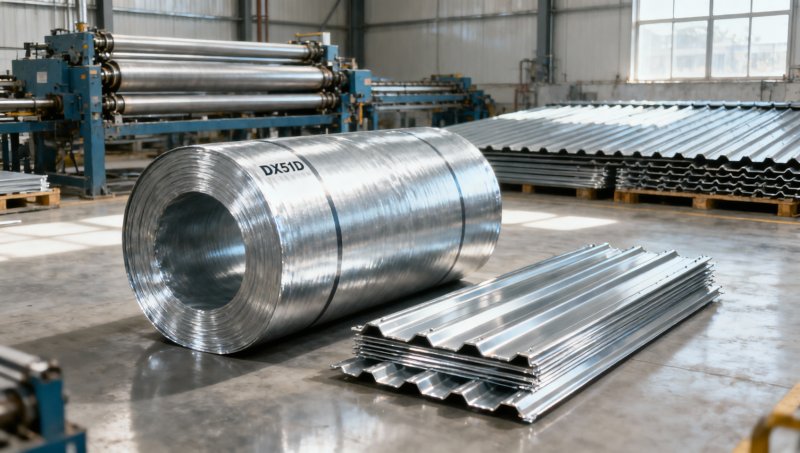
A common situation is this: someone is comparing a DX51D galvanized sheet for roofing sheet applications and sees similar-looking offers with different coating codes, thickness tolerances, and processing notes. On paper, everything seems close enough. But roofing is exposed work. Sun, rain, condensation, and forming stress all act on the same material. If you are still at the research stage, it helps to sort out the basics before comparing suppliers or asking for samples.
Where the confusion usually starts
People often assume that “galvanized roofing sheet” is a simple category and that all they need is thickness and price. That is where selection becomes risky. The steel grade, zinc coating mass, base metal thickness, surface condition, and forming suitability all matter together. A roofing sheet is not only a flat product; it becomes a profiled, fastened, weather-exposed component. Material choice should reflect that actual use.
DX51D is widely recognized as a forming grade in galvanized steel. In practical terms, it is generally chosen where the sheet needs to be bent, roll formed, corrugated, or shaped into roofing profiles without cracking during normal fabrication. That does not mean every DX51D offer is automatically the same. Coating class, substrate quality, surface finish, and delivery condition still influence how the material behaves in production and service.
DX51D is more about forming behavior than marketing labels
One of the more useful ways to understand DX51D is to separate grade from coating. The grade refers to the base steel’s suitability for forming. For roofing, that matters because the sheet is rarely left flat. It may go through roll forming lines, edge trimming, rib shaping, or local bending around details. A grade with appropriate formability helps reduce the risk of edge fracture, surface damage during shaping, and inconsistent profile geometry.
People sometimes focus only on tensile values because those are easy to compare. But for roofing sheets, formability often has more day-to-day relevance than simply chasing a higher strength number. If the steel is too difficult to shape for the required profile, fabrication issues can outweigh any theoretical advantage. This is why the grade marking deserves attention early in the buying process.
Why zinc coating matters more on a roof than in storage
A sheet in a warehouse can look excellent and still be poorly matched to roofing exposure. Once installed, the sheet faces rainwater flow, humid air, debris retention in some areas, and cut-edge exposure. The zinc coating acts as the primary corrosion protection layer, so coating mass is not a small specification line. It is one of the first things to verify when reviewing an offer.
In general sourcing discussions, coating is often expressed by designation codes that indicate total coating mass. Higher coating usually means better corrosion resistance potential, but that does not mean “the highest available” is always the right purchase. The better question is whether the coating level suits the service environment, roof design, expected maintenance, and project life assumptions. A dry inland warehouse roof and a more exposed humid environment are not the same situation.
Another detail people miss is that roofing profiles introduce stress points. Bends, punched areas, overlaps, and fastener zones can become more sensitive over time if protection is inadequate or fabrication damages the coating. So when evaluating a DX51D galvanized sheet for roofing sheet use, it is worth asking not only for coating designation but also for how the material will be processed after delivery.
Base metal thickness and total thickness are not interchangeable
This is one of the most repeated sources of confusion. In roofing, some quotations refer to nominal thickness including coating, while others refer to base metal thickness. If two offers both say “0.5 mm” but one means total thickness and the other means substrate thickness, you are not comparing like for like. That difference can affect structural feel, profile stability, and even how the installed roof looks under light and wind load.
When reviewing specifications, it helps to ask plainly: is the stated thickness the steel base thickness, the finished total thickness, or the nominal commercial thickness used in that market? A clear answer avoids unnecessary disputes later. Roofing sheets are visible finished products, so dimensional clarity matters both technically and commercially.
Surface appearance is not just cosmetic
Buyers often notice spangle first because it is visible and easy to discuss. But roofing performance depends on more than whether the surface has a certain visual pattern. Surface condition can influence painting suitability, profile appearance, and how minor handling marks show after forming. If the sheet will remain unpainted, the visual expectation should be defined early. If it will be further coated or color finished, compatibility of the galvanized surface with later processing becomes important.
For simple research purposes, it is enough to remember this: appearance grade and protective function are related but not identical. A sheet can meet the needed corrosion protection level while still differing in visual finish. That is why roofing projects with exposed architectural requirements usually need both technical and appearance discussions, not just one of them.
What forming basics really mean in roofing work
Forming basics sound simple until a profile line starts producing defects. Roofing sheets may undergo decoiling, leveling, roll forming, shearing, and sometimes hole punching or seaming. At each stage, the material needs to maintain surface integrity and shape consistency. If you are comparing options, these are the practical points to think about:
First, tighter or deeper profile shapes place more demand on the steel than shallow ribs do. Second, repeated forming passes can amplify small differences in substrate behavior. Third, improper tooling or over-tight radii can damage even a suitable grade. In other words, material and process should be considered together. DX51D is often selected because it supports common forming requirements, but production settings still matter.
A useful habit is to connect the sheet specification with the actual roof profile before ordering. A flat-sheet spec alone does not tell the whole story. If the final product has narrow ribs, strong curvature, or tight end details, make sure the forming requirement is part of the discussion.
Common mistakes when people compare offers
One mistake is assuming that all galvanized roofing sheet products in the same thickness band will process the same way. Another is choosing by coating code alone without checking whether the material is intended for forming. Some buyers also skip questions about tolerance, edge condition, or passivation because those details look secondary. They are not secondary when the material reaches fabrication.
There is also a habit of separating “material issues” from “installation issues” too early. In reality, roofing performance is often shaped by both. A suitable sheet can still perform poorly if formed with damaged tooling, stored badly before installation, or fixed in a way that traps moisture. Likewise, skilled installation cannot fully compensate for an unsuitable substrate-coating combination.
A more reliable way to judge suitability
If you are still gathering basic knowledge, try evaluating a roofing sheet with four linked questions instead of one broad question.
Start with the environment: is the roof in a relatively mild setting or somewhere more demanding in terms of moisture or atmospheric corrosion? Then move to coating: does the zinc layer level make sense for that exposure? After that, ask about fabrication: will the sheet be lightly corrugated or heavily profiled? Finally, confirm dimensional basis: what exactly does the quoted thickness represent?
This approach reduces the chance of choosing by habit. It also makes supplier communication easier because your questions become specific. You are no longer asking, “Is this good roofing material?” but rather, “Is this forming grade with this coating and this thickness basis suitable for this type of roof profile and environment?”
Why related steel products sometimes come up during project planning
Roofing sheet selection is often discussed alongside other project materials, especially when the same buyer is reviewing framing, brackets, trims, or fabrication stock. In mixed procurement conversations, it is not unusual to see stainless items considered for components exposed to different service conditions. For example, some projects may also source bar products for fabricated parts, and a reference point could be 316 Stainless Square steel rod. The listed information for that product includes square bar sizes, multiple surface conditions, and common industrial applications such as construction, automotive parts, shipbuilding, and medical instruments.
That does not make stainless bar a substitute for galvanized roofing sheet, of course. It simply shows that material decisions are usually made in context. Where the roofing itself relies on a zinc-protected forming grade like DX51D, adjacent fabricated elements in some projects may follow a different logic based on machining, appearance, or corrosion demands. Even basic product data such as tensile strength, hardness, finish, and standards can help buyers compare how different steel categories are specified.
Questions worth asking before you request a final quotation
Ask for the exact grade designation, the coating designation, and the definition of thickness used in the quote. Ask whether the material is intended for forming into roofing profiles and whether there are any handling or storage recommendations before processing. If appearance matters, ask how the surface is described and whether there are normal visual variations you should expect.
It is also sensible to mention the end use clearly: roof profile type, whether the sheet will remain bare galvanized or receive additional finishing, and whether the project has any special environmental exposure. Suppliers can only judge suitability based on the information they receive. Vague requests tend to produce vague comparisons.
Practical questions people often have
Is DX51D always the best choice for roofing?
Not automatically. It is commonly used because of its forming suitability, which makes sense for many roofing profiles. But the final choice still depends on coating level, thickness, profile design, and exposure conditions.
Does a heavier zinc coating solve every durability concern?
No. Coating is important, but it works with proper forming, storage, installation, drainage design, and maintenance. A good coating cannot fully offset poor handling or unsuitable detailing.
Can I compare roofing sheet offers by price per ton alone?
That usually leads to confusion. You need to compare the same grade basis, thickness basis, coating designation, and delivery condition. Otherwise, the lower price may reflect a different product rather than a better deal.
Why do some sheets crack or mark during forming even when the grade sounds correct?
Material is only part of the picture. Tooling condition, bend severity, roll forming setup, lubrication practice, and handling all influence the result. A suitable grade reduces risk, but process control still matters.
For most buyers, the goal is not to memorize every standard detail. It is to avoid the common trap of treating roofing sheet as a generic commodity. When you break the decision into grade, coating, thickness basis, and forming demand, the specification becomes much easier to understand. That is usually enough to ask better questions, compare offers more fairly, and avoid mismatches before production starts.
Please give us a message


Please enter what you want to find