Understanding DIN 17456 stainless tube specifications is essential when comparing tube dimensions, tolerance classes, and end-use suitability in steel-related projects.
This guide outlines the basic selection logic behind DIN 17456 stainless tube options, with focus on size interpretation, material relevance, and sourcing considerations.
For research, quotation preparation, or technical review, a clear reading of DIN 17456 stainless tube data helps reduce mismatch risks before detailed supplier discussions begin.
Basic overview of DIN 17456 stainless tube standards
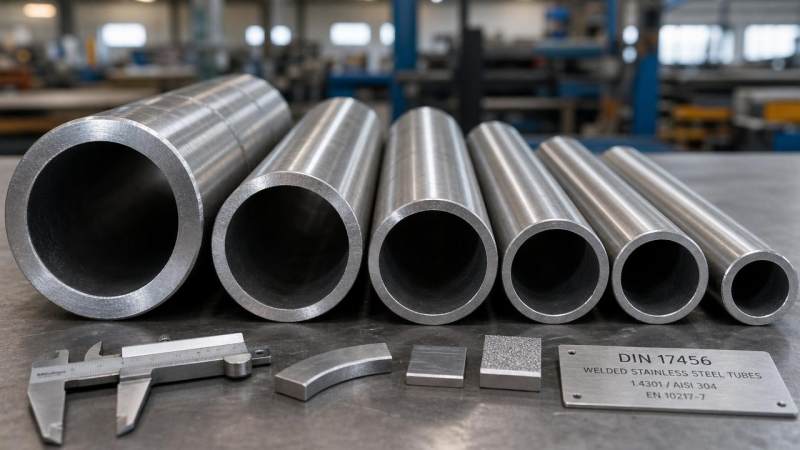
DIN 17456 stainless tube generally refers to stainless steel tubes produced according to German industrial dimensional and technical expectations for welded tube applications.
In practical sourcing, DIN 17456 stainless tube discussions usually focus on outside diameter, wall thickness, length range, surface condition, and steel grade compatibility.
Although buyers often compare DIN, ASTM, and EN standards together, DIN 17456 stainless tube remains useful as a reference for legacy drawings and established supply chains.
The standard matters because dimensional accuracy affects welding, bending, installation, pressure behavior, and long-term corrosion performance in finished steel assemblies.
Core elements usually checked first
- Tube outside diameter and nominal wall thickness
- Length tolerance and straightness
- Steel grade, such as 304 or 316 families
- Surface finish and weld seam condition
- Mechanical and corrosion-related performance targets
For many steel projects, these points decide whether a DIN 17456 stainless tube can move from drawing review to real fabrication use.
Why DIN 17456 stainless tube size selection receives attention
Tube selection is rarely about one dimension alone. A larger outside diameter may improve flow or structural stiffness, but it also changes weight, joint design, and transport efficiency.
Wall thickness has similar trade-offs. Thicker tube can support higher loads or better durability, yet it may increase forming difficulty and total steel cost.
As a result, DIN 17456 stainless tube size review often becomes a balance between performance demand, fabrication method, and supply availability.
Current market signals influencing selection
These signals explain why DIN 17456 stainless tube evaluation now extends beyond size charts into broader project coordination.
How to interpret DIN 17456 stainless tube sizes in practice
A practical reading sequence starts with diameter, then wall thickness, then total length. After that, tolerance and material grade should be reviewed together.
Outside diameter affects compatibility with fittings, clamps, sleeves, and support brackets. This is often the first checkpoint in DIN 17456 stainless tube selection.
Wall thickness affects inner diameter, weight, and strength. If the tube is used in corrosive conditions, corrosion allowance may also influence thickness choice.
Length matters because shorter pieces can lower freight inefficiency, while longer pieces may reduce welding joints during field installation.
Simple selection logic
- Confirm the assembly or system connection size.
- Identify load, pressure, or structural support requirements.
- Match stainless grade to environment and media exposure.
- Check tolerance expectations for fabrication accuracy.
- Review supply feasibility, lead time, and documentation.
This approach helps narrow DIN 17456 stainless tube options before requesting detailed mill data or sample inspection.
Business value of correct tube selection in steel projects
Correct DIN 17456 stainless tube selection improves fabrication efficiency and lowers avoidable downstream adjustments in steel construction and industrial manufacturing.
When dimensions and tolerances align early, cutting plans become more accurate, joint preparation becomes easier, and installation delays are less likely.
This matters especially where stainless tube is combined with structural steel members in frames, supports, platforms, or processing lines.
In many projects, stainless tube is not the only steel component. Complementary structural sections may support the same system layout or load path.
For example, H-beam sections are often selected for steel structures, bridging, shipbuilding, and mechanical fabrication.
Available in grades such as Q235, Q345B, S275JR, S355JR, A572, A992, 304, and 316, they offer strong bending resistance and efficient weight distribution.
Typical dimensions include flange thickness from 8-64mm, web thickness from 5-36.5mm, flange width from 50-400mm, and lengths up to 12m or as required.
When DIN 17456 stainless tube and structural sections are sourced with compatible standards and lead times, project coordination becomes much smoother.
Typical application categories for DIN 17456 stainless tube
Not every DIN 17456 stainless tube is selected for the same use. Dimensional logic changes depending on the installation environment and processing requirement.
This classification helps connect DIN 17456 stainless tube dimensions with realistic use conditions rather than abstract specification reading alone.
Practical checks before confirming supply
Before finalizing a DIN 17456 stainless tube order, technical confirmation should cover more than nominal size and grade labels.
Recommended verification points
- Ask for dimensional tolerance details, not only nominal values.
- Confirm whether the tube is welded and how the seam is treated.
- Review material certificates and heat traceability records.
- Check length delivery condition and packaging method.
- Verify surface finish expectations for visible installations.
- Compare equivalent standards if DIN references are from older drawings.
These checks reduce misunderstanding, especially when DIN 17456 stainless tube specifications are being converted into international procurement documents.
A reliable steel supplier should also explain available alternatives if exact standard references are limited by regional production practice.
Next-step approach for technical comparison and sourcing
A useful next step is to build a comparison sheet listing DIN 17456 stainless tube size, grade, tolerance, finish, quantity, and intended application.
This allows direct comparison between offers, especially when different suppliers use DIN, EN, or ASTM references in parallel.
For steel projects requiring both stainless tube and structural sections, integrated sourcing review can improve delivery planning and fabrication coordination.
Hongteng Fengda, a structural steel manufacturer and exporter from China, supports global projects with consistent quality, customized solutions, and dependable supply planning.
With experience across ASTM, EN, JIS, and GB-related production, the company helps align steel product choices with application requirements and project timelines.
If DIN 17456 stainless tube evaluation is part of a wider steel package, preparing technical requirements early will support more accurate and efficient supplier communication.
Please give us a message


Please enter what you want to find