When evaluating DIN 17456 stainless tube for safety-critical and industrial applications, quality inspections are not just routine—they directly affect performance, compliance, and risk control.
For quality control and safety managers, the most important tests are those that verify chemical composition, mechanical performance, dimensional accuracy, surface integrity, and corrosion resistance before shipment or installation.
A practical inspection plan should not treat every test equally. Instead, it should focus first on the tests most likely to expose defects that can cause leakage, rupture, premature corrosion, or non-compliance.
What quality and safety teams really need to confirm first
When buyers search for DIN 17456 stainless tube, they are usually not looking for a generic standard summary. They want to know which inspections truly reduce project risk.
For quality personnel, the core question is simple: which tests can reliably prove the tube is fit for service, traceable, and consistent with specification under real operating conditions?
Safety managers ask a related question from another angle. They need confidence that the material will not fail in service due to hidden metallurgical, dimensional, or surface defects.
This is why the most valuable approach is not a long checklist without priorities. It is a risk-based test sequence that distinguishes essential tests from supplementary ones.
Why DIN 17456 stainless tube inspection cannot rely on paperwork alone
Mill certificates are important, but certificates alone do not eliminate supply risk. Even when documents look complete, errors can still appear in grade mix-up, wall thickness, heat treatment, or surface condition.
For imported steel products especially, verification matters because project teams often manage multiple suppliers, standards, and logistics stages. Every handoff increases the chance of traceability loss or specification deviation.
That is why incoming inspection should compare the purchase order, applicable standard, material test certificate, product marking, dimensions, and actual test results as one complete control process.
In many industrial environments, the cost of additional testing is minor compared with the cost of a shutdown, claim, replacement campaign, or safety incident caused by one bad batch.
The five tests that matter most in most applications
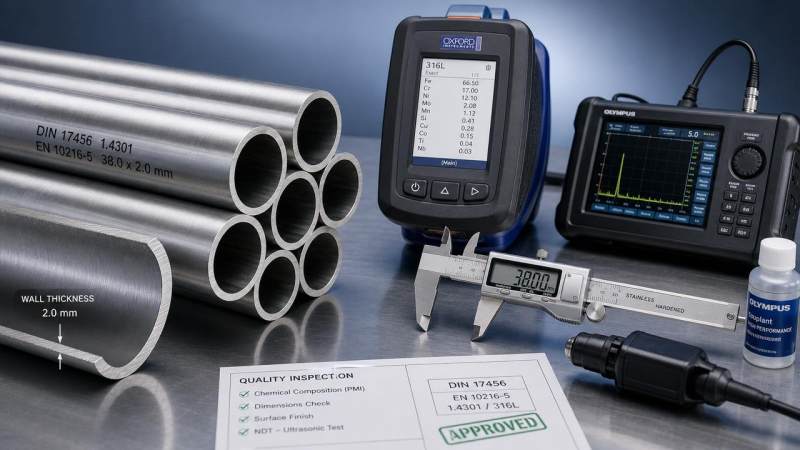
If inspection resources are limited, quality teams should usually prioritize five areas: chemical analysis, mechanical testing, dimensional inspection, non-destructive testing, and corrosion-related verification.
These five categories address the most common failure drivers. Together, they help confirm whether the DIN 17456 stainless tube can deliver the required strength, geometry, weld quality, and service durability.
1. Chemical composition verification
This is the first critical checkpoint because stainless performance starts with composition. If chromium, nickel, molybdenum, or carbon content is out of range, corrosion resistance and mechanical behavior may change significantly.
Positive material identification, often by portable spectrometer or laboratory analysis, helps prevent wrong-grade substitution. This is especially important when similar-looking stainless tubes are stored or shipped together.
For safety-critical applications, relying only on supplier declarations is risky. A quick PMI check can reveal whether the delivered material actually matches the ordered stainless grade.
2. Mechanical property testing
Tensile strength, yield strength, elongation, and where required hardness testing show whether the tube has the expected structural behavior after manufacturing and heat treatment.
These tests are essential when tubes face internal pressure, vibration, cyclic loading, or mechanical assembly stress. Mechanical conformity is not just a standard requirement; it is a failure-prevention measure.
If a batch shows acceptable chemistry but poor tensile performance, the root cause may involve process instability, improper heat treatment, or manufacturing defects that paperwork alone will not reveal.
3. Dimensional and wall thickness inspection
Many service failures begin with dimensional non-conformity rather than dramatic metallurgical defects. Outside diameter, wall thickness, straightness, ovality, and length tolerances all affect fit-up and pressure performance.
Wall thickness deserves special attention because local thinning can reduce safety margin, accelerate corrosion penetration, and create installation problems in welded or threaded systems.
For quality teams, dimensional inspection is also one of the fastest ways to identify inconsistent manufacturing control before material reaches the field.
4. Non-destructive testing for hidden defects
Depending on tube type and application, eddy current testing, hydrostatic testing, or other non-destructive methods may be necessary to identify pinholes, cracks, lamination, seam defects, or leakage paths.
This category matters most when the tube will carry fluid, gas, steam, or corrosive media. Hidden defects may not be visible, but under pressure they can become immediate operational hazards.
For many buyers, this is the point where inspection shifts from quality assurance to direct risk control. A tube that looks acceptable visually can still fail if internal defects are missed.
5. Corrosion-related assessment
Because stainless tube is often selected for its corrosion resistance, teams should verify not only grade identity but also whether the delivered condition supports the intended environment.
In some projects, corrosion verification may include intergranular corrosion testing, surface passivation review, or examination of heat tint and contamination that could weaken protective performance.
This is particularly important in chemical processing, humid environments, food-related systems, or installations exposed to chlorides, cleaning agents, or fluctuating temperatures.
Which tests become critical in safety-sensitive or regulated environments
Not every project needs the same test depth. However, in pressure service, aggressive media, public infrastructure, or audited industrial systems, several additional checks often become critical rather than optional.
These may include flattening tests, flaring tests, impact testing where applicable, microstructure review, weld seam examination, and stricter traceability checks at lot or heat level.
For regulated buyers, traceability deserves equal weight with physical testing. If a failure occurs later, the ability to link each tube to heat number, test report, and inspection record is essential.
In practice, many quality disputes are not caused only by product defects, but by incomplete records that make conformity impossible to prove after delivery.
How to rank test importance by application risk
The right question is not “Which test is best?” but “Which tests best match the failure risks of this application?” The answer depends on medium, temperature, pressure, fabrication method, and service life expectations.
For general structural or low-risk mechanical use, visual inspection, dimensions, chemistry, and mechanical properties may be enough. For fluid service, leak-related and defect-detection tests move much higher in priority.
For corrosive service, chemistry and corrosion-related verification should carry greater weight than appearance alone. A bright surface does not guarantee proper stainless performance in operation.
For installations with welding, forming, or bending after delivery, additional attention should go to ductility, weldability, and surface cleanliness because fabrication can amplify hidden weaknesses.
Common warning signs that a batch needs deeper inspection
Experienced QC teams often detect risk before testing is complete. Warning signs include inconsistent markings, mixed bundle labels, unusual surface discoloration, excessive scratches, poor end finishing, or variable wall readings.
Another warning sign is mismatch between documentation details and actual goods, such as heat number inconsistencies, vague grade descriptions, or certificates missing key mechanical or chemical values.
If the supplier hesitates to provide traceability records or third-party inspection support, that alone justifies stricter verification. Good suppliers understand that transparency reduces risk for both sides.
Even packaging can provide clues. Poor protection during shipment may introduce contamination, moisture exposure, or handling damage that later affects surface quality and corrosion behavior.
What a practical inspection checklist should include before acceptance
For quality control and safety managers, a practical checklist helps turn standard requirements into a repeatable acceptance process. The goal is clear evidence, not administrative formality.
Start with document review: purchase order, standard reference, grade, dimensions, quantity, heat number, and mill test certificate. Then confirm marking and traceability against actual bundles or pieces.
Continue with visual inspection for dents, scale, rust staining, cracks, seam irregularities, and contamination. After that, verify dimensions using calibrated tools and sample according to inspection plan.
Next, review or witness the required material tests. If the project is critical, consider third-party verification for chemical composition, tensile properties, and non-destructive examination.
Finally, record acceptance criteria clearly, along with non-conformance handling steps. A batch should not enter production or installation until unresolved deviations are closed.
Balancing test cost with sourcing efficiency
Some buyers worry that deeper inspection slows delivery and raises cost. In reality, targeted testing often reduces total cost by preventing claims, rework, schedule delays, and field failures.
The best approach is to align test intensity with supplier performance and project criticality. Trusted suppliers with stable quality may need routine verification, while new or high-risk sources justify expanded checks.
For broader project procurement, this same principle applies to other steel products. For example, when sourcing Wire rod for civil engineering or public infrastructure, standards, dimensions, and process consistency also require risk-based inspection planning.
Strong suppliers make this easier by offering complete technical data, standard compliance, processing support, and consistent manufacturing control rather than competing only on unit price.
How reliable suppliers support better inspection outcomes
Quality inspection works best when the supplier’s manufacturing system is stable. A capable producer should provide clear specifications, production traceability, standard compliance, and responsive technical communication.
For global buyers, this includes support with ASTM, EN, JIS, DIN, and GB alignment where projects involve multiple codes or international review requirements.
Manufacturers with modern facilities and strict process control are better positioned to keep dimensions stable, maintain material consistency, and reduce variation between batches.
That matters not only for stainless tube procurement, but across structural steel supply chains where dependable lead times and controllable quality reduce project uncertainty.
Final takeaway: focus on the tests that prevent real failures
For DIN 17456 stainless tube, the tests that matter most are the ones that directly verify grade accuracy, strength, dimensions, hidden defects, and corrosion suitability for the intended service.
If you are responsible for quality or safety, the smartest approach is not to request every possible test by default. It is to prioritize the tests that address your highest operational risks.
In most cases, chemical analysis, mechanical testing, dimensional inspection, and suitable non-destructive examination form the core of an effective acceptance strategy, with corrosion-related checks added as service demands increase.
When those controls are supported by traceability, competent suppliers, and clear acceptance criteria, DIN 17456 stainless tube procurement becomes more predictable, compliant, and far safer in real-world use.
Please give us a message


Please enter what you want to find