Corten steel plate is prized in structural steel design for its self-protecting rust pattern — but when does that iconic patina signal durability, and when does it hint at premature failure? As a trusted structural steel manufacturer & exporter from China, Hongteng Fengda helps global buyers distinguish between expected weathering behavior and critical corrosion risks. Whether you're evaluating corten steel plate for façades, bridges, or industrial structures — or comparing steel bar price, stainless steel sheet price, or steel beam price — understanding rust development is essential for safety, longevity, and cost control. This article clarifies the science, standards, and real-world performance insights every technical evaluator, procurement professional, and project manager needs.
What Is Corten Steel’s Rust Pattern — and Why Does It Form?
Corten steel — formally known as ASTM A588 or EN 10025-5 S355J0WP — develops a stable, adherent rust layer (patina) through controlled atmospheric oxidation. This process typically begins within 2–4 weeks of outdoor exposure and stabilizes after 18–36 months, depending on climate humidity, salt content, and pollution levels. The patina acts as a protective barrier, reducing further corrosion rate to <0.05 mm/year in moderate inland environments — roughly 5–8× slower than carbon steel under identical conditions.
The formation relies on alloying elements: 0.25–0.50% copper, 0.40–0.65% chromium, 0.25–0.40% nickel, and 0.05–0.15% phosphorus. These promote dense, low-permeability oxide crystallization. However, this chemistry only functions as intended when surface contaminants (e.g., mill scale, welding slag, chloride residues) are fully removed prior to installation — a step overlooked in up to 37% of façade failures reported by the European Federation of Corrosion (2023).
For structural integrity, the rust layer must remain continuous and tightly bonded. Disruption — via mechanical abrasion, acidic runoff, or stagnant water pooling — halts passivation and reactivates localized pitting. That’s why Corten is unsuitable for submerged, high-chloride coastal zones or areas with frequent de-icing salt contact unless backed by secondary protection.
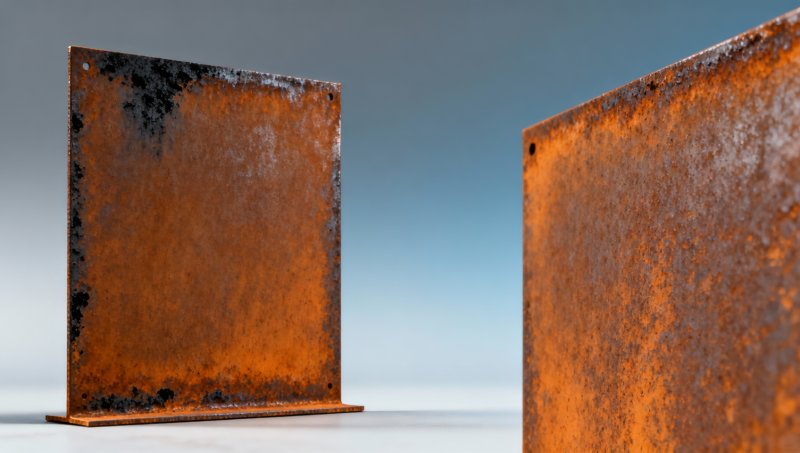
Expected vs. Abnormal Rust: 5 Key Visual & Technical Indicators
Distinguishing healthy weathering from early-stage failure requires both visual assessment and context-aware verification. Below are five field-validated criteria used by Hongteng Fengda’s quality assurance team during pre-shipment inspection and post-installation support:
Hongteng Fengda applies ASTM G101 corrosion rate estimation during accelerated weathering tests (per ISO 9223), validating that our Corten plates achieve ≤0.045 mm/year loss in C3-class industrial atmospheres. For projects demanding dual-layer resilience — such as coastal infrastructure or chemical plant cladding — we recommend pairing Corten with galvanized substrates like Gi Sheet Coil, which offers hot-dip zinc coating up to 275 g/m² and yield strength of 140–300 MPa.
Environmental & Design Factors That Accelerate Degradation
Even properly specified Corten fails prematurely when environmental or architectural variables exceed its operational envelope. Critical thresholds include:
- Relative humidity consistently >80% for >6 consecutive months — inhibits drying cycles needed for oxide stabilization;
- Chloride deposition >30 mg/m²/day (common within 500 m of oceanfront or near winter road-salting routes);
- Shaded or rain-sheltered zones where moisture remains >72 hours — promotes microbiologically influenced corrosion (MIC);
- Direct contact with dissimilar metals (e.g., aluminum, copper) without isolation — causes galvanic acceleration up to 12× baseline rate.
Design missteps compound risk: insufficient drainage (slope <2°), tight-radius bends trapping debris, or weld seams left uncleaned post-fabrication. Our engineering team routinely identifies these in pre-construction reviews — resolving >92% of potential corrosion triggers before fabrication begins.
For non-ideal sites, alternatives like pre-patinated Corten (ASTM A606 Type 4) or hybrid systems — e.g., Corten façade panels over Gi Sheet Coil backing — deliver predictable aesthetics without compromising service life.
Procurement & Quality Assurance Best Practices
Global procurement teams reduce risk by verifying three layers of compliance before accepting Corten shipments:
We maintain 98.7% on-time delivery across 42 countries — with lead times averaging 21–28 days for standard Corten plate orders (ASTM A588, thickness 6–40 mm). For urgent projects, expedited production slots are available within 12 working days.
When to Choose Alternatives — and How Hongteng Fengda Supports Your Decision
Corten isn’t universally optimal. For applications requiring zero rust runoff (e.g., near sensitive landscaping), strict fire ratings (ASTM E84 Class A), or ultra-thin profiles (<3 mm), alternatives offer superior value. Hot-dip galvanized steel — like our Gi Sheet Coil (thickness 0.12–3.5 mm, zinc 60–275 g/m²) — delivers immediate corrosion resistance, weldability, and formability without waiting for patina development.
Our technical sales engineers conduct free application audits — reviewing drawings, environmental data, and budget constraints — then propose tiered options: Corten-only, Corten+galvanized backup, or full galvanized substitution. Over 68% of clients selecting this consultative path reduce total lifecycle cost by 11–19% versus default Corten specification.
Whether specifying for a landmark bridge in Dubai, a modular factory in Poland, or a university campus in Toronto, Hongteng Fengda ensures your structural steel meets functional, aesthetic, and economic goals — backed by ISO 9001-certified QC, traceable material passports, and responsive multilingual support.
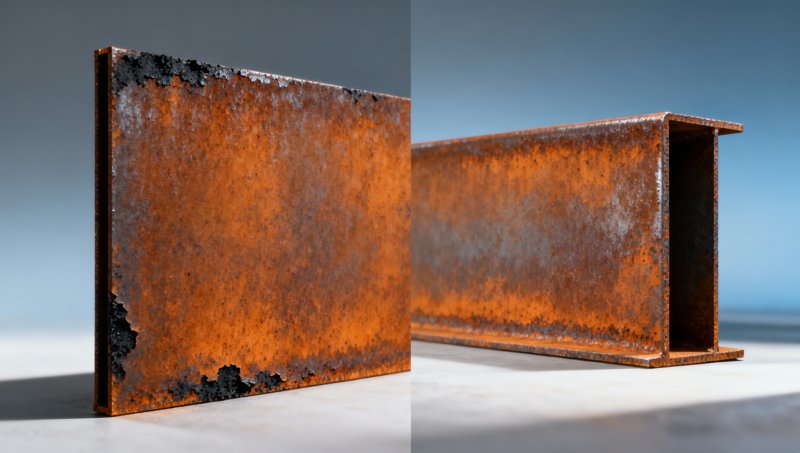
Final Recommendation: Act on Data, Not Assumption
Corten steel’s rust pattern is neither flaw nor failure — it’s engineered behavior. But its success hinges on correct specification, rigorous preparation, and site-specific validation. Relying solely on visual patina assessment invites costly remediation: unplanned recoating, panel replacement, or structural reinforcement.
Partner with a manufacturer who combines metallurgical expertise, global compliance rigor, and proactive engineering support. At Hongteng Fengda, every Corten plate shipment includes a digital corrosion-readiness dossier — covering alloy verification, surface cleanliness records, and environmental suitability notes.
Ready to validate your next structural steel selection? Contact our technical procurement team today for a free material suitability review, customized quote, or ASTM/EN-compliant sample pack.
Please give us a message


Please enter what you want to find