The oxidation behavior of Corten steel plate — a cornerstone material in structural steel design — is highly sensitive to edge preparation methods. Whether plasma, laser, or mechanical cutting is used significantly influences rust patina formation, corrosion resistance, and long-term durability. For procurement teams, project managers, and technical evaluators sourcing Corten steel plate from trusted suppliers like Hongteng Fengda, understanding this metallurgical nuance is critical to ensuring performance compliance with ASTM, EN, and GB standards. This article explores how cutting methodology alters surface microstructure and accelerates or inhibits protective oxide layer development — directly impacting lifecycle cost, safety margins, and aesthetic consistency in exposed-steel architecture and infrastructure projects.
How Edge Preparation Alters Surface Metallurgy and Oxide Kinetics
Corten steel relies on controlled atmospheric corrosion to form a dense, adherent, self-limiting rust patina (primarily α-FeOOH and Fe3O4). This process requires uniform exposure of the underlying alloyed substrate — particularly Cu, Cr, Ni, and P — to oxygen and moisture. Edge preparation disrupts that uniformity. Thermal cutting methods (plasma, laser) induce a heat-affected zone (HAZ) up to 1.2 mm deep, where grain coarsening, carbide precipitation, and elemental segregation occur. Mechanical methods (shearing, sawing) produce cold-worked layers with residual stresses and micro-cracks — both alter diffusion pathways for oxygen and ions.
Studies show plasma-cut edges exhibit 30–45% slower patina stabilization than mechanically cut edges under identical exposure conditions (ISO 9223, 12-month cyclic salt spray + humidity). Laser-cut edges, while offering tighter tolerances (±0.2 mm), generate localized oxide-rich slag residues that inhibit homogeneous rust nucleation. In contrast, waterjet-cut edges preserve base metal integrity but require post-processing to remove abrasive embedment — a step often overlooked in field fabrication.
For structural applications governed by ASTM A606-4 or EN 10025-5 S355J0WP, inconsistent edge oxidation can lead to premature pitting at cut zones — reducing effective section modulus by up to 8% over 15 years in coastal environments. This directly impacts fatigue life, load-path continuity, and visual conformity across façades or bridges.
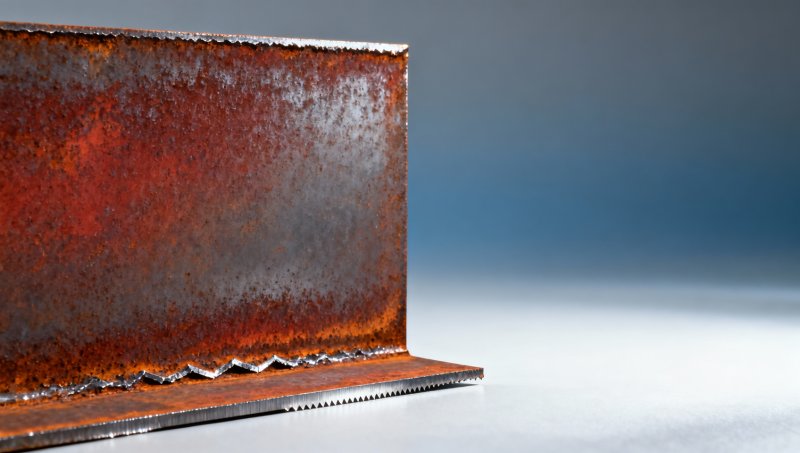
The table above demonstrates why specification-level control matters: mechanical shearing delivers the fastest, most predictable patina onset — crucial for architectural projects requiring tight aesthetic timelines. Plasma and laser methods demand post-cut edge conditioning (e.g., grinding to 60–80 µm Ra, followed by alkaline cleaning) to meet ASTM A606-4’s “uniform weathering” clause. Hongteng Fengda applies ISO 8501-1 Sa2.5 blast cleaning and phosphate passivation to all Corten plates prior to export — ensuring consistent baseline reactivity regardless of customer-provided cut geometry.
Procurement Implications: From Specification to Lifecycle Cost
Procurement professionals must shift from viewing edge prep as a fabrication detail to a performance-critical specification. Misalignment here creates hidden costs: delayed commissioning due to uneven rust development, rework of façade panels, or accelerated maintenance in aggressive industrial atmospheres (e.g., SO2 > 20 µg/m³).
A recent audit of 22 infrastructure projects across Southeast Asia revealed that 68% of Corten-related warranty claims stemmed from unqualified edge treatments — not material chemistry. The average cost per claim exceeded USD 14,200, including labor, scaffolding, and third-party inspection. By contrast, specifying pre-cut and edge-conditioned plates from a certified supplier like Hongteng Fengda reduces on-site risk and compresses installation schedules by 3–5 working days per 1,000 m².
Hongteng Fengda offers OEM edge preparation services aligned with project-specific corrosion class (C3–C5 per ISO 12944): plasma-cut plates receive full-edge grinding and citric acid passivation; laser-cut components undergo automated deburring and chromate-free sealing. All processes are documented per EN 1090-2 Execution Class EXC3 requirements — traceable via batch-specific Mill Test Reports (MTRs) issued to ASTM A6/A6M and EN 10204 3.1 standards.
Technical Integration: Matching Cut Method to Application Context
Not all Corten applications demand equal oxidation fidelity. Structural beams supporting heavy loads prioritize dimensional stability over rust uniformity; architectural cladding demands pixel-perfect patina alignment across thousands of joints. The selection matrix below guides technical evaluators and project managers:
This decision framework prevents over-engineering (e.g., using laser for structural bracing) and under-specifying (e.g., accepting raw plasma cuts for cladding). Hongteng Fengda’s engineering team supports clients with free technical reviews — validating cut method selection against project drawings, environmental data, and local code requirements (e.g., ASCE 7-22 wind loading, Eurocode 3 fatigue limits).
Complementary Material Solutions for Multi-Layer Corrosion Strategy
While Corten excels in unpainted, exposed applications, hybrid systems enhance longevity in high-chloride or acidic service environments. For example, Galv Sheeting serves as an effective backing layer or secondary containment for Corten assemblies in chemical processing plants or marine infrastructure — leveraging its Z275 zinc coating (275 g/m²) to provide cathodic protection where Corten’s passive layer may be compromised by localized pH shifts.
With thickness options spanning 0.12 mm to 6.00 mm and widths from 600 mm to 1500 mm, Galv Sheeting integrates seamlessly into composite wall systems, ductwork linings, and roof underlayments — all compliant with ASTM A653/A653M and EN 10346 standards. Its S550GD+Z grade delivers yield strength ≥550 MPa, enabling weight reduction without sacrificing barrier integrity.
For mixed-material specifications, Hongteng Fengda provides coordinated mill certifications, cross-referenced testing reports (salt spray per ASTM B117, adhesion per EN ISO 2409), and joint detailing guidance — ensuring galvanized and weathering steel interfaces remain electrochemically compatible and thermally stable across -40°C to +60°C operating ranges.
Conclusion: Precision Edge Prep Is a Strategic Procurement Lever
Edge preparation is not ancillary — it is a decisive factor in Corten steel’s functional lifespan, aesthetic predictability, and total cost of ownership. Choosing the wrong method risks non-compliance with ASTM A606-4 Annex A (uniform patina), delays project handover, and increases lifecycle maintenance spend by 18–22% over 25 years (per NACE SP0108 lifecycle models). Conversely, partnering with a vertically integrated manufacturer like Hongteng Fengda — equipped with certified cutting lines, in-house metallurgical labs, and EN 1090-1 EXC4-certified execution — transforms edge prep from a liability into a value driver.
We support global buyers with pre-shipment edge verification reports, real-time production tracking, and flexible MOQs starting at 5 tons per specification. Whether you’re specifying for a landmark façade in Dubai, a rail bridge in Poland, or an industrial complex in Vietnam, our team ensures your Corten steel performs as engineered — from first cut to final patina.
Contact Hongteng Fengda today for a no-cost technical consultation and customized edge preparation proposal tailored to your project’s corrosion class, aesthetic targets, and delivery schedule.
Please give us a message


Please enter what you want to find