Corrugated steel sheet remains one of the most practical steel products in building envelopes and light-duty site structures.
It is valued for low weight, easy installation, and a profile that improves stiffness without adding much material.
At the same time, performance depends heavily on thickness, coating, span, support spacing, and the environment around the project.
That is why the best results come from knowing where a corrugated steel sheet works well, and where its limits start to matter.
Why corrugated profiles are still widely used
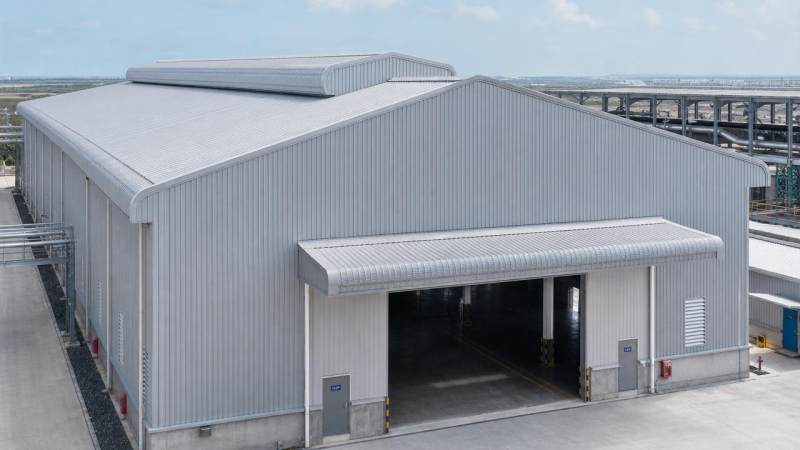
The corrugated shape is not only visual. It increases bending resistance compared with a flat sheet of similar thickness.
This allows a corrugated steel sheet to cover larger areas with less self-weight, which helps handling and transport.
For roofs and wall cladding, that balance is attractive.
Projects often need materials that install quickly, protect against weather, and stay cost-effective across large surfaces.
A corrugated steel sheet fits that need better than many heavier alternatives.
This is especially relevant in industrial buildings, storage areas, agricultural facilities, workshops, and temporary compounds.
In export supply chains, consistent forming quality and coating control also matter.
Suppliers such as Hongteng Fengda, with structural steel production and international standard compliance, help reduce variation between batches.
That matters when roof sheets, purlins, channels, and other steel components must work together on site.
What a corrugated steel sheet does best
The product performs best when used as a covering or enclosure material rather than a primary structural member.
Its strength is real, but it comes from profile geometry working with supports underneath.
In practice, the best uses are usually these:
- Roofing for warehouses, sheds, workshops, and utility buildings
- Exterior wall cladding for industrial and commercial envelopes
- Fencing and partition panels where quick installation is important
- Temporary shelters, site offices, and storage covers
- Protective siding in agricultural and light manufacturing environments
A corrugated steel sheet also works well where maintenance access is manageable and sheet replacement should stay simple.
If one area is damaged, individual panels can often be changed without major disruption.
Where it adds value in daily operation
Operational value is not only about purchase price.
A corrugated steel sheet can lower installation time, reduce load on supporting frames, and simplify logistics.
These effects become important on large sites and remote locations.
This is one reason steel building systems often combine profiled sheets with cold formed sections, beams, and standard accessories.
Not every project relies on sheet products alone.
In handrails, fencing details, water supply supports, or fabricated site elements, round bar can also be part of the same package.
A practical example is Q235 Carbon Steel Round Bar, available in grades and standards such as ASTM, EN, JIS, and GB.
With diameter options from 5 mm to 2500 mm, common lengths like 2 m, 5 m, 6 m, and 12 m, and finishes including galvanized, oiled, painted, or untreated, it supports many secondary steel needs around corrugated systems.
The practical limits that should not be ignored
The biggest mistake is treating a corrugated steel sheet like a universal structural solution.
It is strong for its weight, but it still has clear boundaries.
Span and load limits
Long unsupported spans can lead to deflection, vibration, oil-canning, or local failure at fasteners.
Roof live loads, wind uplift, and maintenance traffic should always be checked against profile data.
Corrosion exposure
In coastal, chemical, or high-humidity settings, coating choice becomes critical.
A corrugated steel sheet with unsuitable coating can age quickly at cut edges, overlaps, and scratched areas.
Thermal and acoustic performance
Single-skin sheet systems are rarely enough where insulation, condensation control, or noise reduction is a major requirement.
Additional layers or sandwich systems may be needed.
Appearance under impact or poor installation
Thin panels can dent during transport or foot traffic.
Incorrect fastener placement can also create leakage paths and shorten service life.
How to judge suitability before selecting
Choosing a corrugated steel sheet should start with the operating conditions, not only the price per ton or per square meter.
A few questions usually make the decision clearer.
- What are the design wind, rain, snow, or dust conditions?
- How far apart are purlins or wall supports?
- Will the sheet face salt air, industrial fumes, or standing moisture?
- Is insulation or condensation control required?
- Will personnel walk on the roof during maintenance?
- What coating, thickness, and fastening system are compatible?
These questions help separate a light cladding application from a more demanding building envelope requirement.
They also help compare galvanized sheet, painted sheet, and heavier-duty coated options more realistically.
Material coordination matters more than many expect
A corrugated steel sheet rarely works alone.
Its long-term performance depends on the full support system, including channels, purlins, beams, trims, fixings, and fabricated accessories.
That is why project teams often prefer suppliers able to support broader structural steel coordination.
Hongteng Fengda serves this kind of need through angle steel, channel steel, steel beams, cold formed steel profiles, and customized structural steel components.
With production aligned to ASTM, EN, JIS, and GB, the goal is not only supply volume.
It is compatibility, stable quality, and fewer surprises during installation.
That approach is useful when schedules are tight and replacement material delays would affect the whole project.
A balanced way to move forward
A corrugated steel sheet is often the right answer when the job calls for fast enclosure, manageable cost, and efficient steel coverage.
It becomes a weaker choice when spans are too large, corrosion risk is underestimated, or thermal performance is expected without supporting layers.
The most reliable next step is to review the real site conditions, support spacing, coating needs, and service expectations together.
Once those points are clear, comparing profile shape, thickness, and related structural steel components becomes much easier and more accurate.
Please give us a message


Please enter what you want to find