Choosing between corrugated steel roofing and standing seam systems in coastal salt air demands careful evaluation of steel roofing benefits, corrosion resistance, installation complexity, and long-term value. As a trusted steel roofing manufacturer and supplier from China, Hongteng Fengda delivers high-performance galvanized steel roofing, insulated steel roofing, and lightweight steel roofing solutions engineered for harsh marine environments. Whether you're assessing steel roofing cost, comparing steel roofing price points, or seeking expert guidance on how to install steel roofing correctly, this comparison helps technical evaluators, project managers, and procurement professionals make data-driven decisions—backed by ASTM/EN-compliant products and OEM-ready structural steel expertise.
Why Coastal Salt Air Demands Specialized Steel Roofing
Coastal environments accelerate corrosion through chloride ion exposure, humidity cycles, and UV radiation. Unprotected carbon steel can lose up to 0.1 mm/year in thickness under sustained salt spray—equivalent to full perforation in 10–15 years for typical 0.5 mm roofing gauges. Even hot-dip galvanized (HDG) coatings face accelerated zinc depletion when exposed to airborne sea salts, especially near shorelines within 500 meters.
Structural integrity, thermal performance, and lifecycle maintenance costs are all impacted—not just aesthetics. That’s why material selection must go beyond base steel grade and consider coating system durability, joint design, and substrate compatibility. For projects across Southeast Asia, the Gulf Coast, or Mediterranean islands, specifying corrosion-resistant substrates like 304 Stainless Steel Coil becomes a strategic risk-mitigation step—not just an option.
Hongteng Fengda applies dual-layer protection strategies: ASTM A792-compliant aluminum-zinc alloy coatings over G300+ galvannealed base steel, plus optional stainless cladding for critical zones. Our EN 10346-certified coils undergo salt-spray testing per ISO 9227 for ≥1,500 hours without red rust—validating real-world resilience where standard HDG fails at 300–600 hours.
Corrugated vs. Standing Seam: Key Performance Differences
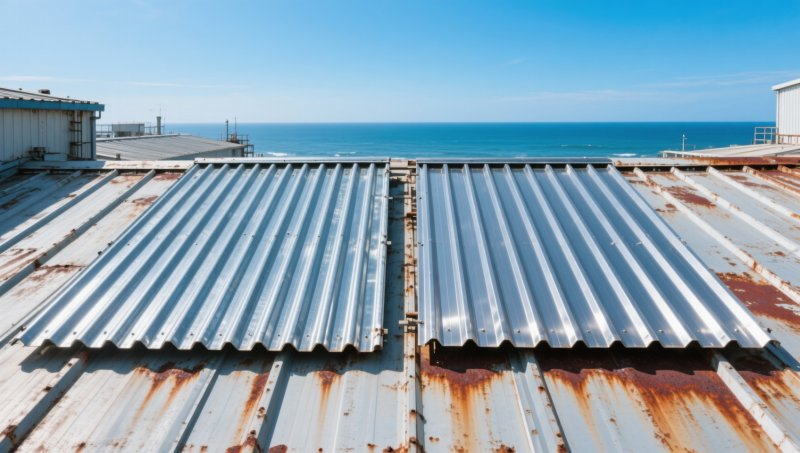
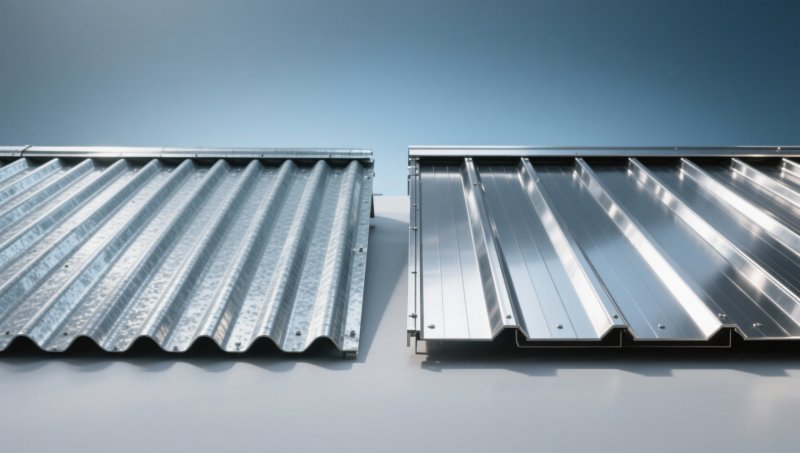
The core distinction lies not in material alone—but in geometry, fastening method, and water-shedding logic. Corrugated profiles rely on mechanical seaming and exposed fasteners; standing seam uses concealed clips and vertical interlocking seams. Both can be fabricated from identical base materials—including cold-formed steel with Z275 galvanized coating or stainless-steel substrates—but their field behavior diverges significantly.
Note: Standing seam excels in long-span applications (>12 m), where thermal cycling fatigue and wind uplift resistance become decisive. Corrugated remains viable for low-slope industrial sheds where budget constraints outweigh lifecycle ROI calculations. But for buildings requiring 30+ year service life—such as port terminals, desalination plants, or coastal resorts—standing seam’s concealed fastener system eliminates a primary failure point: fastener corrosion and sealant degradation.
Material Options That Change the Equation
Both systems benefit from upgraded substrates. While G300 galvannealed steel meets ASTM A653 requirements, it still requires periodic recoating in aggressive marine zones. In contrast, 304 Stainless Steel Coil offers inherent resistance: its chromium-nickel matrix forms a self-repairing passive oxide layer that withstands chloride concentrations up to 200 ppm—well above typical coastal atmospheric levels (50–150 ppm).
- Yield strength ≥275 MPa ensures structural stability under wind loads up to 150 km/h (EN 1991-1-4 Category III)
- Hardness ≤183 HB enables cold-forming into complex standing seam profiles without cracking
- Surface finishes like NO.4 and HL provide both aesthetic consistency and abrasion resistance for foot traffic during maintenance
Procurement Checklist for Coastal Projects
When evaluating suppliers for salt-air roofing, technical and procurement teams should jointly verify these six non-negotiable items:
- ASTM A653 / EN 10346 mill test reports confirming actual coating mass (not nominal)—minimum Z275 for galvanized, or full stainless specification
- Third-party salt-spray validation (ISO 9227) with documented red-rust onset time—not just “pass/fail” statements
- Fastener compatibility documentation: stainless-steel screws with EPDM washers rated for 120+ hr UV exposure
- Thermal movement allowance calculations matching local climate data (e.g., ΔT = 65°C for Gulf Coast summer/winter swing)
- OEM capability for custom panel widths (610–2000 mm) and lengths (up to 6000 mm) to minimize field seams
- Traceable batch-level quality control logs—especially for coil-based production where edge defects impact seam integrity
Hongteng Fengda provides all six items as standard deliverables—not add-ons. Our traceability system logs coil heat numbers, coating thickness scans per meter, and final dimensional checks before packaging—ensuring zero variance across multi-container shipments to North America or Europe.
Why Global Teams Choose Hongteng Fengda for Coastal Steel Roofing
We don’t sell generic steel—we engineer solutions calibrated to your site’s microclimate, loading requirements, and compliance framework. From Dubai’s high-humidity ports to Maine’s freeze-thaw cycles, our structural steel components meet ASTM A572 Gr.50, EN S355JR, or JIS SM490 specifications—with full mill certifications included.
Our advantage is operational: 30-day standard lead time for stocked gauges (0.6–1.2 mm), 45 days for custom stainless profiles, and seamless integration with your engineering team via BIM-ready DWG files and IFC models. We support procurement professionals with pre-shipment SGS inspections, CIF documentation, and bilingual QC reports—reducing customs delays by up to 7 business days in ASEAN and EU markets.
Ready to validate your next coastal roofing specification? Contact us for: free corrosion modeling based on your GPS coordinates, custom sample kits with salt-fog test data, or OEM panel drawings aligned with your roof framing spacing.
Please give us a message


Please enter what you want to find