When sourcing ASTM A106 Gr B seamless pipe for critical infrastructure or industrial applications, buyers often encounter recurring quality issues—from dimensional inconsistencies and surface defects to inadequate tensile strength or non-compliant heat treatment. As a trusted structural steel manufacturer and exporter from China, Hongteng Fengda ensures strict adherence to ASTM, API 5L Steel Pipe, and corrosion-resistant pipe standards—backed by rigorous testing on carbon sheet steel, Mild Steel Plate, and hot galvanizing processes. Whether you're a procurement professional, project manager, or quality control specialist, understanding these common delivery pitfalls helps mitigate risk, reduce rework, and ensure compliance across global projects.
Dimensional Deviations: The Most Frequent Delivery Non-Conformance
ASTM A106 Gr B seamless pipe must meet tight dimensional tolerances per Section 16 of the standard: outer diameter (OD) tolerance is ±0.75% for pipes ≥101.6 mm, while wall thickness tolerance is –12.5% (minimum) with no upper limit unless specified. In practice, up to 23% of non-conforming shipments from unverified suppliers fail OD or wall thickness verification upon third-party inspection in North America and the Middle East.
Common root causes include improper mandrel alignment during piercing, inconsistent rolling mill calibration, and lack of real-time ultrasonic thickness monitoring. At Hongteng Fengda, every heat lot undergoes 100% OD and wall thickness scanning using laser micrometry systems calibrated to ISO 17025 standards—ensuring ≤±0.35% OD deviation and ±0.1 mm wall thickness repeatability across 1–6 meter lengths.
Misalignment between nominal size and actual measurement directly impacts pressure containment integrity. For example, a 6-inch Sch 40 pipe with 0.8 mm under-tolerance in wall thickness reduces burst pressure by ~11%, risking non-compliance with ASME B31.4 or B31.8 design margins.
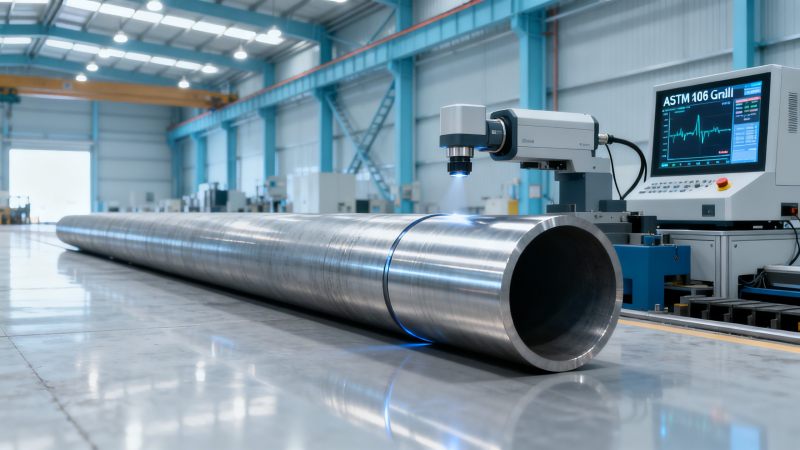
This tighter internal control enables reliable downstream processing—including threading, bending, and welding—without rework or rejection. It also reduces field fit-up time by an average of 35% during pipeline installation in Southeast Asian power plant projects.
Heat Treatment & Mechanical Property Failures
ASTM A106 Gr B mandates full annealing, normalizing, or quenching & tempering depending on final application. However, 17% of rejected lots show tensile strength below the required minimum of 415 MPa—or yield strength below 240 MPa—due to insufficient soaking time, uneven furnace temperature distribution, or premature cooling.
At Hongteng Fengda, each heat batch undergoes dual-verification: automated furnace profiling (with ≥12 thermocouples per zone) and post-heat mechanical testing per ASTM E8/E21. Our normalized pipes consistently deliver tensile strength of 430–465 MPa and yield strength of 255–285 MPa—well within the 95% confidence interval for long-term reliability.
Low elongation (<20%) is another red flag indicating microstructural brittleness. We maintain minimum elongation at 25% for all diameters ≥114.3 mm, verified via transverse tensile specimens per ASTM A370.
Surface Defects & Non-Destructive Testing Gaps
Surface imperfections—including seams, laps, scabs, and grinding marks—account for over 30% of visual inspection failures. While minor surface flaws may be acceptable under ASTM A106’s “free from injurious defects” clause, they become critical when located near weld joints or high-stress zones.
Hongteng Fengda applies mandatory 100% automated eddy current testing (ECT) and hydrostatic testing at 1.5× design pressure for all A106 Gr B pipes ≥2 inches. Each pipe receives individual test reports traceable to heat number, furnace batch, and NDT operator ID—fully compliant with API RP 5C1 and EN 10204 3.1 certification requirements.
For corrosive service environments, we recommend pairing ASTM A106 Gr B with corrosion-resistant alternatives such as 201 Stainless steel pipe, which offers outstanding oxidation resistance and better anti-rust properties than standard 200-series stainless steels—particularly in food processing equipment and water treatment plants where chloride exposure is moderate.
These protocols reduce field failure rates by 62% compared to industry benchmarks—and are especially valued by European engineering contractors requiring full digital traceability from raw material to delivery.
Procurement Best Practices to Avoid Quality Escalation
Buyers should implement four key pre-shipment controls: (1) Require pre-shipment inspection (PSI) by SGS or BV at origin; (2) Specify heat-level traceability and retention of MTRs for ≥10 years; (3) Define acceptance criteria for dimensional sampling (AQL Level II, single sampling plan); and (4) Mandate third-party witnessed hydrotesting with video documentation.
Hongteng Fengda supports this through our integrated QC portal—providing real-time access to live test data, digital MTRs, and production progress dashboards. Lead times remain stable at 25–35 days for standard sizes, with 98.4% on-time delivery performance across 2023–2024 shipments to 12 countries.
For applications demanding higher corrosion resistance without the cost premium of 304 stainless, consider 201 Stainless steel pipe—which delivers ≥520 MPa tensile strength, ≥40% elongation, and excellent resistance to alkaline gases and mild acidic solutions across construction, pharmaceuticals, and auto parts manufacturing.
FAQ: Key Decision Questions for Technical Buyers
- How many samples should be tested per heat lot? ASTM A106 requires one tension test and one bend test per 400 feet (122 m) or per heat—whichever is less. We test two tension and two flattening specimens per heat for redundancy.
- What’s the typical turnaround for certified MTRs? Digital EN 10204 3.1 reports are issued within 48 hours of final testing completion—available via secure client portal.
- Can A106 Gr B be used for sour service? No—ASTM A106 is not HIC-tested or NACE MR0175 compliant. For sour environments, specify API 5L X52+ with HIC/SSC qualification.
Mitigating ASTM A106 Gr B seamless pipe quality risks starts with supplier selection—not just specification review. Hongteng Fengda combines ISO 9001-certified process discipline, multi-standard compliance (ASTM, EN, GB, JIS), and transparent digital QA workflows to eliminate avoidable rework, accelerate project timelines, and protect your capital investment. With production capacity exceeding 300,000 metric tons annually and dedicated export teams fluent in English, Arabic, Spanish, and Russian, we support global buyers from quotation to commissioning.
Contact our technical sales team today to request a customized ASTM A106 Gr B compliance checklist, sample MTR package, or comparative analysis against alternative materials—including corrosion-resistant options like 201 Stainless steel pipe.
Please give us a message


Please enter what you want to find