Galvanized steel sheet for construction is widely used because it balances strength, corrosion protection, and practical cost control. In building projects, that balance matters.
It supports longer service life in exposed environments, reduces repainting frequency, and helps structures perform reliably under changing weather conditions.
From roofing systems to framing accessories, galvanized steel sheet for construction remains a dependable material for projects that need durability without excessive maintenance.
This article explains the most common applications, key selection differences between scenarios, and practical guidance for choosing suitable specifications.
Why application context matters in construction projects
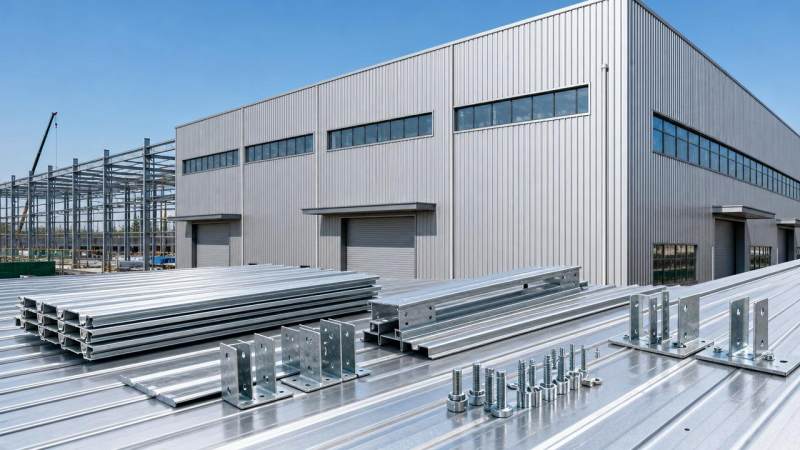
Not every building environment creates the same performance demands. A warehouse roof, a façade panel, and a ventilation duct face different stresses.
Humidity, coastal exposure, forming requirements, and expected lifespan all influence the right grade, coating weight, and thickness selection.
That is why galvanized steel sheet for construction should be chosen by use case, not by price alone.
A suitable product can lower total project cost by limiting corrosion repairs, avoiding premature replacement, and improving fabrication efficiency on site.
Roofing and wall cladding are the most common uses
Roofing sheets and wall panels are among the most visible uses of galvanized steel sheet for construction in industrial and commercial buildings.
These parts are exposed to rain, sunlight, dust, and seasonal temperature change. Corrosion resistance becomes a primary decision factor.
Galvanized surfaces help protect the steel base from rust. This extends panel life and keeps maintenance planning more predictable.
For roofing, forming quality also matters. Sheets must bend, corrugate, or profile cleanly without coating failure at critical edges.
Key judgment points for roofing and cladding
- Check local climate and rainfall intensity.
- Match coating mass to service exposure.
- Confirm forming performance for panel profiles.
- Review thickness against span and wind load.
In coastal or high-humidity zones, stronger corrosion protection is often more important than achieving the lowest initial material cost.
Framing accessories and structural support parts need balanced strength
Galvanized steel sheet for construction is also processed into brackets, channels, sleeves, trims, connectors, and light support members.
These components may not be highly visible, but they affect assembly speed, dimensional stability, and long-term structural reliability.
In these applications, corrosion resistance alone is not enough. Yield strength, welding behavior, and fabrication consistency are equally important.
For many projects, grades such as DX51D, SGCC, S250GD, S350GD, or S550GD are selected according to forming and strength demands.
A practical inserted option is Galvanized Steel Sheet, available in thicknesses from 0.12mm to 6.00mm.
Common widths range from 600mm to 1500mm, while lengths can reach 12m or be customized for fabrication efficiency.
Its yield strength can reach ≥240-380 MPa, with tensile strength of ≥270-500 MPa and elongation of ≥22%.
These values support bending, roll forming, and general welding needs in construction-related processing.
Ducting, enclosures, and service systems require process-friendly material
Mechanical rooms, ventilation systems, cable trays, and equipment enclosures often use galvanized steel sheet for construction support systems.
These applications usually involve cutting, folding, punching, and joining. Material workability becomes central to production quality.
Sheets with easy plastic processing and welding reduce production difficulty and improve consistency across batch fabrication.
Where indoor moisture or chemical vapors exist, coating selection should still be reviewed carefully to prevent early deterioration.
Typical service-system applications
- HVAC duct casings and support frames
- Electrical cabinets and equipment covers
- Cable tray accessories and mounting parts
- Partition framing and concealed reinforcements
Temporary works and site facilities focus on cost efficiency and durability
Construction sites also use galvanized steel sheet for construction in temporary barriers, storage sheds, walkways, and protective covers.
These structures must resist weather during active project phases while remaining economical and easy to install or relocate.
Here, buyers often seek the best balance between zinc coating, thickness, and expected reuse cycles rather than premium specifications.
Stable quality control still matters. Inconsistent coating or dimensional tolerance can create installation delays and replacement waste.
How demand changes across construction scenarios
The same material family serves many uses, but each scenario emphasizes different performance priorities.
This comparison shows why galvanized steel sheet for construction should be evaluated against real project exposure and fabrication needs.
Practical selection advice for better scenario matching
A clear selection process improves durability and prevents expensive specification mistakes.
- Define whether the component is exposed, enclosed, or temporary.
- Estimate corrosion risk from rain, salt, condensation, or chemicals.
- Confirm whether deep forming, welding, or punching is required.
- Choose thickness and width that reduce fabrication waste.
- Verify compliance with ASTM, EN, JIS, GB, DIN, or AISI requirements.
Projects with stricter international supply expectations often prefer material supported by recognized standards and consistent export documentation.
Hongteng Fengda, a structural steel manufacturer and exporter from China, supports this need with stable capacity and strict quality control.
Its supply experience across North America, Europe, the Middle East, and Southeast Asia helps reduce sourcing uncertainty in global projects.
Common mistakes when choosing galvanized sheet for building use
One frequent mistake is selecting only by thickness while ignoring zinc coating range and environment severity.
Hot galvanizing at 60-275g/m² or pre-galvanized options at 80-275g/m² may perform differently depending on exposure conditions.
Another mistake is overlooking forming requirements. A sheet suitable for flat covers may not perform well in deep profiles.
Some projects also underestimate edge treatment, drainage design, and fastener compatibility, all of which affect corrosion behavior over time.
Finally, buyers may ignore the relationship between base grade and final use, especially when support parts need higher strength levels.
What to do next for a better construction material decision
Galvanized steel sheet for construction remains a practical choice because it adapts to many building scenarios with reliable protection and strong processing value.
The best result comes from matching environment, fabrication method, structural demand, and service-life expectations before ordering.
When reviewing a project, compare application type, coating requirement, strength level, and standard compliance at the same time.
That approach helps control maintenance risk, improve installation efficiency, and support long-term building performance with greater confidence.
If a project needs standard sizes or customized structural steel support, a detailed specification review is the most effective next step.
Please give us a message


Please enter what you want to find