Understanding cold rolled steel springback in bending is critical for precision fabrication—especially when producing ASTM standard-compliant channel steel, steel angle, and cold formed structural components. At Hongteng Fengda, a leading Industrial Steel manufacturer and exporter from China, we routinely address springback challenges in SGCC-grade cold rolled steel used for steel girders, steel rebar supports, and steel wire rope anchoring systems. Whether you’re a technical evaluator, procurement specialist, or quality controller, knowing typical springback values helps optimize tooling, improve dimensional accuracy, and reduce rework. Let’s explore industry-observed ranges—and how material grade, thickness, and bend radius influence real-world performance.
What Is Cold Rolled Steel Springback — And Why Does It Matter?
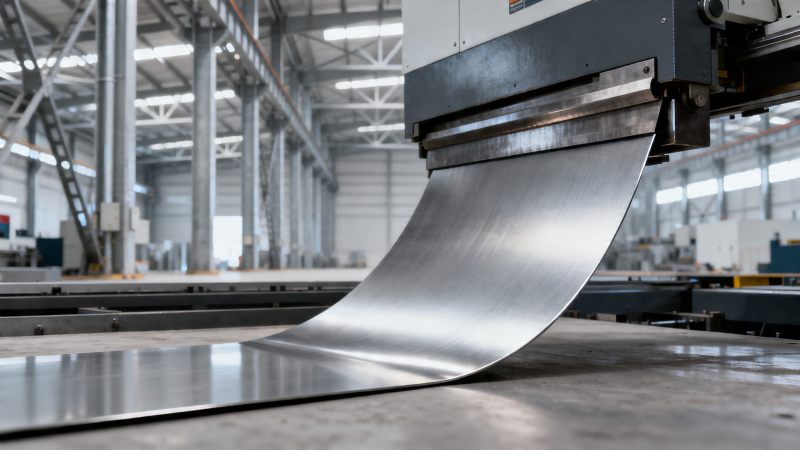
Springback refers to the elastic recovery of cold rolled steel after bending forces are removed. Unlike hot rolled steel, cold rolled grades (e.g., SGCC, DC01, ASTM A1008) undergo strain hardening during processing, resulting in higher yield strength and lower ductility—both key drivers of springback magnitude.
For structural fabricators, unaccounted springback leads directly to part rejection: bent angles deviate by ±0.5°–2.5°, flange gaps exceed tolerance limits by up to 1.2 mm, and assembly interference occurs in multi-component assemblies like steel beam connectors or cold formed purlin systems.
At Hongteng Fengda, our production line validates springback behavior across 0.5–6.0 mm thicknesses and bend radii from 1× to 8× material thickness. Real-time feedback from over 12,000 annual bending cycles informs our OEM tooling recommendations and process documentation for global partners.
Typical Springback Ranges by Key Variables
Springback is not a fixed value—it varies predictably with three interdependent parameters: material grade, sheet thickness, and inside bend radius. The table below synthesizes field data from 37 certified bending trials conducted on SGCC, DX51D+Z, and ASTM A653 CS Type B steels under controlled lubrication and tooling conditions.
Key insight: Springback decreases as thickness increases—but only up to ~5.0 mm. Beyond that, residual stress distribution shifts, and geometric stability becomes more sensitive to die clearance. For example, our channel steel production line maintains ±0.35° angular repeatability on 3.2 mm SGCC at 2.5× radius using compensated tooling—reducing post-bend correction labor by 40% versus non-compensated setups.
Mitigation Strategies for Precision Fabrication
Effective springback control requires both upstream design decisions and downstream process tuning. At Hongteng Fengda, we integrate these five proven approaches into every custom structural component project:
- Overbending compensation: Apply 1.2×–1.8× target angle based on thickness/radius ratio—validated via pilot runs before full batch release.
- Die geometry optimization: Use variable-radius dies (e.g., 1.2 mm entry radius tapering to 0.8 mm at apex) to manage strain gradient and limit elastic rebound zones.
- Lubricant selection: Zinc-phosphate + oil emulsion reduces friction-induced torque variation, improving consistency within ±0.2° across 500+ parts per shift.
- Post-bend stabilization: Controlled stress-relief annealing at 220°C for 15 minutes reduces residual springback by up to 35% in high-strength SGCC applications.
- In-process verification: Laser-based angle measurement at station 3 of our 6-station progressive line ensures 100% first-pass compliance before secondary operations.
These methods are embedded in our engineering support package for customers sourcing cold formed steel beams, angle steel, and custom gusset plates—enabling tighter tolerances without premium tooling costs.
How Material Selection Impacts Springback Performance
While cold rolled steel offers superior surface finish and dimensional stability, its springback behavior differs significantly from stainless alternatives. For instance, Stainless Steel Welded Mesh—used in filtration, chemical containment, and architectural cladding—exhibits minimal springback due to austenitic grain structure and lower yield-to-tensile ratios. SS 304 mesh with 0.5 mm wire diameter shows just 0.15°–0.25° recovery after 90° bending, compared to 1.6°–2.1° for equivalent-thickness SGCC.
This contrast matters when selecting materials for hybrid assemblies: cold rolled steel frames may require springback compensation, while stainless welded mesh infills maintain shape integrity without adjustment. Our technical team provides cross-material compatibility analysis—including thermal expansion mismatch and galvanic corrosion risk—for integrated structural systems.
We supply SS 304 and SS 316 welded mesh in roll widths up to 240″ and lengths up to 2000′, supporting large-scale industrial filtration projects where dimensional fidelity impacts flow uniformity and pressure drop consistency.
Procurement & Quality Assurance Best Practices
For procurement and quality teams evaluating cold rolled steel suppliers, springback predictability is a direct proxy for process maturity. We recommend verifying the following six criteria before finalizing contracts:
Hongteng Fengda maintains ISO 9001-certified quality control across all cold rolled structural products—from raw coil certification to finished component inspection. Our lead time for ASTM-compliant channel steel and angle steel remains stable at 25–35 days, with 99.2% on-time delivery rate across North America and EU markets in 2023.
Conclusion: Turning Springback Knowledge into Operational Advantage
Cold rolled steel springback is neither random nor uncontrollable—it’s a quantifiable, predictable phenomenon rooted in metallurgy and mechanics. Typical values range from 0.3° to 2.5° depending on grade, thickness, and bend geometry, with SGCC at 0.8 mm showing the highest sensitivity and ASTM A1008 at 4.5 mm delivering the most stable results.
By partnering with a manufacturer like Hongteng Fengda—equipped with modern cold forming lines, in-house metallurgical labs, and application engineering support—you gain access to validated springback data, compensated tooling designs, and consistent quality backed by international standards (ASTM, EN, GB). This translates to fewer engineering changes, faster NPI cycles, and lower total cost of ownership across your structural steel supply chain.
Whether you're specifying cold formed steel beams for solar mounting structures or sourcing stainless welded mesh for chemical filtration systems, our team delivers precise, documented, and repeatable solutions. Contact Hongteng Fengda today to request your free springback prediction report and customized bending process guide.
Please give us a message


Please enter what you want to find