When surface quality, dimensional accuracy, and forming performance matter, choosing between cold rolled steel coil and HRC becomes a critical technical decision.
For steel-related construction and manufacturing, this choice affects finish, tolerance, coating behavior, fabrication efficiency, and total cost.
A clear comparison helps reduce sourcing risk, improve consistency, and support practical material planning across structural and industrial projects.
Understanding cold rolled steel coil and HRC
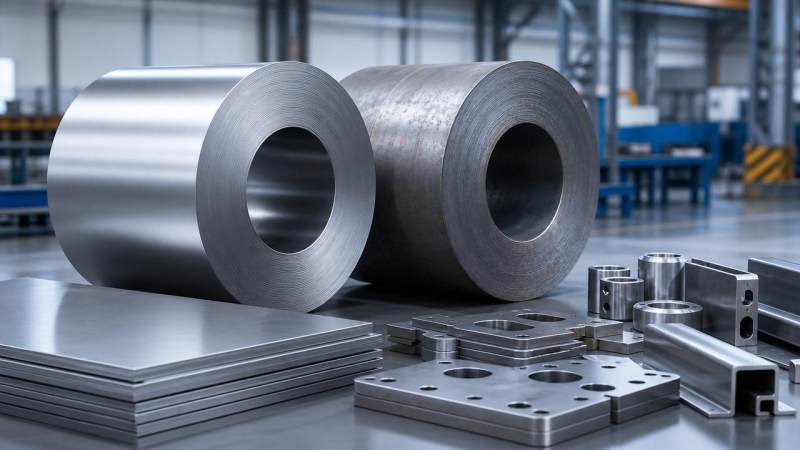
Cold rolled steel coil is produced by processing hot rolled material further at room temperature.
This additional reduction improves thickness control, surface smoothness, and shape consistency.
HRC, or hot rolled coil, is formed at high temperature.
It usually has a scaled surface, broader tolerances, and a less refined appearance.
If the target is a smoother finish, cold rolled steel coil often becomes the preferred option.
Still, finish is only one factor.
Mechanical performance, forming route, coating needs, and budget must also be reviewed together.
Core process difference
- HRC is rolled above recrystallization temperature.
- Cold rolled steel coil is reprocessed after hot rolling and pickling.
- Cold reduction creates tighter gauge control and cleaner surfaces.
Why surface finish matters in steel selection
Surface condition influences painting, plating, lamination, and visible part quality.
It also affects friction during forming and the final appearance of fabricated products.
Cold rolled steel coil is widely used where clean lines and stable dimensions are important.
Typical examples include cabinets, appliance panels, precision profiles, and formed components.
HRC remains useful for structural or hidden parts where appearance is secondary.
Current industry focus in construction and manufacturing
Material evaluation today goes beyond simple price comparison.
Projects increasingly measure processing yield, coating quality, lead time stability, and compliance with ASTM, EN, JIS, or GB requirements.
In this environment, cold rolled steel coil attracts attention because better consistency can reduce rework.
That matters for automated lines, repeated forming, laser cutting, and assembled systems.
- Visible steel parts require cleaner surfaces and fewer finishing defects.
- Precision fabrication benefits from tighter gauge and flatter coil.
- Corrosion protection systems perform better on more uniform surfaces.
- Stable quality helps control waste, especially in volume production.
For many structural applications, however, HRC still provides strong value.
When the part is thick, concealed, or later galvanized after fabrication, the smoother finish may not justify the extra cost.
Application value and material impact on downstream work
The value of cold rolled steel coil appears most clearly during downstream processing.
Better flatness supports more predictable cutting and bending.
Improved surface quality helps reduce sanding, cleaning, and coating corrections.
This can shorten production cycles for parts that must look uniform after assembly.
HRC may remain more efficient for frames, supports, and heavier duty components.
Its cost advantage is meaningful when appearance and precision are less critical.
A useful reference in structural applications is Channel In Steel.
This product suits construction, automobile manufacture, wall beams, brackets, lightweight roofs, and mechanical columns.
Available grades include Q195, Q235, Q235B, Q345B, Duplex, and stainless options such as 201, 202, 304, and 316.
Typical dimensions include thickness from 1.5mm to 25mm, height from 80mm to 160mm, and length from 6m to 12m.
Its strength, weldability, and corrosion resistance show how steel selection should match real use conditions rather than appearance alone.
Typical use scenarios for a smoother finish requirement
Not every project needs cold rolled steel coil, but some applications strongly benefit from it.
When cold rolled steel coil is the better fit
- The part remains visible after installation.
- Surface coating quality is closely inspected.
- Tight forming repeatability is required.
- Dimensional consistency affects assembly speed.
Practical selection guidance and common cautions
Material choice should begin with the final function of the part.
If appearance, coating, or tolerance drives quality, cold rolled steel coil deserves priority review.
If thickness, structural utility, or budget dominates, HRC may be more rational.
- Define whether the steel surface will remain exposed.
- Check thickness tolerance needed for forming and assembly.
- Review coating or galvanizing steps in the process route.
- Compare total processing cost, not only raw material price.
- Confirm standards, grade, and test requirements before ordering.
A common mistake is selecting HRC for a painted visible part, then spending more on surface preparation.
Another is using cold rolled steel coil where structural appearance has no impact, increasing cost without meaningful gain.
The right answer depends on the full fabrication chain.
Next-step evaluation for steel sourcing decisions
Cold rolled steel coil generally delivers a smoother finish, better tolerance, and cleaner processing behavior than HRC.
HRC remains important where cost efficiency and structural utility outweigh finish requirements.
A practical evaluation should compare appearance expectations, forming difficulty, coating standards, and total downstream cost.
Hongteng Fengda, a structural steel manufacturer and exporter from China, supports global projects with reliable steel products and customized solutions.
Its portfolio covers angle steel, channel steel, steel beams, cold formed profiles, and custom structural components under ASTM, EN, JIS, and GB standards.
For smoother-finish applications or structural alternatives, reviewing specifications early can improve quality control and reduce sourcing uncertainty.
Please give us a message


Please enter what you want to find