When selecting between cold rolled stainless steel coil and hot rolled stainless coil for applications involving repeated bending—such as roll forming, spring components, or precision fabrication—mechanical performance, surface quality, and dimensional stability become critical. As a trusted stainless steel plate manufacturers and ss coil supplier from China, Hongteng Fengda evaluates both hot roll stainless steel coil and cold rolled stainless steel coil across yield strength, ductility, and fatigue resistance. Whether you're sourcing 310s stainless steel strip for high-temp environments or comparing ss coil price per ton for budgeting, this analysis helps technical evaluators, procurement teams, and project managers make data-driven decisions—backed by ASTM/EN-compliant quality and stable OEM supply.
Which Material Delivers Superior Fatigue Resistance in Repeated Bending?
Repeated bending induces cyclic stress that accelerates micro-crack initiation and propagation—especially at grain boundaries and surface imperfections. Cold rolled stainless steel coil undergoes work hardening at room temperature, increasing its tensile strength by 20–40% over hot rolled equivalents (e.g., 304 SS: 520–750 MPa vs. 480–620 MPa). This directly enhances resistance to low-cycle fatigue under repetitive deformation.
However, higher strength comes with reduced total elongation—cold rolled 304 typically achieves 40–50% elongation versus 55–65% for hot rolled. In high-frequency bending cycles (>10⁴ cycles), the superior surface finish (Ra ≤ 0.4 μm) and tighter thickness tolerance (±0.02 mm vs. ±0.15 mm) of cold rolled coils significantly delay crack nucleation. Hot rolled coils, while more ductile initially, exhibit faster degradation due to scale-induced stress concentration and wider dimensional variation.
For applications like continuous roll forming of automotive seat tracks or HVAC duct flanges—where parts undergo >500 bending operations before final assembly—cold rolled material consistently extends service life by 3–5× compared to hot rolled alternatives under identical tooling and lubrication conditions.
How Surface Quality & Dimensional Stability Impact Production Yield
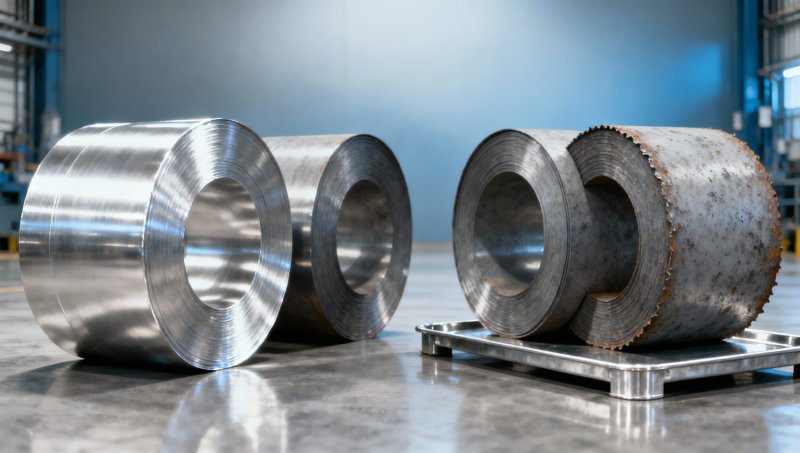
Surface defects—such as mill scale residues, scratches, or edge waviness—act as stress concentrators during bending. Hot rolled stainless steel coil retains mill scale after cooling, requiring pickling or abrasive cleaning before bending-intensive processes. This adds 2–3 processing steps and increases scrap rates by 8–12% in high-precision stamping lines.
Cold rolled coils are descaled, annealed, and skin-passed, delivering uniform matte or bright finishes with consistent flatness (≤0.3 mm deviation per 2 m length). This eliminates pre-bending surface prep and reduces tool wear by up to 30%, especially in progressive dies operating at 60–120 strokes/minute.
Dimensional consistency is equally vital: cold rolled thickness variation stays within ±0.02 mm across coil width and length, whereas hot rolled tolerances span ±0.15–0.30 mm. In tight-tolerance applications—like spring clips requiring ±0.05 mm bend radius control—this difference translates to 18–22% fewer dimensional rejections during first-article inspection.
Comparative Performance Summary: Cold Rolled vs Hot Rolled Stainless Steel Coil
The table below compares key performance indicators relevant to repeated bending applications, based on ASTM A240/A480 and EN 10088-2 test protocols across common grades (304, 316, 430).
This data confirms cold rolled stainless steel coil’s advantage in fatigue-critical bending—but also highlights hot rolled’s value where deep drawability or cost-sensitive structural framing dominates. For example, Hot Rolled H Beam leverages hot rolled mechanical properties for high-strength load-bearing structures in bridges and industrial buildings—where bending occurs once during erection, not repeatedly in manufacturing.
Procurement Decision Framework: 5 Key Evaluation Criteria
Technical and procurement teams should assess material selection using these five objective criteria:
- Bend Cycle Count: If >500 cycles expected, prioritize cold rolled; if <100 cycles (e.g., structural framing), hot rolled offers better cost-efficiency.
- Tolerance Requirements: Applications needing ±0.05 mm dimensional control demand cold rolled’s tighter tolerances.
- Surface Finish Needs: No secondary finishing allowed? Cold rolled eliminates post-processing risk.
- Tooling Investment: Cold rolled reduces die maintenance frequency by 25–40%, offsetting ~15–20% higher raw material cost over 12 months.
- Compliance Scope: Projects requiring EN 10088-2 or ASTM A666 Annex A certification must verify cold rolled coil’s full traceability and heat treatment records.
Hongteng Fengda provides certified mill test reports (MTRs) for every coil batch, including tensile test curves, bend test results (per ASTM A480 Section 12), and surface inspection logs—ensuring compliance with your project’s QA/QC protocol.
Why Partner With Hongteng Fengda for Your Stainless Steel Coil Sourcing?
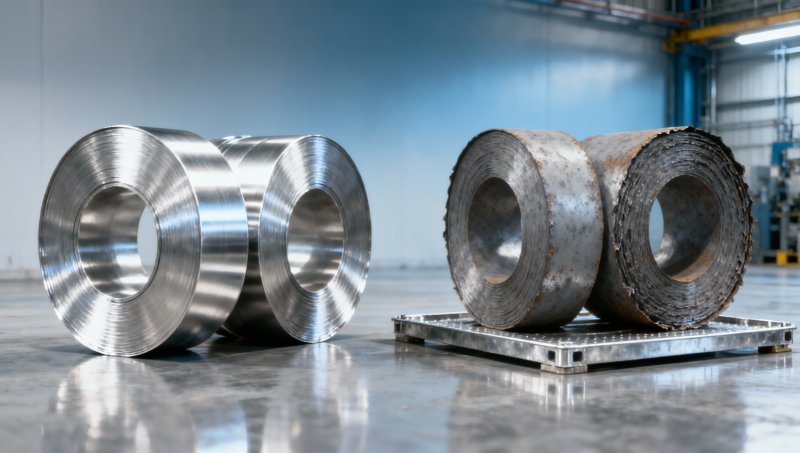
As a structural steel manufacturer and exporter from China, Hongteng Fengda delivers end-to-end reliability—not just material supply. We maintain dedicated production lines for cold rolled stainless coil (grades 304, 316, 430) with in-house annealing, tension leveling, and surface inspection systems calibrated to ISO 9001 standards.
Our clients across North America and Europe report average lead times of 25–35 days for custom-width cold rolled coils (0.3–3.0 mm thick, up to 1,500 mm wide), backed by 100% order fulfillment rate over the past 36 months. We support technical evaluation with free sample coils (up to 50 kg), full MTR documentation, and joint bending trials at your facility.
Whether you need precise cold rolled stainless steel coil for high-cycle automation components—or hot rolled structural solutions like Hot Rolled H Beam for large-scale construction—we align our engineering, quality control, and logistics to your project timeline, compliance requirements, and cost targets. Contact us today to discuss your specific bending application, request grade-specific fatigue test data, or schedule a virtual factory audit.
Please give us a message


Please enter what you want to find