Cold Rolled Steel Sheet in Coil is widely used in structural and industrial applications, but flatness issues can directly affect product quality, safety performance, and downstream processing efficiency. For quality control and safety management teams, understanding the causes of these defects is essential to reducing risks, maintaining compliance, and ensuring stable project results.
What does flatness mean for Cold Rolled Steel Sheet in Coil?
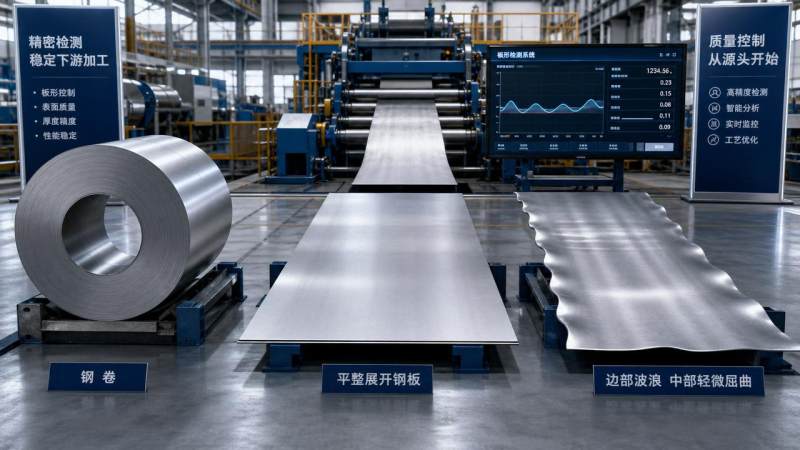
Flatness describes how evenly a steel sheet lies across its width and length without unwanted waves, buckles, or edge distortion.
For Cold Rolled Steel Sheet in Coil, flatness is not only a visual quality point. It directly influences forming, cutting, welding, assembly, and final dimensional accuracy.
Common flatness defects include center buckle, edge wave, full-length camber, cross bow, and localized high spots.
These conditions often appear small at first. However, they can become serious during slitting, stamping, roll forming, and automated fabrication.
In structural and industrial steel use, uneven sheet geometry may create alignment errors, coating problems, and unstable welding gaps.
That is why Cold Rolled Steel Sheet in Coil must be evaluated beyond thickness tolerance alone. Shape control matters just as much as strength.
Why do flatness issues happen in Cold Rolled Steel Sheet in Coil?
Flatness defects usually result from uneven internal stress distribution. When stress is not balanced, the sheet changes shape after rolling or processing.
Several production stages can create this imbalance. The main causes are related to rolling force, temperature, tension, and coil handling.
Rolling pressure and crown variation
If roll pressure is inconsistent across the strip width, elongation differs between the center and edges.
When the center elongates more, center buckle may appear. When edges elongate more, edge waves are more likely.
Improper tension control
Entry and exit tension strongly affect shape. Too much or too little tension can lock stress into the material.
This becomes especially important during recoiling, where tightly wound layers can preserve distortion until further fabrication.
Thermal differences and cooling inconsistency
Although cold rolled products are processed at lower temperatures, previous thermal history still matters.
Uneven cooling after hot rolling, pickling, or annealing can create residual stress that later affects Cold Rolled Steel Sheet in Coil.
Leveling and handling problems
Incorrect leveling setup may fail to remove shape defects or may even worsen them.
Storage on uneven supports, impact during transport, and poor lifting methods can also introduce permanent deformation.
How can flatness problems affect safety, cost, and downstream performance?
The effect of poor flatness goes far beyond appearance. In many cases, it creates direct technical and commercial losses.
- Stamping tools may wear faster because contact pressure becomes uneven.
- Laser cutting and shearing accuracy can fall when sheets do not stay stable on the working table.
- Welding quality may drop due to variable fit-up and inconsistent joint gaps.
- Coating, painting, or laminating may show poor adhesion on distorted areas.
- Assembly lines can face stoppages when components do not align as expected.
For structural applications, geometry errors may affect load transfer, connection accuracy, and long-term service reliability.
For industrial manufacturing, poor flatness usually increases scrap rates, extra re-leveling time, and hidden labor cost.
This is why buyers often review flatness together with strength grade, thickness tolerance, and surface quality before final acceptance.
How should Cold Rolled Steel Sheet in Coil be inspected and judged?
Effective inspection starts with clear acceptance criteria. Visual checks alone are not enough for reliable quality control.
A practical inspection routine normally includes shape observation, straightedge checking, width-based measurement, and process traceability review.
When possible, compare measurements against ASTM, EN, JIS, or GB requirements relevant to the project specification.
Reviewing coil history is also valuable. Mill settings, annealing records, and leveling parameters often explain recurring shape problems.
In many projects, trial processing of a sample sheet gives the most realistic answer about whether Cold Rolled Steel Sheet in Coil is suitable.
Which material and product factors should be compared before selection?
Selection should not focus on price alone. Material chemistry, processing behavior, and end-use conditions all influence flatness stability.
In some applications, a tailored coil solution can help balance workability and dimensional control.
One relevant option is Rolled Coil, available in grades such as Q235, Q235B, Q345, Q345B, Q195, St37, and St52.4.
This carbon steel product supports boiler plate applications and follows standards including GB/T 700-2006, AiSi, ASTM, DIN, and JIS.
Its carbon content ranges from 0.12% to 0.20%, with manganese at 0.30% to 0.70%.
It also offers good weldability, reliable cold working performance, and suitability for bending, stamping, forging, and hot rolling.
When reviewing Cold Rolled Steel Sheet in Coil, compare not only grade labels but also coil width range, tolerance consistency, surface condition, and forming behavior.
A coated finish, width flexibility, and controlled chemistry may improve consistency in downstream operations where flatness is critical.
What are the most common mistakes when dealing with Cold Rolled Steel Sheet in Coil flatness issues?
Many flatness problems continue because they are treated as isolated defects instead of system-level quality signals.
Mistake 1: judging only by thickness
A coil may meet thickness tolerance and still perform poorly if shape defects remain uncontrolled.
Mistake 2: ignoring storage and transport
Even well-produced Cold Rolled Steel Sheet in Coil can lose flatness after improper stacking, wet conditions, or rough handling.
Mistake 3: overcorrecting with aggressive leveling
Strong corrective leveling can change residual stress patterns and create new defects, especially in thinner gauges.
Mistake 4: using one acceptance standard for every application
Requirements for decorative panels, structural parts, and stamping components are different. The same flatness limit may not fit all uses.
How can flatness risks be reduced in real projects?
The best approach combines supplier control, incoming inspection, and process feedback from actual fabrication results.
- Define flatness requirements clearly in purchase documents.
- Match acceptance criteria to the real application, not generic expectations.
- Request material certificates and relevant process records.
- Inspect coils early before large-scale cutting or forming begins.
- Store coils on proper supports and protect them from impact and moisture.
- Share downstream defect data with the steel source for corrective action.
For projects requiring stable global supply, a qualified structural steel partner can reduce variation through controlled production and standard compliance.
Hongteng Fengda, a structural steel manufacturer and exporter from China, provides reliable steel products and customized solutions for construction and industrial use.
With modern facilities and quality control aligned to ASTM, EN, JIS, and GB, consistent supply and dependable lead times become easier to maintain.
In summary, Cold Rolled Steel Sheet in Coil flatness issues should be managed as a performance and risk-control priority, not a minor visual defect.
By checking root causes, selecting suitable material, and applying practical inspection standards, project outcomes become safer, more efficient, and more predictable.
If a project requires stable structural steel support, the next step is to confirm specifications, review standards, and align product selection with actual fabrication demands.
Please give us a message


Please enter what you want to find