A roof purlin, an interior wall stud, and a warehouse storage rack may look like very different components, yet all can be made from steel shaped into thin, efficient profiles. Cold-formed steel sections, known in Spanish as aceros conformados en frio, are valued because their shape makes relatively light steel sheet useful in a wide range of structural systems.
For anyone comparing C, U, Z, or hat sections for the first time, the challenge is understanding what each profile does and how it behaves after installation. The right choice depends on loading, span, restraint, connections, and exposure—not simply on which section looks strongest.
What are cold-formed steel sections?
Cold-formed sections are produced by bending or roll-forming steel sheet or strip at approximately room temperature. The starting material is commonly supplied in coils, which pass through forming equipment to create a continuous profile. Alternatively, a press brake can bend individual lengths, an approach often useful for shorter runs or special shapes.
Unlike hot-rolled sections, which are shaped while the steel is hot, cold-formed profiles generally have thinner walls and can incorporate folds, lips, and stiffeners. These features make the section more efficient and can provide surfaces for fastening or overlapping. Holes and slots may also be formed for services or connections, although their effect on structural capacity must be considered.
Cold forming can change the properties of steel around the bends. More importantly for a designer, a thin-walled member may buckle locally or twist before the entire cross-section reaches its material strength. That is why a section’s geometry and support conditions matter as much as its steel grade.
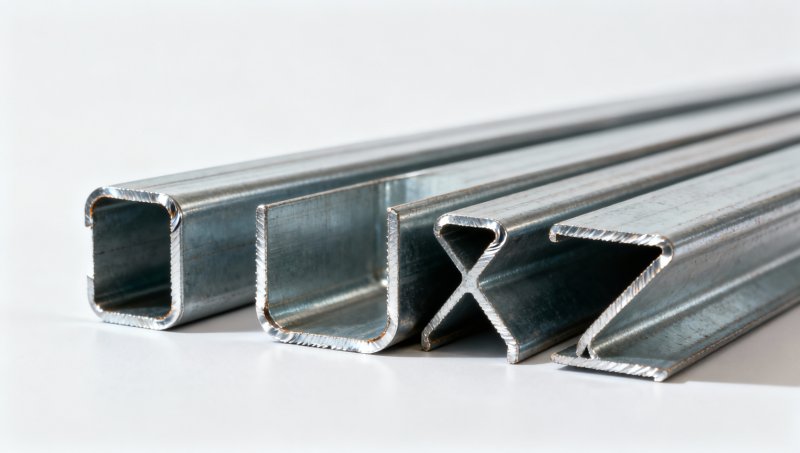
Common profiles and where they fit
The names of cold-formed sections usually describe their cross-sectional shape. Actual profiles vary by manufacturer, particularly in lip dimensions, hole patterns, thickness, and tolerances.
C sections: adaptable framing members
C sections are among the most familiar cold-formed shapes. In a light steel wall, vertical C-shaped studs fit into horizontal tracks. Depending on the design, similar profiles can also serve as floor joists, roof members, or secondary framing.
Many C sections have small return lips at the edges of their flanges. These lips help stiffen the compression flange, but they do not eliminate the need to check buckling or provide restraint. A C section that works well as a wall stud is not automatically suitable as a long-span roof member.
U sections: practical tracks and supports
U sections, often called channels or tracks, are frequently used to locate and connect studs at the top and bottom of a framed wall. Their relatively open shape makes assembly straightforward. They can also form edge members or supports in other steel assemblies.
Terminology varies: some suppliers describe both lipped and unlipped profiles as channels. When requesting a quote, a dimensioned drawing is more reliable than a section name alone.
Z sections: useful for continuous roof and wall systems
Z sections are common as purlins beneath roof sheeting and as girts behind wall cladding. Their opposing flanges allow compatible sections to overlap at supports in some designs. A properly engineered lap can create continuity between spans, but its effectiveness depends on dimensions, fasteners, support details, and the applicable design method.
Not every Z section is interchangeable with another. Flange sizes and orientations must suit the intended overlap, and the designer must account for the way roof or wall loads act in both pressure and uplift.
Hat sections and special shapes
Hat sections provide a raised surface with flanges that can be fixed to a supporting substrate. They are often used as furring or as secondary supports for roofing and cladding. Their usefulness lies partly in the available fixing surfaces and the space created between layers.
Custom profiles can combine bends, lips, slots, or asymmetric dimensions to meet a particular assembly requirement. This flexibility is attractive when standard shapes create awkward connections, though tooling, production quantity, and tolerances should be discussed before a profile is finalized.
How cold-formed steel works in a structure
A section does not carry load in isolation. Its performance depends on the whole load path: how forces enter the member, where it is supported, how it is restrained, and how forces pass into the rest of the structure.
Consider a roof purlin. It may support roof sheeting under downward loads and experience uplift when wind acts on the roof. The sheeting can provide restraint under certain conditions, but the designer should not assume that it restrains every flange equally in every load case. Fastener spacing and the type of sheeting are part of the calculation.
In wall framing, studs transfer loads to tracks and the supporting structure. Openings for doors, windows, or building services can interrupt that path, so adjacent members and connections may need additional attention. Similarly, a storage rack upright may carry compression while its perforations and beam connections influence its capacity.
Common checks include bending, shear, compression, deflection, and several forms of instability. Local buckling can occur in a slender flat element; distortional buckling involves movement of part of the cross-section; and overall buckling can affect the member as a whole. The relevant design standard determines how these effects are assessed.
Cold-formed versus hot-rolled steel
Cold-formed and hot-rolled steel are complementary rather than competing answers to every structural question. Cold-formed sections are often selected for secondary framing and light structural systems where thin material and detailed shapes are advantageous. Hot-rolled beams and columns are commonly used where heavier sections, larger loads, or different connection requirements make them suitable.
A single building may use both: hot-rolled primary frames with cold-formed purlins, girts, and internal studs. Comparing the two by weight alone can be misleading. Installation, bracing, fire protection, corrosion protection, and connection details all affect the finished system.
Choosing a section: questions to settle before ordering
For information researchers and early-stage buyers, the most useful specifications are often the ones that prevent two parties from imagining different products. Start with the intended application, then establish the following with the project designer and supplier:
- Section geometry: Provide web depth, flange width, lip size, bend details, and a drawing where possible. State which dimensions are inside, outside, or overall measurements.
- Steel grade and thickness: Identify the required material standard and strength. Confirm whether the specified thickness refers to base steel or includes a metallic coating.
- Length and holes: Specify cut lengths, permitted tolerances, hole sizes, positions, and orientation. A mirrored or misplaced hole pattern can complicate installation.
- Design conditions: Establish spans, loads, support locations, and restraint assumptions. A supplier’s profile dimensions alone do not establish suitability for a particular structure.
- Exposure and protection: Consider moisture, condensation, chemicals, coastal conditions, and maintenance access when selecting a coating or material.
- Connections: Check compatibility with screws, bolts, welds, clips, and adjoining materials. Thin sections require connection details appropriate to their thickness.
For international projects, also identify the applicable material, manufacturing, and structural design standards. ASTM, EN, JIS, and GB designations cover different products and requirements; they should not be treated as automatically equivalent. The project documents should specify which standard and grade apply, along with the documentation needed to verify the order.
Corrosion, material choices, and service environment
Many cold-formed profiles are made from coated carbon steel. Metallic coatings can protect the base steel, but the appropriate coating depends on the environment and expected service life. Cut edges, drilled holes, damaged surfaces, and contact with dissimilar metals deserve particular attention. In concealed wall or roof cavities, controlling moisture is also important.
Stainless steel is another material option for certain corrosive environments, though grade selection and structural design still depend on exposure and loading. For related fabrication needs, 316L Stainless Steel Plate is a low-carbon, molybdenum-containing material used in applications such as chemical and food-processing equipment. Plate is not automatically a substitute for a cold-formed structural profile: its dimensions, finish, forming requirements, and suitability for the environment must be evaluated separately.
Frequently asked questions
Are cold-formed sections suitable for load-bearing walls?
Yes. Cold-formed steel studs can be used in load-bearing walls when the members, bracing, connections, and foundations are designed for the applicable loads and code requirements. A profile intended only for a non-load-bearing partition should not be assumed adequate for a structural wall.
Does a thicker section always solve a capacity problem?
Not necessarily. Greater thickness may improve capacity, but failure or excessive movement can also be governed by the section shape, span, restraint, connection, or supporting structure. Changing one dimension without checking the system can create new fit or fastening issues.
Can cold-formed steel be welded?
It can be welded when the material, thickness, coating, and joint are suitable and the work follows an appropriate procedure. Thin steel is sensitive to heat input and distortion, while coated material calls for attention to welding safety and restoration of corrosion protection. Bolted and screwed connections are also common.
What should a buyer send to a manufacturer?
A useful inquiry includes a section drawing, steel grade, base-metal thickness, coating requirement, lengths, quantities, hole details, required standard, and destination. Hongteng Fengda supplies standard and customized structural steel products, including cold-formed profiles; discussing these details early helps establish what can be produced and what information still needs confirmation.
Ultimately, selecting aceros conformados en frio is less about finding a universally “best” shape than matching a profile to its job. A clear load path, realistic exposure assumptions, and precise ordering information give the section a better chance of performing as intended—from the first drawing through installation.
Please give us a message


Please enter what you want to find