It often starts with a practical question rather than a technical one. A designer needs a lighter framing member. A buyer is comparing sections from different suppliers. A workshop is trying to understand why one profile nests cleanly into an assembly while another needs rework. In these situations, people may already know that cold formed steel profiles are common, but they are not always sure how to judge whether a specific profile is strong enough, dimensionally consistent enough, or even suitable for the intended use.
The difficulty is that the wrong assumption usually does not show up on a drawing. It appears later as deflection, poor fit-up, extra welding, misaligned holes, wasted coating, or avoidable delays during installation. If you are sorting through technical data and trying to make sense of load capacity, tolerances, and application limits, it helps to break the topic into a few decisions that can actually be checked.
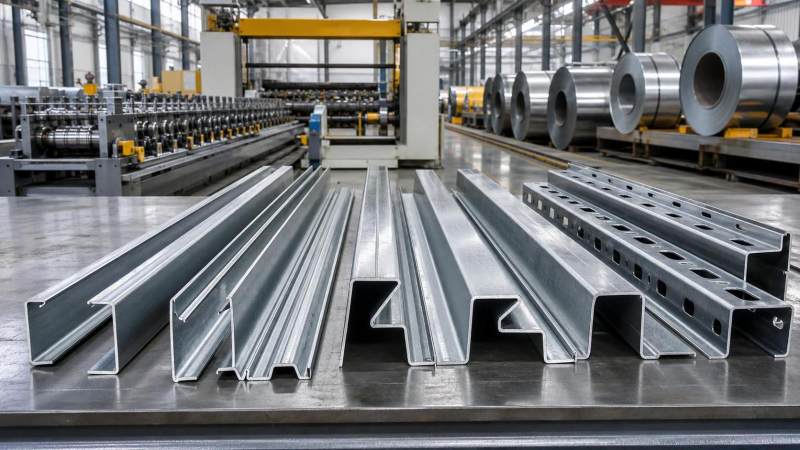
Cold formed steel profiles are produced by shaping steel sheet or strip at room temperature, usually through roll forming or press braking. That manufacturing route is what gives them their familiar mix of efficiency and precision. Compared with hot rolled sections, they are often thinner, lighter, and easier to tailor into shapes such as channels, C sections, Z sections, hat profiles, tracks, studs, and custom open or closed forms. But that same thin-wall geometry is also the reason they must be evaluated differently. People sometimes compare them to heavier structural sections on appearance alone and miss the details that matter most.
Where confusion usually begins
A common misunderstanding is to treat all steel sections as if strength comes only from material grade. Grade matters, of course, but with cold formed members the geometry does a great deal of the work. Lip size, web depth, flange width, corner radius, and thickness all affect the way the section resists bending, shear, torsion, and local buckling. Two profiles made from similar steel can behave very differently under the same load if their shape changes even slightly.
Another source of confusion is the phrase “load capacity.” Many people use it as a single number, when in practice it depends on support conditions, span, load type, bracing, connection method, hole placement, and whether the profile is acting alone or as part of a system. A member that performs well in a wall stud application may not be suitable as a purlin without considering lateral restraint. A section that looks stiff in hand may still be vulnerable to local crippling near supports.
Reading load capacity without oversimplifying it
When you review data for cold formed steel profiles, the first step is to separate material properties from section properties. Material properties include yield strength, tensile strength, and elongation. Section properties include moment of inertia, section modulus, torsional characteristics, and effective area. The profile’s final performance comes from both. This sounds obvious, but in real sourcing and design discussions, one set of values is often examined while the other is assumed.
For practical comparison, ask these questions:
- Is the load mainly bending, axial compression, or a combination?
- Will the member be laterally restrained or free to twist?
- Are there concentrated loads at supports, fastener points, or bracket locations?
- Does the profile include perforations, slots, or service holes that reduce effective section?
- Is the thickness sufficient to control local buckling, not just gross yielding?
These questions matter because thin steel sections often fail by instability before the base steel reaches its nominal yield strength. That is why a profile that seems generous on paper may still need a closer check under compression, uplift, or repeated service loading. It is also why design based only on thickness is risky. Thickness is important, but by itself it does not tell you how the shape will distort under real use.
If you are comparing profiles for framing, racks, cable support systems, partition structures, cladding rails, or light industrial members, look for whether the section is intended for that exact role. Some profiles are proportioned for easy fastening and enclosure support rather than maximum structural efficiency. Others are designed for spanning and stiffness. Using one in place of the other can create avoidable problems.
Tolerances are not a minor detail
People often focus on strength first and discover tolerance issues later on the shop floor. With cold formed steel profiles, dimensional consistency is one of the main reasons they are chosen in the first place. Accurate width, depth, flange angle, straightness, length, and hole location reduce fitting time and help assemblies repeat properly.
In everyday project terms, tolerances influence whether:
- Profiles align with brackets, tracks, and connection plates
- Panels seat correctly on framing members
- Bolted holes match without forcing or elongation
- Long runs remain straight enough for installation appearance and serviceability
- Nested or telescoping parts slide together as intended
Even a profile that is technically strong enough can become frustrating if twist, camber, edge waviness, or inconsistent flange dimensions interfere with fabrication. This is especially true in modular work, partition systems, suspended frames, and repeated OEM components where one piece must behave like the next one. The more standardized the assembly, the more visible tolerance problems become.
When checking tolerances, avoid asking only for “standard accuracy.” Ask what is being controlled and how it is measured. Different applications care about different dimensions. A purlin line may care deeply about depth and straightness. A track and stud system may be sensitive to width and lip geometry. A custom bracket profile may depend on bend angle and hole position. If a supplier does not know which features are critical to your use, useful tolerance discussion becomes vague very quickly.
Good applications and the places where caution is needed
Cold formed steel profiles are a strong fit where low to moderate structural demand needs to be combined with repeatability, lower self-weight, easier handling, and efficient production. Typical uses include wall studs, tracks, ceiling systems, purlins, girts, cladding supports, door frames, cable tray structures, storage systems, solar mounting elements, equipment housings, and many custom fabricated components.
They also work well where corrosion protection and surface finish are part of the decision, not just structural behavior. In exposed or semi-exposed environments, the base profile may be formed from coated steel rather than protected only after fabrication. In those situations, the feedstock matters because forming performance, coating condition, and final durability are tied together.
For some profile applications, coated coil such as AZ150 Galvalume Steel Coil may be considered during material selection, especially when corrosion resistance, paintability, and formability all need to be balanced. Its available substrate options, coating range, and finish conditions can be relevant when a profile is roll formed for light structural or enclosure-related uses. That does not replace structural design checks, but it can influence service life expectations and fabrication practicality.
Caution is needed when sections are asked to do work that approaches heavy structural behavior without proper verification. Long unbraced spans, severe point loads, high-impact environments, aggressive fire exposure, or applications with significant torsion should not be judged by appearance or by generic section tables alone. A profile can be suitable in one orientation and unsuitable in another. It can also require stiffeners, bridging, thicker material, or a different shape altogether.
A more reliable way to compare options
If you are trying to choose between several cold formed steel profiles, a better approach is to compare them through the actual service conditions rather than through catalog dimensions only.
Start with the load path. Identify where the load enters the member, how it travels through the profile, and where it exits into the support or connection. That simple step often reveals whether web crippling, flange distortion, screw pull-out, or torsional rotation is likely to govern.
Then review the section in three layers:
First layer: material. Check steel grade, coating type if relevant, and basic mechanical properties. For formed products, elongation can matter because very low ductility may limit bending performance during manufacturing.
Second layer: shape. Look at depth-to-thickness relationships, lip details, corner radii, and whether the profile is open, lipped, hat-shaped, boxed, or reinforced. Small changes here can influence both stiffness and stability.
Third layer: manufacturing consistency. Ask about thickness control, dimensional tolerances, straightness, edge condition, and whether the profile is produced from pre-coated or uncoated material depending on the application. A well-designed shape still causes trouble if production variation is too wide for the assembly.
This method is slower than choosing by weight alone, but it avoids a common failure in procurement: selecting a profile that seems economical per ton or per meter yet creates higher total cost because of extra support steel, installation correction, or protective treatment later.
What people often overlook during sourcing
One of the most overlooked issues is the relationship between forming and final dimensional performance. Profiles made from thinner strip can be very efficient, but they also react more visibly to residual stress, springback, and handling. That does not make them unreliable; it means the production route and quality control matter. If your project depends on repeatable assembly, ask whether the profile dimensions remain stable across production runs and whether critical bends are monitored.
Another point that gets missed is surface condition after forming. If the profile is intended for painted systems, outdoor enclosures, or humid service conditions, the base material and surface treatment should match the fabrication sequence. In some cases, using a corrosion-resistant coated substrate from the start is more practical than relying entirely on post-fabrication protection. That is one reason some manufacturers evaluate materials like AZ150 Galvalume Steel Coil for profile production where corrosion resistance, workable coating condition, and consistent coil supply are relevant factors.
Hole punching and notching also deserve attention. Openings added for service integration or fastening convenience can reduce local strength more than expected if they are placed near supports, bends, or high-stress regions. A profile that works in its unperforated form may need redesign after those features are introduced. This is common in cable management sections, light equipment frames, and modular installation systems.
When a profile is probably the wrong choice
Not every problem should be solved with a cold formed section. If the application involves very high concentrated loads, severe abrasion, repeated impact, or large unsupported spans with strict deflection limits, a hot rolled section, built-up member, or thicker plate fabrication may be more sensible. The issue is not that cold formed steel profiles are weak; it is that they are optimized differently.
You should also pause if the design relies on field modifications that are likely to alter the section shape. Cutting flanges, enlarging holes, flattening lips, or forcing a member into alignment can quickly remove the very geometry that gives the profile its efficiency. In those cases, either the profile needs re-engineering or the installation method does.
Practical takeaways for design and purchasing reviews
If you are reviewing a profile for the first time, resist the urge to ask only “Is it strong enough?” A more useful set of questions is: strong enough for which loading condition, stable enough in which orientation, accurate enough for which assembly, and durable enough for which environment?
That shift in wording usually leads to better decisions. It moves the conversation from general material preference to actual service requirements. It also makes it easier to compare suppliers and profile options on technical grounds rather than on assumptions.
Cold formed steel profiles earn their place because they can combine efficient material use, repeatable geometry, and wide application flexibility. But they perform best when load capacity is checked as a system issue, tolerances are treated as part of function rather than appearance, and the final use is matched to the strengths of the profile instead of forced onto it. For anyone evaluating sections for framing, industrial systems, or custom components, that is usually the difference between a profile that merely looks suitable and one that works cleanly in practice.
Please give us a message


Please enter what you want to find