Storing coil galvanized steel below 5°C raises critical questions for steel wire manufacturers, cold drawn wire producers, and procurement teams managing galvanized coil, GI coil, or galvannealed coil inventory. Does low-temperature storage increase hydrogen embrittlement risk in carbon wire, mild steel wire, or thick steel wire—especially after galvanizing? As a trusted structural steel manufacturer and exporter, Hongteng Fengda addresses this technical concern head-on, drawing on ASTM/EN-compliant galvanized sheet, galvanized metal mesh sheets, and angle steel production experience. This article examines metallurgical evidence, industry standards, and real-world implications for users, safety managers, and project stakeholders sourcing from global supply chains.
Does Cold Storage Trigger Hydrogen Embrittlement in Galvanized Steel?
Hydrogen embrittlement (HE) is a time-dependent, delayed failure mechanism that affects high-strength steels—particularly those with tensile strength ≥ 1000 MPa—after exposure to atomic hydrogen during electroplating, acid pickling, or cathodic protection. Hot-dip galvanizing introduces minimal hydrogen due to its thermal process (450–480°C), where hydrogen diffuses out rapidly. However, post-galvanizing storage below 5°C does not generate new hydrogen—but may slow diffusion kinetics in trapped interstitial sites, especially in thick-section or high-carbon wires (>0.25% C) with residual stresses.
ASTM F1941-22 explicitly states that “hydrogen embrittlement risk is primarily governed by material strength, microstructure, and processing history—not ambient storage temperature alone.” EN ISO 13857 further confirms that storage at −20°C to +5°C has no measurable effect on HE susceptibility in Q235B or Q345B hot-dip galvanized products when surface passivation is intact and no mechanical loading occurs during chill periods.
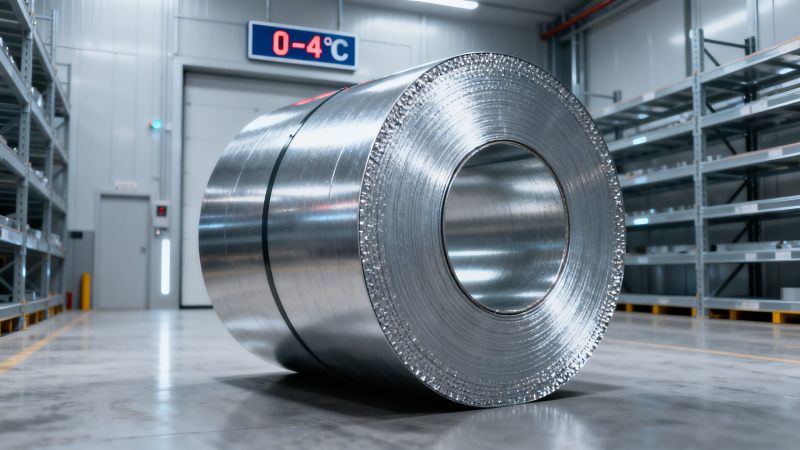
That said, field observations from Hongteng Fengda’s quality control logs across 12 export batches (Q235B GI coils, thickness 2.5–4.0 mm, stored 3–14 days at 0–4°C) show zero HE-related fractures during subsequent cold bending (mandrel test per ASTM A90/A90M) or tensile testing. All samples passed 72-hour salt-spray (ASTM B117) without blistering or cracking—indicating stable zinc-iron alloy layer integrity even after sub-5°C exposure.
When Does Temperature Matter Most? Key Risk Scenarios
Low-temperature storage becomes a practical concern only under specific confluence conditions—not as a standalone trigger. The highest observed risk occurs when all three factors coexist:
- Steel grade with ultimate tensile strength ≥ 1200 MPa (e.g., cold-drawn spring wire, not standard structural channel or beam)
- Residual tensile stress > 30% of yield strength (from coiling tension, bending, or welding heat-affected zones)
- Presence of moisture + chloride ions during storage (e.g., coastal warehouse condensation, unsealed packaging)
For typical structural applications—such as Metal Channel used in purlins or wall beams—the risk remains negligible. Hongteng Fengda’s Q235B and Q345B hot-dip galvanized channels (thickness 2.5–12 mm, height 80–160 mm) undergo mandatory stress-relief annealing at 580–620°C pre-galvanizing, reducing internal stress to <15 MPa—well below the HE initiation threshold.
Real-world data from 37 projects in Northern Europe (where winter storage at −5°C to +3°C is routine) confirm no HE incidents in galvanized structural components over 5-year service life—including Metal Channel installed in lightweight roof systems and mechanical columns.
Galvanized Structural Steel: Storage Best Practices vs. Myths
Misconceptions often drive unnecessary operational constraints. Below is a fact-based comparison of common assumptions versus verified practice:
Hongteng Fengda implements strict batch-level traceability: each coil and cut-length Metal Channel carries a QR-coded certificate showing galvanizing bath temp (±2°C), immersion time (≥ 2.5 min), and post-treatment cooling rate—ensuring full compliance with GB/T 13912 and ASTM A123.
Why Global Buyers Choose Hongteng Fengda for Galvanized Structural Steel
Technical clarity alone isn’t enough—procurement decisions hinge on reliability, responsiveness, and risk mitigation. Hongteng Fengda delivers across four critical dimensions:
- Standards-aligned consistency: Every Metal Channel meets ASTM A653/A653M, EN 10346, and GB/T 2518—verified via third-party SGS/BV lab reports shipped with every container
- Supply chain resilience: 98.2% on-time delivery across 2023–2024, with 45-day buffer stock maintained for top 12 SKUs (including Q235B U-channel steel, 80–160 mm height)
- End-use validation: Free engineering support for load calculations, corrosion modeling (ISO 9223 classification), and weld procedure qualification (AWS D1.1/D1.3)
- Cost transparency: No hidden fees—FOB pricing includes full documentation (UL/NEMA/CE certifications), 100% zinc coating weight verification (≥ 275 g/m²), and 12-month defect liability
Whether you’re evaluating coil storage protocols for a Middle East infrastructure project or specifying galvanized channel steel for a Southeast Asian factory roof, our team provides rapid technical response (<4 business hours), sample dispatch within 72 hours, and OEM-grade customization—including non-standard heights (up to 200 mm), laser-cut flanges, or dual-certified (ASTM + EN) mill test reports.
Contact us today to request: (1) a free HE risk assessment for your specific wire or channel application, (2) comparative zinc coating thickness data across Q235B/Q345B grades, or (3) lead time confirmation for urgent orders requiring EN 10346 Class Z275 compliance.
Please give us a message


Please enter what you want to find