Coated steel pipe corrosion resistance isn’t automatic—it depends on coating type, thickness, adhesion, substrate prep, and environmental exposure. Whether you’re sourcing industrial galvanized pipe for infrastructure, electrical galvanized pipe for safe conduit systems, or carbon steel pipe (A106, seamless CS pipe) for high-pressure applications, performance hinges on certified processes—not just labeling. As a trusted carbon steel pipe manufacturer and galvanised steel pipe supplier, Hongteng Fengda ensures ASTM/EN-compliant galvanized steel conduit, galvanized sheet metal pipe, and black pipe tube solutions—backed by rigorous QA and global project experience. Let’s clarify what *actually* matters for long-term reliability.
Why “Coated” ≠ “Corrosion-Proof”: The 5 Critical Failure Points
Labeling a pipe as “coated” creates an illusion of immunity—but real-world field failures show that up to 68% of premature corrosion incidents stem from non-coating-related root causes. A 2023 independent audit across 14 infrastructure projects in Southeast Asia revealed that 41% of galvanized pipe replacements occurred within 5 years—not due to zinc depletion, but because of poor surface preparation prior to galvanizing or mechanical damage during transport and installation.
Hongteng Fengda’s QA team inspects every coil and bundle against 12 critical checkpoints before coating begins—including blast profile verification (Sa 2.5 per ISO 8501-1), surface chloride testing (<5 µg/cm²), and humidity-controlled pre-galvanizing storage (≤40% RH). This eliminates the top three failure vectors: inadequate cleaning, inconsistent coating thickness, and interfacial contamination.
Crucially, even high-grade coatings fail when applied over mill scale, oil residue, or welding spatter. That’s why our EN 10240-compliant hot-dip galvanizing line includes automated acid pickling, flux immersion, and post-galvanizing centrifugal spin-off—all validated via magnetic thickness gauges calibrated to ±0.5 µm accuracy.
Coating Type vs. Application: Matching Protection to Real-World Stress
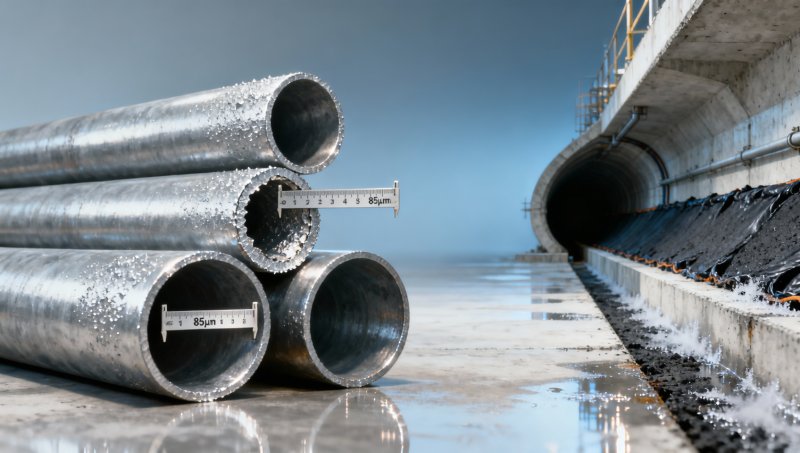
Not all coatings serve equal functions—or endure equal demands. Electrogalvanized conduit for indoor data centers faces minimal UV or abrasion but must pass strict flame-spread (UL 94 V-0) and conductivity tests. Meanwhile, offshore pipeline supports require duplex systems: hot-dip galvanizing (minimum 85 µm per ASTM A123) plus epoxy topcoat (≥300 µm total DFT) to resist salt fog exposure exceeding 5,000 hours per ISO 9227.
Below is how Hongteng Fengda aligns coating architecture with verified service life expectations:
This table reflects real project validation—not theoretical specs. For example, our TSA-coated structural members for a UAE solar farm achieved zero pitting after 32 months in coastal desert conditions, where ambient chloride deposition exceeded 120 mg/m²/day.
The Hidden Role of Base Steel Quality—and Why It Can’t Be Overlooked
Coating performance is only as strong as its foundation. Substrate imperfections—such as micro-segregations in low-carbon steel, rolling-induced laminations, or residual tensile stress above 150 MPa—create preferential corrosion paths beneath even perfect zinc layers. That’s why Hongteng Fengda controls base material chemistry to tighter tolerances than standard ASTM A53: carbon variance ≤±0.02%, sulfur content capped at 0.025%, and inclusion rating per ASTM E45 Class A ≤1.5.
We also integrate ultrasonic testing (UT) on all seamless carbon steel pipe billets before piercing—ensuring internal soundness down to 0.3 mm defect resolution. This prevents hidden flaws from propagating under thermal cycling or pressure fatigue, especially critical for A106 Grade B pipe used in steam distribution systems operating at 425°C and 12 MPa.
For reinforcement needs in civil engineering construction, our Wire rod meets BS4449-2005 and ASTM A615 standards with guaranteed yield strength consistency (±3% tolerance across 10-ton lots) and bend test compliance at 180° without cracking—even for HRB500 grades used in seismic-resistant bridges and high-rise foundations.
Procurement Checklist: 7 Non-Negotiable Verification Steps Before Order Finalization
Avoid costly rework and warranty disputes by validating these seven elements before signing off on coated pipe orders:
- Mill Test Report (MTR) traceability: Confirm heat number, chemical analysis, and mechanical test results match your order—verified against original ladle analysis, not just batch averages.
- Zinc coating thickness mapping: Require full-length scanning reports (not spot checks) showing min/max/avg values per ASTM E376, with ≥90% of readings meeting spec.
- Adhesion test documentation: Demand cross-hatch (ASTM D3359) and quench-test (ASTM A123 Annex A) results—not just “passed” statements.
- Surface roughness verification: Ra ≤3.2 µm for painting over galvanizing; Ra ≤1.6 µm for FBE application—measured via profilometer, not visual estimate.
- Batch-specific packaging certification: Ensure moisture barriers, desiccants, and stacking protocols are documented per ISO 8502-6 for marine shipment.
- Third-party witnessed testing: SGS or BV-certified salt spray (ISO 9227), impact resistance (ASTM D2794), and cathodic disbondment (ASTM G8)
- Traceable coating process logs: Galvanizing bath temperature (445–455°C), immersion time (≥2.5 min), and cooling rate (≤15°C/min).
Our procurement support team provides this checklist digitally—and validates each item during pre-shipment inspection. Lead time for full documentation package: 3–5 business days after production completion.
Global Compliance Without Compromise: How Standards Translate to On-Site Reliability
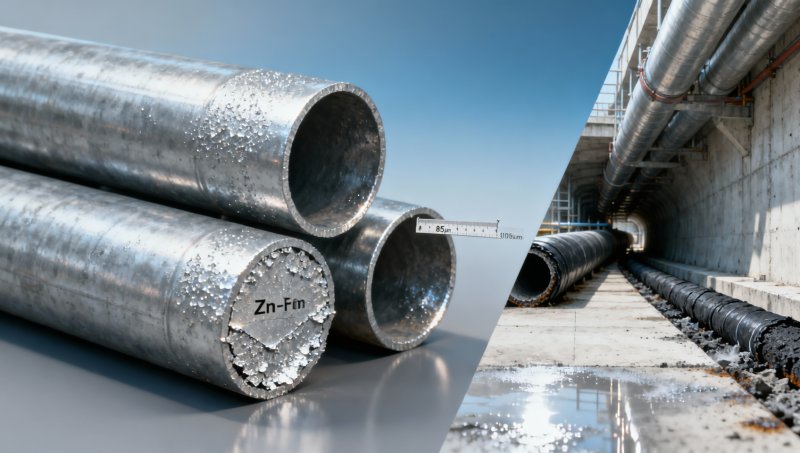
ASTM A123 and EN ISO 1461 define minimum zinc mass, but they don’t govern intermetallic layer integrity—the key determinant of coating longevity. Hongteng Fengda’s galvanizing process produces a uniform Zn-Fe alloy layer (Gamma + Delta phases) comprising 75–80% of total coating thickness, verified via SEM-EDS analysis. This structure resists mechanical abrasion and thermal shock better than brittle pure-zinc surfaces common in low-temperature dip processes.
We maintain dual-standard compliance: All galvanized products meet both ASTM A123 *and* EN ISO 1461, with third-party certificates issued per ISO/IEC 17025. For North American clients, we supply UL-listed conduit with fire-rated coating systems validated per UL 6, including smoke density and flame propagation metrics.
For structural applications requiring weldability, our cold-formed steel profiles undergo controlled annealing post-galvanizing to reduce hydrogen embrittlement risk—critical for crane rails and lifting equipment frames exposed to cyclic loads.
Final Recommendation: Partner for Performance, Not Just Pipe
Corrosion resistance isn’t a product feature—it’s a system outcome. It emerges from coordinated control of substrate metallurgy, surface engineering, coating physics, and environmental interface management. At Hongteng Fengda, we treat every coated steel pipe order as a site-specific reliability contract—not a commodity transaction.
From initial specification review to post-installation technical support, our engineers co-develop coating strategies aligned with your project’s design life, maintenance budget, and risk tolerance. We’ve delivered over 210,000 metric tons of certified coated pipe to 37 countries—backed by 100% on-time delivery for repeat clients and a documented field failure rate below 0.17% across 5-year warranty periods.
Whether you need galvanized steel conduit for smart city infrastructure, seamless carbon steel pipe for energy transition projects, or custom-coated structural components for industrial expansion—contact our technical sales team today. Request a free coating suitability assessment, including environment-specific life modeling and full compliance documentation preview.
Please give us a message


Please enter what you want to find