Coated steel wire choices start with the real service environment
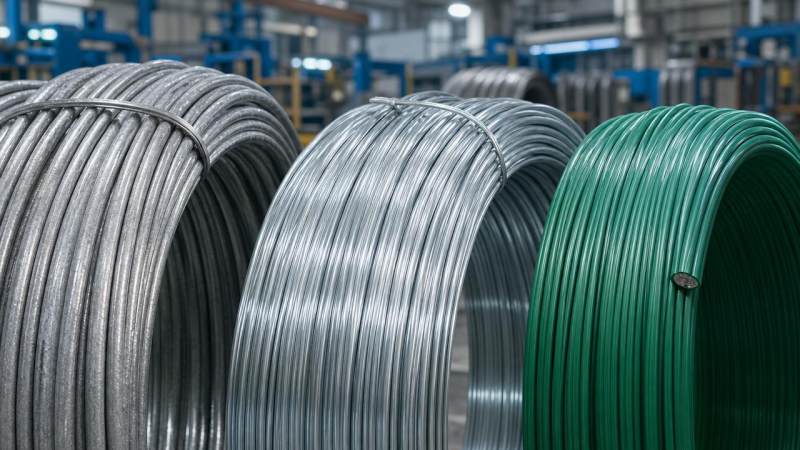
Choosing coated steel wire is rarely just a finish decision. It affects corrosion life, maintenance intervals, appearance stability, and how reliably a steel product performs in use.
In construction, industrial processing, and fabrication, similar-looking jobs can require very different coated steel wire specifications. Moisture, abrasion, chemicals, sunlight, and forming stress all change the answer.
That is why coated steel wire selection should be tied to application conditions, not only to nominal diameter or upfront price. A low-cost finish can become expensive after early replacement.
For companies supplying structural steel and related fabricated products worldwide, this matters even more. Projects across North America, Europe, the Middle East, and Southeast Asia often follow different standards and exposure demands.
Hongteng Fengda works in that reality. With structural steel manufacturing, OEM support, and compliance with ASTM, EN, JIS, and GB, the practical question is not which coating sounds better, but which one fits the job.
Why one coated steel wire finish does not suit every use
Different finishes protect steel wire in different ways. Zinc mainly provides sacrificial corrosion protection. PVC adds a physical barrier and helps in contact-sensitive or decorative environments.
Other coatings, including PE, nylon, or specialized alloy finishes, are often chosen when impact resistance, smoother handling, or additional weather protection matter more than basic galvanizing alone.
The main mistake is assuming exposure level tells the whole story. In actual use, bending frequency, fastening method, installation speed, and expected service life can be just as important.
A coated steel wire used for fencing behaves differently from one used inside a cable support, agricultural enclosure, or light industrial assembly. The surrounding environment may look similar, but the stress pattern is not.
A quick comparison before looking at applications
Outdoor fencing and boundary systems usually need more than basic corrosion control
This is where coated steel wire is often judged too narrowly. Many fence projects are exposed not only to rain, but also to impact, soil splash, fertilizer residue, and daily contact.
PVC coated steel wire is common here because the outer layer improves visual consistency and reduces direct metal exposure. In residential, public, and agricultural boundaries, that often matters as much as rust resistance.
Still, not every PVC option performs equally well. The underlying base wire, zinc layer quality, and UV resistance of the polymer make a major difference in service life.
Where the installation is near coastal air or strong sunlight, a simple color choice should never be the deciding factor. Better coated steel wire selection starts with expected weathering and mechanical wear.
When zinc-only wire remains the better fit
Hot dip galvanized wire often makes more sense for utility fencing, temporary perimeter systems, and rugged site use. These jobs usually value corrosion life and field durability over surface appearance.
If the wire may be scraped during installation, a thicker zinc finish can be more forgiving than a softer polymer skin. That is especially true on uneven ground or high-tension runs.
Industrial handling conditions change the selection logic
In workshops, light manufacturing lines, and equipment support systems, coated steel wire may face repeated motion, friction, and local heat. Corrosion is still relevant, but it is not always the first concern.
A polymer-coated surface can reduce scratching on adjacent parts and improve handling safety. That makes it useful for guides, racks, protective barriers, and some packaging-related supports.
In harsher chemical or temperature conditions, however, a standard coated steel wire may not be the best answer. Some applications need stainless material instead of thicker surface coating.
That is why related materials sometimes enter the discussion. For example, in high-temperature, food, chemical, or transport-linked fabrication, 304 Stainless Steel Coil can be relevant for complementary components that need stronger corrosion resistance, tensile strength of at least 520, and stable forming performance.
This does not replace coated steel wire in every assembly. It shows that finish selection should be part of a broader material decision, especially where corrosion, hygiene, and heat resistance overlap.
Construction and fabricated steel projects often require a more balanced judgment
On construction sites, coated steel wire may be used in tying, partition systems, mesh products, support elements, or secondary assemblies. These uses vary widely in exposure and expected lifespan.
For short-cycle use, electro galvanized wire may be sufficient where storage is dry and service life is limited. For permanent outdoor installations, that same choice can create preventable replacement issues.
Projects connected to structural steel supply also tend to involve specification alignment. Material consistency, lead time, and standard compliance are often as important as coating type.
A supplier with stable production and OEM capability can help avoid mismatches between design intent and delivered coated steel wire. That becomes valuable when multiple steel items must perform together on one project.
What usually drives the final choice on site
- Whether the wire is temporary, semi-permanent, or part of a long-life assembly.
- How much bending, twisting, or tension the coated steel wire will experience.
- Whether local codes or project documents reference ASTM, EN, JIS, or GB requirements.
- How much maintenance access exists after installation.
Different application conditions create different priorities
A useful way to evaluate coated steel wire is to compare the dominant risk, not just the industry label. Two industrial jobs can have less in common than one industrial job and one outdoor enclosure.
Where coated steel wire selection often goes wrong
One common misjudgment is choosing by coating name alone. A PVC coated steel wire with poor adhesion or weak UV stability may fail faster than a well-made galvanized alternative.
Another issue is focusing only on purchase price. When installation labor is high, replacing failed coated steel wire can cost far more than upgrading the finish at the start.
There is also a tendency to treat similar environments as equal. A shaded inland fence and a coastal equipment enclosure both sit outdoors, but their corrosion profile is not comparable.
Forming requirements are often overlooked too. If the wire must be bent tightly, twisted repeatedly, or tensioned hard, coating flexibility and base wire quality need close review.
A practical way to narrow the right finish before ordering
Start by defining the actual exposure: indoor, outdoor, wet, coastal, chemical, or mixed. Then confirm whether the coated steel wire will stay static or face repeated movement.
Next, decide whether appearance matters throughout the service life. That single point often separates zinc-only wire from PVC coated steel wire in visible installations.
After that, review maintenance access. If replacement is difficult, a stronger finish usually delivers better overall value. If the assembly includes other corrosion-resistant parts, material compatibility should also be checked.
In some fabricated systems, materials such as 304 stainless steel components with BA, 2B, NO.4, or HL finishes are paired with coated wire only where each material fits best. That kind of mixed selection is often more efficient than forcing one material everywhere.
The most reliable next step is to map the use condition, expected life, forming demands, and applicable standards together. Once those factors are clear, the right coated steel wire finish becomes easier to justify and easier to source consistently.
Please give us a message


Please enter what you want to find