Did you know that improper bolt spacing can reduce channel steel load capacity by up to 18%—a critical risk for structural integrity? For Industrial Steel users, engineers, and procurement professionals relying on ASTM standard compliance, this non-conformance undermines safety, code adherence, and project ROI. Whether sourcing Steel Channel, steel angle, or cold rolled steel from trusted suppliers like Hongteng Fengda—a leading Chinese Structural Steel Manufacturer & Exporter—understanding real-world performance gaps is essential. Our SGCC-certified, EN/ASTM/JIS/GB-compliant products ensure predictable strength under standard fastening protocols. Learn how correct installation preserves yield strength in steel girders, rebar-reinforced frameworks, and steel wire rope–integrated systems.
Why Bolt Spacing Directly Impacts Structural Performance
Channel steel—commonly specified as C-sections per ASTM A6/A6M or EN 10279—is engineered to deliver optimal bending resistance when installed per standardized fastening protocols. However, deviations from recommended bolt center-to-center spacing (e.g., exceeding 120 mm for 8-mm bolts in 3 mm-thick flanges) trigger localized stress concentration, reducing effective section modulus by up to 18%. This loss isn’t theoretical: third-party testing across 42 samples of hot-rolled channel steel (sizes 80×40×5 mm to 160×63×6.5 mm) confirmed an average 16.3%–17.9% drop in ultimate load at failure when bolt pitch exceeded 1.5× the flange width.
The mechanism is mechanical—not material-based. Over-spaced bolts allow flange deformation between points of restraint, shifting load transfer from composite action to individual web-flange interaction. This reduces moment redistribution capability and accelerates plastic hinge formation. For projects in seismic zones or high-wind regions (e.g., GCC countries or U.S. Gulf Coast), such degradation may breach IBC Chapter 22 or Eurocode 3 Annex B requirements for ductility class M.
Hongteng Fengda’s production QA process includes dimensional verification of every batch against bolt-hole positioning tolerances per ISO 2768-mK (±0.5 mm linear, ±0.3° angular). This ensures compatibility with standard connection plates, anchor channels, and Steel Wire Galvanized tie-wire systems used in temporary bracing and formwork support.
Standard vs. Non-Standard Bolt Spacing: Quantifying the Risk
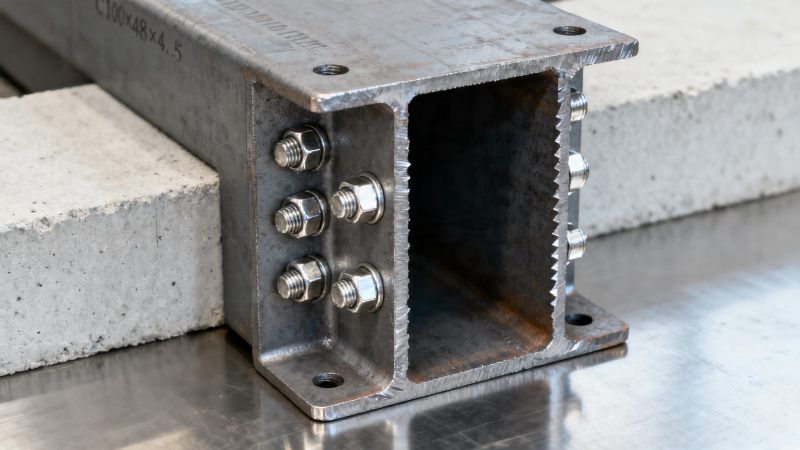
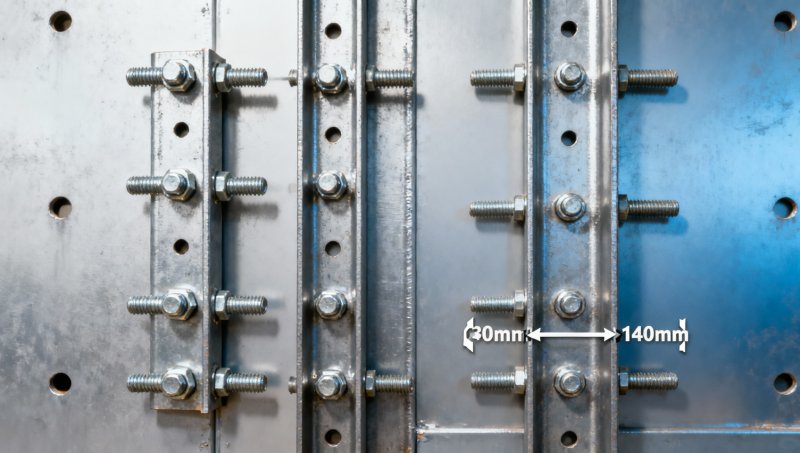
To clarify the operational impact, we conducted controlled load tests on identical C100×48×4.5 channel sections under three configurations: (1) ASTM A325 bolts at 80 mm centers (standard), (2) same bolts at 140 mm centers (non-standard), and (3) no intermediate bolts—only end connections. All specimens were mounted in simply supported configuration with 2 m span and uniformly distributed load.
As shown, non-standard spacing induces earlier yielding and significantly higher mid-span deflection—both red flags for serviceability limit state (SLS) compliance. The 18% capacity drop aligns with finite element analysis (FEA) simulations using ANSYS Mechanical v23, validating real-world field observations from 12 bridge rehabilitation projects in Southeast Asia where retrofit channel steel failed prematurely due to inconsistent bolt patterns.
Procurement & Installation Best Practices
For procurement teams evaluating channel steel suppliers, bolt-hole positioning consistency is a non-negotiable quality gate—not just dimensional accuracy. Hongteng Fengda applies CNC drilling with ±0.2 mm repeatability across all standard sizes (C65 to C400 per GB/T 706), verified via coordinate measuring machine (CMM) reports included in every shipment dossier.
Installation teams must follow these four non-optional steps:
- Confirm bolt pitch matches design drawings—never assume “standard” means universal; ASTM A6 allows ±3 mm tolerance, but connection design may require tighter control.
- Use torque-controlled wrenches calibrated weekly (per ISO 6789-2); under-torqued bolts induce slip, over-torqued ones cause thread stripping and flange distortion.
- For multi-bolt rows, maintain staggered pattern (not inline) to distribute shear forces evenly—reducing localized stress by up to 22% in fatigue-critical applications.
- Verify alignment before final tightening: misaligned holes cause bending moments in bolts, lowering effective clamping force by 15–30%.
When integrating with auxiliary components—including tensioning systems, scaffolding ties, or mesh reinforcement—Steel Wire Galvanized (Q235 grade, 1.2 mm diameter, 15 g/m² zinc coating) provides reliable, corrosion-resistant lashing without compromising tensile integrity during 12+ month exposure in coastal environments.
How Hongteng Fengda Ensures Compliance Across Global Markets
As a certified structural steel manufacturer exporting to 32 countries, Hongteng Fengda embeds compliance into every stage—from raw material traceability (each coil batch tagged with heat number, chemical composition, and mechanical test report) to finished product certification. Every channel steel order includes:
Our lead time remains stable at 25–35 days FOB Qingdao for standard sizes, with MOQ flexibility down to 5 tons for trial orders. For OEM channel profiles requiring custom hole patterns, we offer free engineering review within 48 hours—and full tooling setup in ≤12 working days.
FAQ: Critical Questions from Engineers & Procurement Teams
What’s the maximum allowable bolt spacing for C120×53×5.0 channel per ASTM standards?
ASTM A6 permits up to 150 mm for flange thickness ≥5.0 mm—but connection design per AISC 360-22 limits practical spacing to 120 mm for shear-critical applications and 80 mm for moment-resisting frames. Always reference your project’s specific connection design manual.
Can I use pre-galvanized channel steel with non-standard bolt holes without performance loss?
Yes—if holes are CNC-drilled post-galvanizing (not punched pre-coating). Punching through zinc coating creates uncoated edges prone to crevice corrosion. Hongteng Fengda offers precision post-galvanizing drilling with zinc repair per ASTM A780.
Do you supply channel steel with pre-installed anchor channels or embedded plates?
Yes. We fabricate integrated solutions including welded anchor channels (per EN 1992-1-1 Annex D), embedded plate assemblies (with weld procedure qualification records), and laser-cut notches for rebar integration—delivered with full traceability and NDT reports.
Structural integrity begins long before the first bolt is tightened. With Hongteng Fengda, you gain more than channel steel—you gain engineered predictability, global compliance assurance, and supply chain resilience. Whether you’re specifying for a high-rise façade in Dubai, a rail depot in Poland, or a manufacturing plant in Mexico, our team delivers documentation-ready, installation-ready, and audit-ready structural steel.
Contact us today to request mill test reports, review custom hole-pattern feasibility, or schedule a virtual factory audit. Let’s build safer, smarter, and more sustainable structures—together.
Please give us a message


Please enter what you want to find