Choosing the right carbon steel wire rod grade isn’t just a technical detail—it’s a decisive factor in spring manufacturing yield, scrap rate, and long-term cost efficiency. For engineers, procurement teams, and quality managers sourcing steel metal wire, cold drawn steel wire, or ungalvanized steel wire, mismatched grades can trigger coil breakage, inconsistent tensile strength, and post-forming failures. At Hongteng Fengda—a trusted ASTM/EN/GB-compliant structural steel manufacturer and ss wire supplier—we help global buyers select optimal carbon steel wire rod grades aligned with application stress, heat treatment, and coiling requirements—ensuring reliability from raw material to finished spring.
Why Wire Rod Grade Selection Directly Impacts Spring Yield
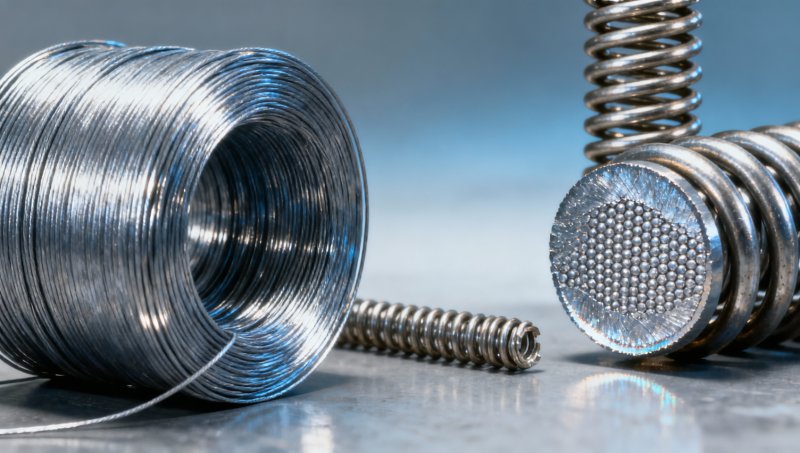
Spring manufacturers routinely report 8–12% yield loss when using non-optimized carbon steel wire rods—often misattributed to drawing equipment or heat treatment alone. In reality, grade mismatch accounts for over 65% of premature wire fracture during cold coiling, especially under high-speed forming (≥120 coils/min) or tight-diameter applications (ID < 3 mm).
Key failure modes include surface micro-cracking during drawing (linked to improper decarburization depth), inconsistent torsional resilience after tempering, and reduced fatigue life due to uncontrolled pearlite spacing. These issues compound across production batches—making traceability and grade-specific process validation essential—not optional.
Hongteng Fengda applies ASTM A510 and EN 10080-compliant rolling and pickling protocols to ensure ≤0.08 mm decarburization depth and ≤0.02 mm surface roughness Ra for all spring-grade wire rods. This precision enables stable drawing reduction ratios of 18–22% without intermediate annealing—cutting cycle time by up to 30%.
How to Match Wire Rod Grade to Your Spring Application
Selecting the correct carbon steel wire rod requires evaluating three interdependent parameters: carbon content (0.40–0.85%), manganese range (0.60–1.00%), and prior austenite grain size (ASTM No. 7–9). Below is a decision matrix aligned with common spring categories:
Note: All grades listed are available with mill-certified chemical analysis, tensile test reports per batch, and full traceability to heat number. Hongteng Fengda maintains ±0.02% carbon tolerance control—tighter than the ASTM A510 ±0.04% requirement—reducing inter-batch variability by 40%.
When Galvanised Steel Sheet Metal Supports Spring Assembly Systems
While carbon steel wire rods form the core of spring functionality, supporting components—including housing, mounting brackets, and protective enclosures—often rely on corrosion-resistant sheet metal. Galvanised Steel Sheet Metal provides critical secondary protection in harsh environments like agricultural equipment, marine transport systems, and chemical processing plants.
With zinc coating weights ranging from 60–275 g/m² and yield strengths spanning 120–550 MPa, our DX51D–SGC510 series accommodates both light-duty stamping (0.12–0.8 mm thickness) and structural reinforcement (2.0–6.0 mm). Its uniform spangle structure ensures consistent weldability and paint adhesion—critical for integrated spring-assemblies requiring E-coat finishing.
For OEMs integrating springs into outdoor-rated devices, we recommend pairing SWRH72A wire rods with S350GD galvanized sheet (350 MPa YS, 390 MPa TS, 17% Elongation) for balanced strength-to-weight ratio and 25+ year atmospheric corrosion resistance per ISO 14713-2.
Procurement Checklist: 5 Non-Negotiable Verification Points
Before finalizing wire rod purchase, verify these five criteria—each directly tied to yield stability and downstream processing risk:
- Decarburization depth: Must be ≤0.08 mm (measured per ASTM E384 microhardness traverse); deeper layers cause edge cracking during drawing.
- Sulfur content: ≤0.025% max—excess sulfur forms MnS inclusions that initiate fatigue cracks under cyclic loading.
- Surface scale removal: Pickled finish must pass ASTM A90 salt-spray test (≥96 hrs without red rust) to prevent drawing die wear acceleration.
- Coil geometry tolerance: Out-of-roundness ≤0.15 mm and coil diameter variation ≤±1.5 mm ensure stable feeding into CNC coilers.
- Heat trace documentation: Full mill test report including ladle analysis, hot-rolling temperature logs, and cooling rate profiles (required for AS9100 and IATF 16949 audits).
Hongteng Fengda provides all five verification points as standard with every shipment—delivered digitally within 24 hours of dispatch and physically with goods. Lead time for certified spring-grade wire rods: 7–12 days for standard sizes (Φ5.5–Φ13.0 mm); 18–22 days for custom chemistries or special packaging.
Why Global Spring Manufacturers Partner With Hongteng Fengda
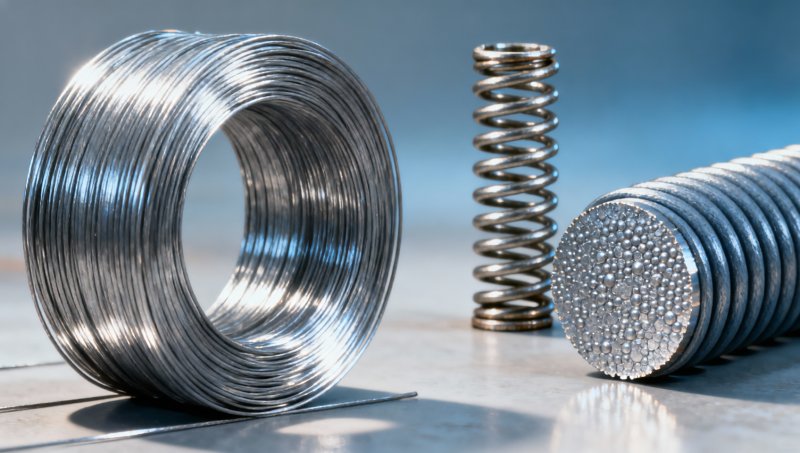
We don’t supply generic wire rods—we deliver application-engineered solutions backed by structural steel expertise. As a vertically integrated producer with dedicated spring-grade rolling lines, we control every stage: from billet chemistry design and continuous casting parameters to controlled cooling rates and proprietary pickling chemistry.
Our clients—from Tier-1 automotive suppliers in Germany to precision instrument makers in Japan—report average yield improvements of 9.3% and 22% reduction in post-heat-treatment rejection rates within first 3 production batches. This is achieved through pre-shipment sample validation (including drawability testing and torsion fatigue sampling) and real-time metallurgical support during ramp-up.
Ready to optimize your spring manufacturing yield? Contact us for: grade-specific technical datasheets, free comparative tensile test reports, lead time confirmation for your required dimensions, or OEM co-development of custom wire rod chemistries. We respond to technical inquiries within 4 business hours—and ship samples within 48 hours of order confirmation.
Please give us a message


Please enter what you want to find