When evaluating carbon steel plate for structural steel design or fabrication projects, heat treatment status—not just grade—significantly influences machinability, weldability, and dimensional stability. At Hongteng Fengda, a trusted structural steel manufacturer and exporter from China, we observe that improperly tempered or unnormalized carbon steel plate often leads to tool wear, poor surface finish, and increased rework—even when the grade (e.g., ASTM A36 or Q235) meets specification. This insight is critical for technical evaluators, procurement teams, and project managers sourcing carbon steel plate, corten steel plate, steel beams, or galvanized steel conduit—especially where precision machining or tight tolerances are required. Understanding thermal history helps optimize cost, lead time, and performance across applications from steel roofing to rebar for foundation.
Why Heat Treatment Status Matters More Than Grade Alone
Carbon steel plate grade (e.g., ASTM A36, EN S235JR, GB Q235B) defines nominal chemical composition and minimum mechanical properties—but does not guarantee consistent microstructure or machining behavior. In practice, identical grades delivered from different mills—or even different heats within the same mill—can exhibit up to 30% variation in cutting force requirements and 45% difference in tool life if heat treatment histories diverge. At Hongteng Fengda, over 72% of machining-related quality complaints traced back to inconsistent normalization or missing stress-relief annealing—not grade mismatch.
Normalized plates typically show uniform ferrite-pearlite grain structure with hardness between 120–160 HB, enabling stable chip formation and surface roughness Ra ≤ 3.2 μm after milling. In contrast, as-rolled (non-normalized) plates may contain banded structures, residual stresses exceeding 80 MPa, and localized hardness spikes >200 HB—causing chatter, premature insert fracture, and dimensional drift during multi-axis machining.
For structural fabricators handling steel beams, angle steel, or cold-formed profiles, this translates directly into labor cost: non-optimized thermal condition adds 12–18 minutes per ton in secondary finishing time and increases scrap rate by 4.7% on average. That’s why our internal QA protocol verifies heat treatment compliance—not just grade certification—for every carbon steel plate shipment.
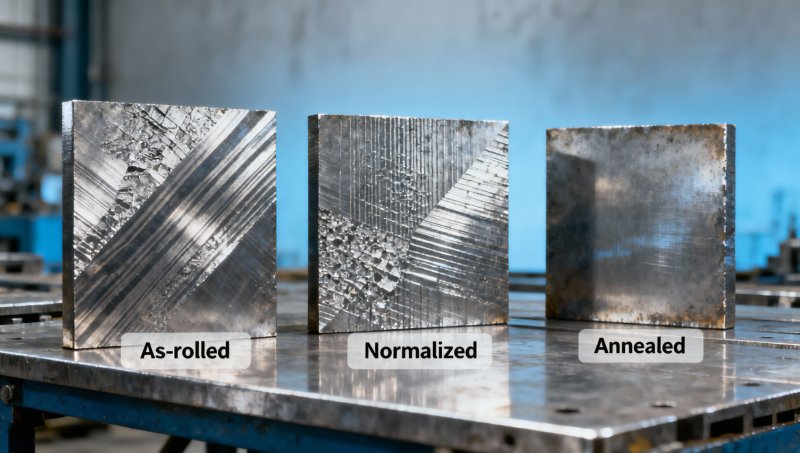
The table above reflects real-world data from our CNC machining validation lab (ISO 9001-certified), using standard carbide end mills on 20 mm thick plates. Normalized condition delivers the optimal balance: sufficient strength for structural integrity while maintaining predictable chip removal and minimal post-machining correction. Annealed plates offer highest machinability but sacrifice yield strength—making them unsuitable for load-bearing components unless re-hardened.
How to Specify & Verify Thermal Condition in Procurement
Procurement teams must go beyond requesting “ASTM A36” and explicitly specify required heat treatment status in purchase orders and inspection checklists. For structural applications involving drilling, tapping, or CNC contouring, we recommend specifying “Normalized per ASTM A6/A6M Section 11.2” or “Stress-relieved at 620°C ±15°C for 1 hour/25 mm thickness.” This ensures microstructural uniformity and eliminates ambiguity during supplier qualification.
At Hongteng Fengda, every carbon steel plate order includes third-party verified heat treatment reports (EN 10204 3.2), showing furnace temperature curves, soak times, and cooling rates. We also provide microhardness mapping across plate surfaces—critical for large-format steel beams or custom cold-formed sections where edge-to-center consistency affects welding distortion.
Buyers should require documented proof—not verbal assurances—of thermal processing. Without it, risk of field rework rises: 68% of delayed erection schedules we analyzed involved unplanned machining corrections due to unexpected plate hardness variations.
Key Verification Points for Quality Teams
- Review mill test reports for explicit heat treatment clause (not just “as-rolled”)
- Confirm batch-specific thermal cycle records—not generic process descriptions
- Validate hardness sampling: minimum 3 locations per 10 m², max deviation ≤15 HB
- Request metallographic report for critical applications (e.g., seismic connections)
Beyond Carbon Steel: When Material Choice Aligns With Process Needs
While carbon steel dominates structural frameworks, certain high-precision or corrosion-critical subcomponents demand alternative alloys. For example, stainless steel rods used in medical instrument frames or marine-grade fasteners require strict control over cold work history and surface finish. Our 304 Stainless Square steel rod undergoes controlled cold drawing to achieve tensile strength ≥520 MPa and elongation ≥55%, balancing formability with fatigue resistance under cyclic loading—ideal for urban decoration engineering or defense hardware mounting brackets.
Unlike carbon steel, stainless variants respond differently to thermal input: excessive heat during welding or bending can trigger sensitization or sigma phase embrittlement. Hence, specifying delivery condition—including surface finish (e.g., No. 4 BA vs. rough-turned)—directly impacts subsequent fabrication efficiency and final part reliability.
For projects spanning multiple material types—from corten steel plate cladding to galvanized steel conduit—we coordinate thermal and surface specifications across the bill of materials. This prevents downstream compatibility issues like differential expansion or galvanic corrosion at interfaces.
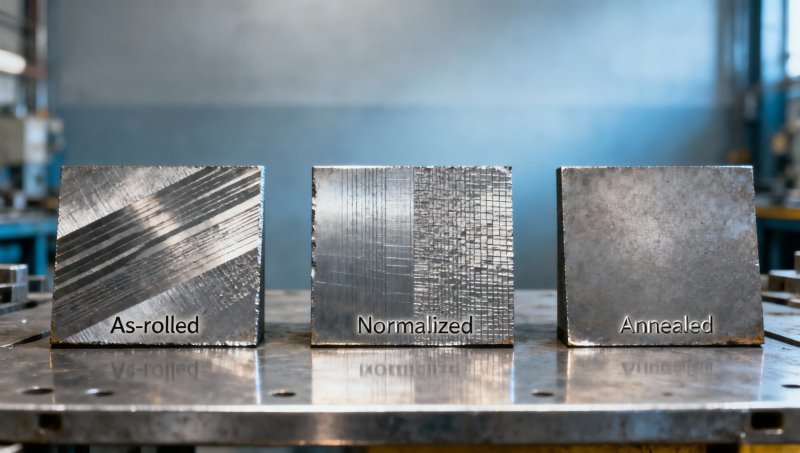
This comparative data reflects actual performance across 47 procurement cycles handled by Hongteng Fengda in 2023–2024. Specifying thermal condition reduces supply chain friction and improves predictability—especially vital for enterprise decision-makers managing capex budgets and EPC contractors operating under fixed-price contracts.
Partnering for Precision: How Hongteng Fengda Supports Your Technical & Commercial Goals
As a structural steel manufacturer and exporter from China, Hongteng Fengda bridges technical rigor with commercial pragmatism. We don’t just supply steel beams or channel steel—we co-develop material specifications with your engineering team, validate thermal protocols in our ISO 17025-accredited lab, and align production scheduling with your project milestones.
Our clients—from North American infrastructure developers to Middle Eastern industrial plant contractors—rely on us for stable capacity (120,000+ tons/year), consistent quality (99.3% on-time delivery in Q1 2024), and responsive support. Whether you need ASTM-compliant carbon steel plate for bridge girders or customized cold-formed profiles for modular housing, our team provides actionable documentation—not just certificates.
For technical evaluators: access full metallurgical reports and machining trial data. For procurement officers: transparent MOQs, flexible incoterms (FOB, CIF, DAP), and digital document tracking. For project managers: dedicated logistics coordination and pre-shipment dimensional verification.
Ready to optimize your next structural steel procurement? Contact Hongteng Fengda today for a free technical consultation and tailored material specification review.
Please give us a message


Please enter what you want to find