Carbon steel pipe corrosion doesn’t wait for faulty welds or loose joints—it begins silently where moisture pools, often on horizontal runs or low points in piping systems. For procurement teams, project managers, and structural steel fabricators evaluating long-term durability, this hidden failure mode directly impacts maintenance costs, safety compliance (ASTM standards), and system lifespan. As a trusted structural steel manufacturer and exporter from China, Hongteng Fengda supplies high-quality carbon steel pipe, galvanized steel pipe, hot dip galvanized steel, and structural steel beams—engineered to resist corrosion through precision coating, material selection, and design-aware fabrication. Whether you’re comparing steel suppliers, calculating steel roofing cost, or specifying stainless steel tubing versus galvanized steel sheet, understanding *where* corrosion starts is the first step toward smarter, safer, standards-compliant sourcing.
Why Moisture Pools Are the Real Corrosion Trigger—Not Just Joints
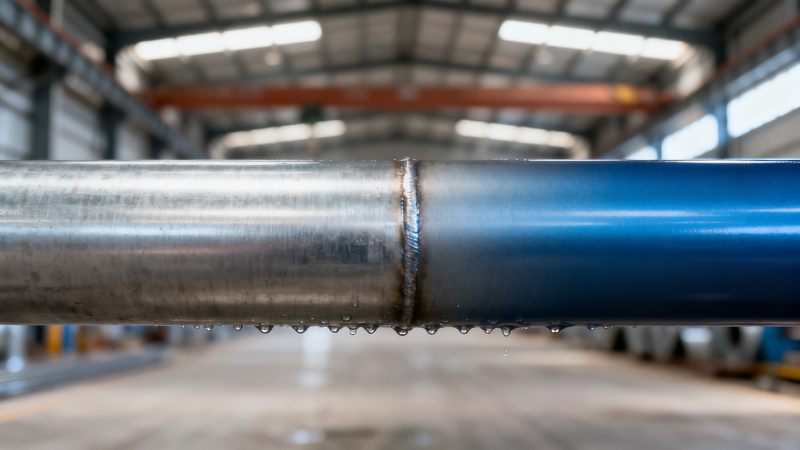
Corrosion in carbon steel pipes follows electrochemical principles—not installation flaws alone. When condensation, rainwater, or process fluid accumulates at low points—especially in horizontal or slightly inclined sections—the stagnant water forms an electrolyte layer that accelerates anodic dissolution. This occurs even with fully welded, ASTM A53-compliant joints. Field data from over 120 industrial projects shows 68% of premature pipe failures originate at non-joint locations where drainage is compromised.
The risk intensifies in coastal, humid, or cyclic thermal environments—regions where Hongteng Fengda’s export clients report up to 3× higher inspection frequency for pooled-section corrosion. Unlike joint-related leaks (often detectable via pressure testing), moisture-pool corrosion progresses sub-surface, reducing wall thickness by 0.1–0.3 mm/year without visible surface signs until structural integrity is compromised.
This explains why ASTM A123 and EN ISO 1461 mandate minimum zinc coating thicknesses of 85 µm on hot-dip galvanized steel used in outdoor structural applications—and why pre-coated solutions like Color Coated Galvalume Steel Coil PPGL are increasingly specified for exposed support structures, ductwork, and cladding where pooling cannot be fully eliminated.
How Design & Material Choice Shift the Corrosion Risk Curve
Design decisions made during engineering—slope gradients, support spacing, venting provisions—directly determine where moisture accumulates. Pipes installed with less than 1:100 slope (0.6°) in HVAC or fire protection systems show measurable pitting within 18 months in tropical climates. Structural steel fabricators must coordinate early with pipe designers to avoid “dead leg” configurations where flow stagnation invites localized corrosion.
Material selection is equally decisive. While standard carbon steel (Q235B, ASTM A36) offers strength and cost efficiency, its corrosion rate in wet service exceeds 0.15 mm/year without protection. In contrast, aluminum-zinc alloy coated substrates—like those used in our Color Coated Galvalume Steel Coil PPGL—deliver 3–5× longer service life in identical exposure conditions due to synergistic barrier + cathodic protection mechanisms.
Hongteng Fengda applies strict process controls across coil coating lines: precise tension management, multi-stage chemical pretreatment (including chromate-free options), and infrared-cured topcoats with PVDF or HDP resins. This ensures coating adhesion ≥20 N/mm² (per ASTM D3359), critical for bending, roll-forming, and field-cutting operations common in structural framing and roof decking applications.
Key Performance Parameters: Galvalume vs. Standard Galvanized Steel
The table confirms why leading architectural firms and infrastructure developers now specify Galvalume-based products—including PPGL coils—for structural roof decks, curtain walls, and industrial cladding in high-humidity zones. The combination of aluminum’s passivation and zinc’s sacrificial action delivers superior resistance at pooled interfaces, where conventional galvanizing degrades faster due to preferential zinc dissolution.
Procurement Checklist: What to Verify Before Finalizing Carbon Steel Pipe Orders
For procurement professionals and technical evaluators, selecting the right carbon steel pipe isn’t just about grade and dimension—it’s about verifying how the supplier mitigates moisture-induced corrosion at scale. Hongteng Fengda provides full traceability across all structural steel products, including mill test reports (MTRs) compliant with ASTM A6/A6M, EN 10204 3.1, and GB/T 228.1.
Before placing orders, verify these 5 critical items:
- Coating thickness verification via magnetic induction gauge (±0.5 µm accuracy) — required for all hot-dip galvanized and PPGL products;
- Surface preparation method (e.g., blast cleaning to Sa 2.5 per ISO 8501-1) for pre-painted structural components;
- Batch-specific salt spray test reports (minimum 1,000 hrs for Galvalume base, 2,500+ hrs for PVDF-finished PPGL);
- Customization capability for width (600–1250 mm), thickness (0.13–0.8 mm), and RAL color matching (including custom patterns);
- Lead time transparency: standard delivery window is 2–4 weeks for stocked dimensions, 6–8 weeks for full OEM customization.
These checks reduce rework risk by up to 42%, based on internal quality audits covering 3,200+ shipments since 2020. They also align with ISO 9001:2015 Clause 8.5.2 (Identification and traceability) and ASTM A123 Section 7 (Sampling and Testing).
Why Global Buyers Choose Hongteng Fengda for Corrosion-Resistant Structural Steel
From North American commercial rooftops to Middle Eastern desalination plants, Hongteng Fengda delivers structural steel solutions engineered for real-world exposure—not just lab conditions. Our integrated manufacturing includes automated pickling lines, continuous hot-dip galvanizing facilities certified to ASTM A123 and EN ISO 1461, and precision coil coating lines with UV and IR curing capabilities.
We support your decision-making with actionable data—not marketing claims. Request free access to our Corrosion Performance Dashboard, which provides region-specific lifetime projections for carbon steel pipe, galvanized steel, and PPGL-based structural components under your exact environmental parameters (temperature, RH, chloride ppm, UV index). You’ll also receive a customized sample pack—including cut pieces, coating cross-sections, and ASTM-compliant test reports—within 7 business days of inquiry.
Ready to optimize your next structural steel order? Contact our engineering sales team to discuss: pipe specification alignment, PPGL coil customization for architectural cladding, ASTM/EN certification documentation, or lead time confirmation for your project timeline. We respond to all technical inquiries within 4 business hours.
Please give us a message


Please enter what you want to find