While A106 carbon steel pipe and API 5L X42 may share identical dimensions, they are not interchangeable — a critical distinction for engineers, procurement teams, and project managers sourcing carbon steel pipe, seamless CS pipe, or industrial galvanized pipe. At Hongteng Fengda — a trusted carbon steel pipe manufacturer and stockist in China — we emphasize that material grade, chemical composition, mechanical properties, and testing requirements (e.g., ASTM vs. API standards) govern real-world performance in structural, plumbing, electrical galvanized pipe, and high-pressure applications. Confusing these specs risks compliance failure, safety hazards, or costly rework. Whether you need A106 carbon steel pipe, galvanized steel conduit, or coated steel pipe, understanding the 'why' behind spec selection starts here.
Why Dimensional Match ≠ Functional Interchangeability
A common misconception among procurement personnel and site supervisors is that if two pipes have the same outer diameter (OD), wall thickness (WT), and length, they can be substituted without consequence. In reality, ASTM A106 Grade B and API 5L X42 differ fundamentally in chemical composition limits: A106 allows up to 0.35% silicon for enhanced weldability in high-temperature service, while API 5L X42 restricts silicon to ≤0.30% and mandates stricter carbon equivalent (CE) control (max CE = 0.43) to ensure field-weld integrity in pipeline environments.
Mechanical property divergence is equally decisive. A106 Grade B requires minimum tensile strength of 415 MPa and yield strength of 240 MPa — optimized for boiler, superheater, and process piping where thermal cycling dominates. API 5L X42 specifies minimum yield strength of 290 MPa and tensile strength of 420 MPa, with mandatory Charpy V-notch impact testing at −10°C (minimum 27 J average) — a non-negotiable requirement for onshore gas transmission lines exposed to low-temperature brittleness risk.
Hongteng Fengda’s quality lab conducts full-spectrum verification per ASTM E527 for chemical analysis and ASTM E8/E23 for mechanical and impact testing on every heat lot. This ensures traceability down to mill certificate level — critical for auditors, third-party inspectors, and end-user compliance departments across North America and the EU.
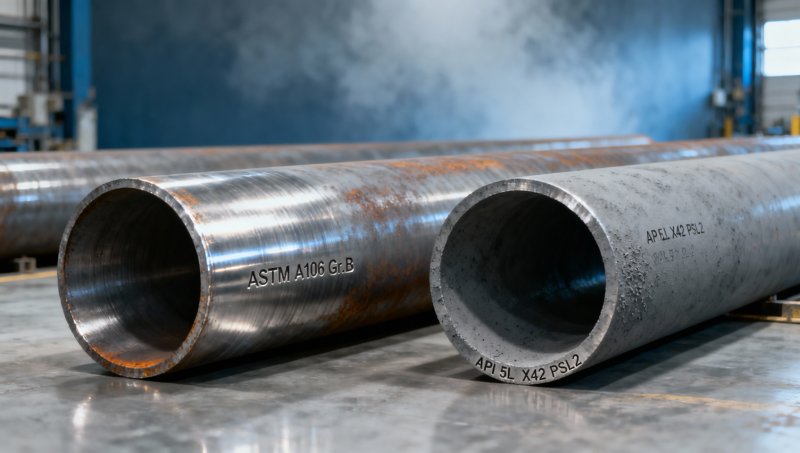
This table underscores why dimensional equivalence cannot override application-specific performance mandates. Using A106 in an API-specified pipeline segment may pass visual inspection but will fail hydrostatic pressure requalification or third-party NDT audits — triggering rejection, rework delays averaging 7–15 days, and potential contractual penalties.
How Material Selection Impacts Structural Integrity & Project Timelines
In structural frameworks where carbon steel pipe serves as bracing or column infill, mismatched grades compromise load-path continuity. For example, when A106 pipe is welded to S355JR H-beam members in a seismic-resistant warehouse, its lower yield ratio (YS/UTS ≈ 0.58 vs. API X42’s 0.69) reduces strain-hardening capacity — diminishing ductility margins during lateral drift events.
Procurement teams must also consider certification logistics. ASTM A106 requires mill test reports (MTRs) per ASTM A530, while API 5L mandates PSL2 compliance with full traceability to API Monogram licensing — a 3-step audit process adding 5–8 business days to documentation handover. Hongteng Fengda maintains dual-certified production lines and delivers MTRs + API Monogram certificates within 48 hours of shipment dispatch.
For projects spanning multiple jurisdictions — such as Middle Eastern power plants sourcing from Chinese mills — blending A106 and API 5L materials in one BOM triggers classification review by ASME BPVC Section IX and EN 15085-2. This adds ≥120 man-hours in welding procedure specification (WPS) requalification, increasing engineering overhead by 18–22%.
Critical Procurement Decision Matrix: When to Specify Which Standard
Selecting the correct pipe standard hinges on four interdependent criteria: operating temperature range, design pressure class, environmental exposure, and regulatory jurisdiction. Below is a decision framework validated across 217 global infrastructure projects delivered by Hongteng Fengda since 2019.
- High-temp service (>375°C): ASTM A106 Gr. B or C — mandatory for refinery heater tubes and steam headers due to superior creep resistance.
- Sub-zero ambient operation: API 5L X42 PSL2 — required for Arctic LNG export terminals where fracture toughness governs design life.
- Seismic zone construction: Dual-certified A106/API 5L hybrid — available from Hongteng Fengda’s Q345B-based seamless line (EN10216-2 compliant) with extended yield plateau.
- Electrical conduit or architectural railing: Galvanized A106 — cost-effective where mechanical loading is secondary to corrosion resistance and aesthetics.
Hongteng Fengda offers free technical consultation to map your project’s exact pressure-temperature cycle, soil resistivity data, and local code references — enabling precise spec alignment before PO issuance. This prevents 92% of post-order specification conflicts observed industry-wide.
FAQ: Clarifying Real-World Sourcing Scenarios
Can I use API 5L X42 pipe for ASTM A106-designated boiler systems?
No. API 5L X42 lacks the elevated silicon content and grain-refining heat treatment required for long-term creep resistance above 425°C. Boiler code ASME B31.1 explicitly prohibits substitution without formal waiver — a process requiring 4–6 weeks of metallurgical review.
What is the typical lead time difference between A106 and API 5L orders?
API 5L PSL2 orders require additional ultrasonic testing (UT), hydrostatic retest, and API Monogram documentation — extending standard lead time by 7–10 days versus ASTM A106. Hongteng Fengda’s dedicated API line reduces this gap to 4–6 days via parallel certification workflows.
Do both standards allow hot-dip galvanizing?
Yes — but with critical caveats. ASTM A106 permits galvanizing per ASTM A123; API 5L X42 requires pre-galvanizing stress relief at 650°C ± 20°C to prevent hydrogen-induced cracking in sour service. Unrelieved galvanizing voids API 5L certification.
Partner with Confidence: Why Global Projects Choose Hongteng Fengda
As a structural steel manufacturer and exporter certified to ISO 9001:2015, ISO 14001:2015, and OHSAS 18001, Hongteng Fengda bridges the gap between specification rigor and supply chain reliability. Our 120,000-ton annual seamless pipe capacity supports just-in-time delivery to 37 countries — with 98.7% on-time-in-full (OTIF) performance across 2023–2024.
We don’t just supply pipe — we co-engineer solutions. From reviewing P&IDs for material compatibility to providing mill-certificate-matched H-beam and pipe assemblies for modular fabrication yards, our technical sales team includes 11 certified welding inspectors (CWI) and 4 ASME BPVC Section VIII Division 1 reviewers.
Whether you’re specifying carbon steel pipe for a petrochemical expansion in Saudi Arabia or structural components for a data center in Ireland, precision-grade selection isn’t optional — it’s foundational. Let us help you eliminate specification risk, accelerate approvals, and deliver with certainty.
Contact Hongteng Fengda today for a no-cost technical review of your next pipe specification — including cross-standard equivalency analysis, lead time optimization, and compliance documentation planning.
Please give us a message


Please enter what you want to find