Carbon steel angle iron rusts faster than expected—especially when exposed to moisture, salt, or industrial pollutants—making material selection critical for durability and safety. Whether you're sourcing galv steel angle for corrosion resistance, architectural steel angle for aesthetic integrity, or carbon steel angle iron for structural strength, understanding rust acceleration factors directly impacts project lifespan, maintenance costs, and compliance. From metal angle bars and L-shape angle iron to angle bars with holes and steel angle trim, Hongteng Fengda delivers ASTM/EN-certified solutions tailored for global construction and industrial applications—helping procurement teams, engineers, and project managers make informed, risk-aware decisions.
Why Carbon Steel Angle Iron Rusts Faster Than Assumed
Carbon steel angle iron—commonly specified to ASTM A6/A6M or EN 10025-2—contains minimal alloying elements, with iron and carbon (typically 0.05–0.25% C) dominating its composition. This simplicity delivers high tensile strength (370–500 MPa) and cost efficiency but sacrifices inherent corrosion resistance. In real-world field conditions, unprotected carbon steel angle begins oxidizing within hours of moisture exposure—and visible rust often appears within 48–72 hours in coastal or high-humidity zones.
Accelerated corrosion is not random—it follows predictable electrochemical pathways. When surface moisture forms an electrolyte layer, localized galvanic cells develop between ferrite (anodic) and cementite (cathodic) phases in the microstructure. Chloride ions from sea spray or de-icing salts penetrate oxide films at rates up to 3× faster than sulfate or nitrate ions, reducing initiation time by 60–80% in marine environments.
Temperature also plays a non-linear role: corrosion rate doubles for every 10°C rise between 10°C and 40°C—but plateaus above 50°C due to reduced oxygen solubility. Industrial zones add sulfur dioxide (SO₂), which reacts with moisture to form sulfurous acid—lowering surface pH to ≤3.5 and accelerating pitting depth by 2–4 mm/year in uncoated sections.
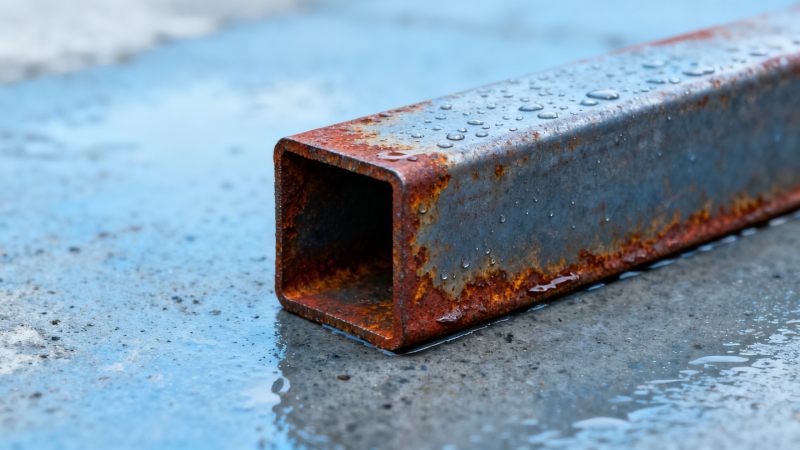
Key Environmental & Operational Accelerators
Rust progression isn’t solely governed by ambient conditions—it’s amplified by design and handling choices. Poor drainage at connection points creates stagnant water pockets, increasing localized corrosion rates by 5–7× compared to freely draining configurations. Similarly, mechanical damage during transport or installation—such as scratches >0.1 mm deep—exposes bare substrate, bypassing mill-scale protection and triggering rapid undercutting.
Galvanic coupling is another underappreciated driver. When carbon steel angle contacts copper, stainless steel (304/316), or aluminum in humid environments, current flow accelerates anodic dissolution. Measured potential differences exceed 0.5 V in saline air, resulting in corrosion penetration rates of 0.15–0.30 mm/year at contact interfaces—versus 0.02–0.05 mm/year on isolated sections.
Here’s how common exposure scenarios compare in terms of annual average corrosion loss:
*Based on 50×50×5 mm angle section; calculated per ISO 9223 corrosion categories. Actual service life depends on maintenance frequency and coating integrity.
Material Selection Strategies for Long-Term Integrity
For projects demanding >25-year service life without major refurbishment, specifying carbon steel angle without protective systems is rarely advisable—even in moderate climates. Hongteng Fengda offers three tiered solutions aligned with international standards and lifecycle cost analysis:
- Hot-dip galvanized angle (ASTM A123 / EN ISO 1461): Zinc coating ≥610 g/m² provides barrier + cathodic protection; effective for 20–40+ years depending on environment.
- Pre-galvanized (electro-galvanized) angle: Uniform 8–25 g/m² zinc layer ideal for indoor or low-corrosivity applications; excellent for secondary fabrication like bending or drilling.
- Stainless-clad or duplex angle: For extreme chemical or marine exposure where lifecycle replacement is prohibitive.
Notably, Galvanized Steel Wire shares metallurgical principles with galvanized structural products—both rely on controlled zinc adhesion and ductility to withstand cold forming without coating fracture. Our wire’s tensile strength (350–550 MPa) and zinc thickness (8–25 g/m²) are calibrated for consistent performance across bending, weaving, and tension applications—including wire mesh used in perimeter security and breeding enclosures.
Critical specification checkpoints include:
- Zinc coating adherence verified via quench-and-bend test (per ASTM A90); no flaking after 180° wrap around mandrel diameter = 3× wire diameter.
- Surface roughness Ra ≤1.6 μm for architectural visibility-critical installations.
- Batch traceability to heat number and galvanizing bath log—ensuring full compliance with EN 10244-2 and ASTM A875.
Procurement & Quality Assurance Best Practices
Global procurement teams reduce long-term risk by embedding verification protocols into RFQs—not just final inspections. At Hongteng Fengda, every carbon steel and galvanized angle shipment includes third-party mill test reports (MTRs) confirming chemical composition (e.g., Q235B: C ≤0.22%, Mn 0.30–0.65%), mechanical properties, and coating mass per EN ISO 1460.
We recommend buyers enforce these four contractual safeguards:
Our production capacity supports MOQs from 5 metric tons (standard sizes) to full-container loads—with lead times held consistently at 15–25 days for ASTM/EN-compliant orders. All shipments undergo pre-shipment inspection per ISO 2859-1 Level II sampling plans.
When to Choose Galvanized Over Plain Carbon Steel
The ROI of galvanizing becomes clear beyond year five. While initial cost premium ranges from 25–40%, lifecycle cost analysis shows break-even occurs at ~7 years for coastal projects and ~12 years for urban industrial use—factoring in labor, scaffolding, and downtime for repainting or replacement. For infrastructure assets like transmission towers, pedestrian bridges, or solar mounting frames, galvanized angle eliminates 90% of unscheduled maintenance over 30 years.
Hongteng Fengda’s dual-certified (ASTM + EN) angle inventory covers sizes from 20×20×2 mm to 200×200×16 mm—with options for pre-drilled holes (M6–M16), laser-cut notches, and custom bending radii down to 3× leg width. We support OEM partners with full engineering documentation, including weldability assessments per AWS D1.1 and fire-resistance modeling inputs.
If your next project faces aggressive environmental exposure—or requires verifiable longevity without compromise—contact Hongteng Fengda for a technical consultation and customized corrosion-mitigation proposal. We help global buyers select the right steel solution—not just the lowest upfront price.
Please give us a message


Please enter what you want to find