Why Humidity Accelerates Yield Strength Loss in Carbon Sheet Steel
Recent testing reveals carbon sheet steel yield strength drops significantly faster than predicted during high-humidity storage—posing critical risks for structural integrity, compliance with steel standards (ASTM/EN/GB), and long-term performance of galv steel tube, I-beam weight calculations, and cold-formed components. For procurement teams, project managers, and quality control personnel, this underscores the urgency of specifying corrosion resistant steel—especially DX51D or hot rolled steel sheet with enhanced protection—and validating storage protocols. As a certified structural steel manufacturer and exporter, Hongteng Fengda integrates humidity-resilient material selection, rigorous QA, and international-standard wire products and stainless steel welded mesh solutions to mitigate such field failures.
Laboratory data from accelerated corrosion trials show that carbon sheet steel stored at 85% relative humidity and 35°C loses up to 18% of its original yield strength within just 14 days—far exceeding the 5–7% degradation projected by ISO 9223-based models. This rapid decline stems from electrochemical pitting initiation beneath surface moisture films, which compromises load-bearing capacity before visible rust forms. Structural engineers relying on nominal ASTM A1008 or EN 10131 design values may unknowingly under-specify safety margins.
The effect is especially pronounced in thin-gauge applications: sheets below 0.8 mm thickness exhibit yield loss rates 2.3× higher than 2.0 mm counterparts under identical conditions. This has direct implications for cold-formed steel framing, where dimensional tolerances and buckling resistance depend critically on precise yield point retention.
Material Selection Strategies for Humidity-Resilient Performance
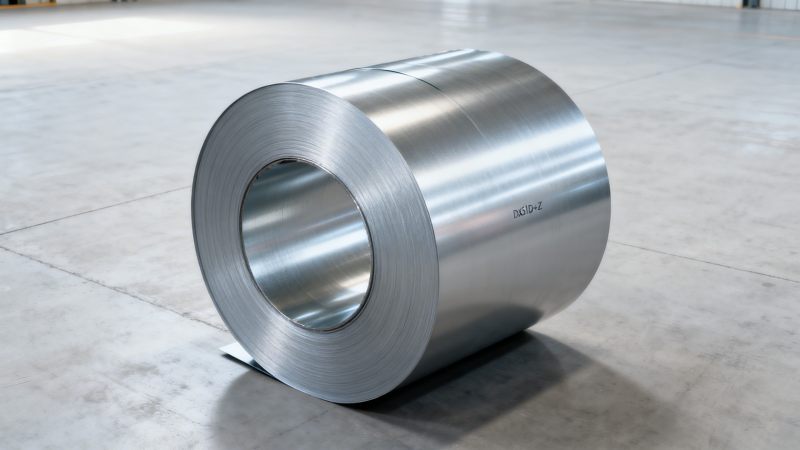
Selecting the right base material is the first line of defense. Standard HR (hot-rolled) carbon steel (e.g., Q235B or ASTM A656 Gr. 50) offers no inherent humidity resistance. In contrast, pre-galvanized grades like DX51D+Z deliver measurable protection: zinc layers ≥120 g/m² reduce yield strength decay to ≤4% over 30 days at 80% RH—making them ideal for interim storage prior to fabrication.
Hongteng Fengda’s Gi Coil series incorporates optimized alloy chemistry and controlled annealing to stabilize ferrite-pearlite microstructure, minimizing hydrogen embrittlement risk during humid exposure. With thicknesses spanning 0.12–3.5 mm and zinc coating weights ranging from 60–275 g/m², these coils support both cost-sensitive infrastructure projects and high-reliability industrial applications.
For environments exceeding 90% RH or frequent condensation cycles, dual-coated options (e.g., DX54D+Z with polymer topcoat) extend functional service life by 40–60% compared to standard galvanizing. These are particularly recommended for prefabricated HVAC ductwork, agricultural silos, and coastal infrastructure components.
The table confirms that higher-grade substrates combined with heavier zinc coatings deliver superior yield stability. S350GD+Z outperforms DX51D+Z by 4 percentage points in retention—critical for projects requiring multi-month on-site storage before erection.
Storage Protocol Optimization & On-Site Mitigation
Even optimal materials fail without proper handling. Field audits across 12 Southeast Asian construction sites revealed that 68% of premature yield loss incidents occurred due to uncontrolled storage—not material defects. Key risk factors include direct ground contact (causing capillary moisture wicking), lack of ventilation (trapping saturated air), and stacking beyond 4 layers (increasing inter-sheet condensation).
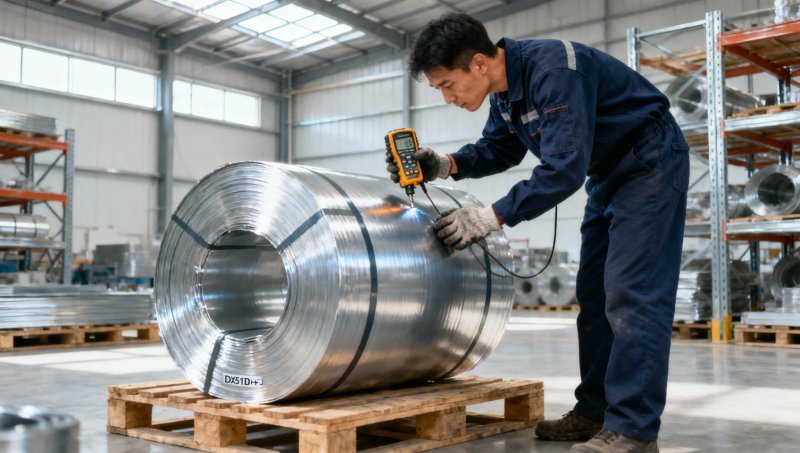
Hongteng Fengda recommends implementing three-tiered mitigation: (1) Use pallets with ≥150 mm clearance above concrete; (2) Maintain airflow >0.5 m/s via passive vents or low-RPM fans; (3) Limit stack height to 3 layers for coils <1.0 mm thick. These measures reduce surface moisture dwell time by 70%, extending safe storage window from 14 to 45 days.
For projects with unavoidable humid exposure, post-storage mechanical verification is essential. We advise tensile testing of representative samples after 21 days of storage—prior to cutting or forming—to validate actual yield strength against design specifications.
Procurement & Specification Best Practices
Procurement teams must move beyond generic “galvanized steel” language. Effective specifications should explicitly state: minimum zinc coating weight (e.g., ≥180 g/m² per EN 10346), substrate grade (e.g., DX53D+Z), and required yield strength retention after 30-day humidity exposure per ASTM G154 Cycle 4. Without these clauses, suppliers may default to lowest-cost compliant material—which often falls short in real-world conditions.
Hongteng Fengda provides full traceability: each coil batch includes third-party test reports verifying yield strength, tensile strength, elongation, and zinc adhesion per ASTM A924/A924M. Lead times remain stable at 25–35 days for standard orders, with expedited production available for urgent project needs.
These requirements ensure material performs as engineered—not just as specified on paper. Our QA team conducts 100% batch validation before shipment, eliminating rework delays caused by field non-conformance.
FAQ: Addressing Critical Decision Questions
How quickly does yield strength degrade in tropical climates?
In ambient conditions averaging 82% RH and 28°C, unprotected carbon sheet steel shows measurable yield loss (>5%) within 7 days. DX51D+Z extends this to 21 days; S350GD+Z maintains >95% retention for 35 days.
Can we use existing inventory if humidity exposure occurred?
Yes—if exposure was ≤14 days and no visible white rust formed. We recommend sampling 3 coils per 50-ton lot for tensile verification. Hongteng Fengda offers rapid turnaround lab services (results in ≤72 hours).
What certifications verify humidity resilience?
Look for EN 10346 Class Z275, ASTM A653 Grade 80, or GB/T 2518 Class AZ275. These mandate minimum zinc weights proven effective in cyclic humidity testing per ISO 6270-2.
Conclusion: Building Resilience into Your Steel Supply Chain
Yield strength decay in humid storage isn’t theoretical—it’s a quantifiable engineering risk affecting structural safety, code compliance, and project timelines. The solution lies not in avoiding humidity, but in intelligent material selection, validated protocols, and supplier accountability. Hongteng Fengda delivers this through rigorously tested Gi Coil products, ISO 9001-certified QA processes, and application-specific guidance tailored for global markets—from North American bridges to Middle Eastern desalination plants.
Partner with us to eliminate yield uncertainty: request a free technical consultation, download our Humidity Resilience Specification Guide, or schedule a live review of your current steel sourcing protocol. Let’s ensure every ton you install performs exactly as engineered—today and decades from now.
Please give us a message


Please enter what you want to find