Choosing between carbon sheet steel and cold rolled steel is critical for structural integrity, formability, and downstream processing—especially when integrating materials like ASTM A106 Gr B pipe, mild steel plate, or galvanised sheet steel into global construction and industrial projects. As a leading structural steel manufacturer and exporter from China, Hongteng Fengda leverages deep expertise in hot rolled coil, GI sheet coil, and corrosion-resistant pipe solutions to guide engineers, procurement teams, and project managers through material selection trade-offs. This article breaks down key differences in ductility, surface finish, yield strength, and bending performance—helping technical evaluators and decision-makers optimize cost, quality, and manufacturability without compromising compliance with API 5L, EN, ASTM, or GB standards.
Understanding Carbon Sheet Steel vs. Cold Rolled Steel: Core Definitions
Carbon sheet steel refers to low- to medium-carbon hot-rolled steel sheets (typically C ≤ 0.25%), produced via high-temperature rolling above the recrystallization point (~1,100°C). It offers good weldability and moderate strength but exhibits lower dimensional accuracy and rougher surface finish (Ra ≈ 3.2–6.3 µm) compared to cold-rolled variants.
Cold rolled steel undergoes further processing at room temperature after hot rolling—passing through tension-leveling stands and skin-pass mills. This reduces thickness tolerance to ±0.02 mm (vs. ±0.15 mm for hot-rolled), improves surface roughness (Ra ≤ 0.8 µm), and increases yield strength by up to 20% due to strain hardening. Typical carbon content remains similar (0.05–0.25%), but mechanical properties diverge significantly post-processing.
For structural applications requiring tight tolerances—such as cold-formed steel profiles, precision brackets, or laser-cut components—cold rolled steel delivers superior repeatability. In contrast, carbon sheet steel remains preferred for large-scale fabrication where cost efficiency, thermal stability during welding, and ease of handling outweigh surface-critical requirements.
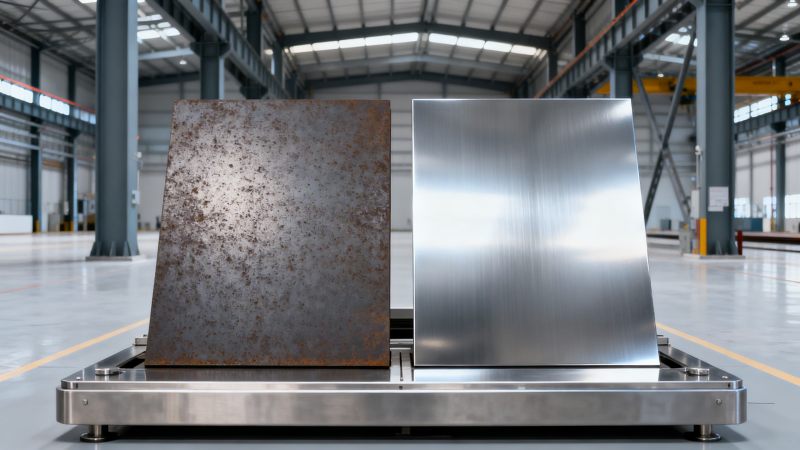
Formability Comparison: Ductility, Bend Radius & Springback
Formability hinges on three interdependent metrics: elongation at break, minimum bend radius, and springback angle. Carbon sheet steel typically achieves 22–30% elongation (ASTM A653), while cold rolled equivalents reach 18–25%—a seemingly counterintuitive reduction caused by work hardening. However, cold rolled steel’s tighter grain structure enables sharper bends without cracking.
Minimum inside bend radius for carbon sheet steel is generally 1.5× material thickness (e.g., 1.5 mm for 1.0 mm sheet); cold rolled steel supports 1.0× thickness in most cases. Springback—the elastic recovery after bending—is 15–25% higher in cold rolled grades due to elevated yield-to-tensile ratio (often ≥ 0.75 vs. 0.65 for hot rolled), demanding precise die compensation in press brake operations.
When designing parts for roll forming or progressive die stamping, cold rolled steel allows tighter radii, reduced tool wear, and better edge quality—critical for components used alongside 316L Stainless Steel Plate in corrosive environments like food processing lines or marine structures.
This table confirms that while cold rolled steel sacrifices some elongation, it gains precision, strength, and surface uniformity—making it indispensable for high-volume, tight-tolerance manufacturing. For projects specifying ASTM A653 or EN 10131, Hongteng Fengda maintains certified production lines across both product categories, ensuring traceable mill test reports per batch.
Application-Specific Selection Criteria
Selecting the right grade depends on functional hierarchy: primary load-bearing function > dimensional repeatability > surface aesthetics > cost sensitivity. For structural framing elements (e.g., channel steel or angle steel), carbon sheet steel meets ASTM A6/A6M and EN 10025 standards at 15–20% lower unit cost than cold rolled alternatives—without compromising safety margins.
Conversely, cold rolled steel dominates in automotive chassis subassemblies, HVAC ductwork flanges, and architectural cladding systems where flatness tolerance must hold within ±0.1 mm over 2 m lengths. Its consistent thickness profile also reduces scrap rates in high-speed laser cutting—improving yield by 3–5% versus hot rolled feedstock.
When integrating with stainless solutions such as chemical-grade 316L Stainless Steel Plate, cold rolled carbon steel provides optimal galvanic compatibility and weld joint integrity—especially in mixed-material assemblies for pharmaceutical cleanrooms or offshore platforms.
Procurement & Quality Assurance Best Practices
Global buyers should verify three key documentation layers before order placement: (1) Mill Test Report (MTR) confirming tensile/yield values per ASTM E8/E8M, (2) Surface inspection report detailing oil film type (e.g., rust preventive vs. drawing compound), and (3) Dimensional verification across width, thickness, and flatness (EN 10162 Class A/B/C).
Hongteng Fengda applies 100% ultrasonic testing (UT) on coils exceeding 3 mm thickness and performs quarterly third-party audits against ISO 9001:2015 and ISO 14001:2015. Lead times average 25–35 days for standard orders (MOQ: 25 metric tons), with expedited options available for priority shipments to North America and EU markets.
These criteria help procurement teams align technical specs with commercial objectives. Hongteng Fengda supports dual-certification requests (e.g., ASTM + GB) and offers free sample kits—including side-by-side bend test specimens—to validate real-world formability before bulk ordering.
FAQ: Common Decision Questions
How does cold rolled steel affect welding parameters?
Cold rolled steel requires 10–15% lower heat input during MIG/TIG welding to prevent excessive grain growth in the HAZ. Preheating is rarely needed unless thickness exceeds 12 mm. Use ER70S-6 filler wire with 75% Ar/25% CO₂ shielding gas for optimal penetration control.
Can carbon sheet steel replace cold rolled in roll forming lines?
Yes—but only if the part design accommodates larger bend radii and tolerates ±0.2 mm thickness variation. Tooling life decreases by ~30% due to abrasive scale residue; descaling pretreatment adds 1–2 process steps and 8–12 hours lead time.
Material selection directly impacts structural reliability, production efficiency, and total cost of ownership. Whether you’re specifying angle steel for infrastructure projects or cold formed profiles for industrial machinery, Hongteng Fengda delivers certified, traceable steel products backed by 15+ years of export experience across 40+ countries. Our engineering team collaborates with clients to co-develop optimized material specifications—balancing formability, compliance, and lifecycle value.
Contact us today to request mill test reports, dimensional validation samples, or customized quoting for carbon sheet steel, cold rolled steel, or corrosion-resistant solutions including 316L Stainless Steel Plate.
Please give us a message


Please enter what you want to find