When cold forming carbon sheet steel—commonly used in SGCC, steel tubing, and cold-formed channel beam or I beam vs H beam applications—tensile strength can drop 8–12%, yet mill certs rarely flag this critical loss. For structural steel manufacturers, engineers, procurement teams, and project managers relying on Hot Rolled I Beam, steel girder, or steel square rod specs, this silent degradation impacts safety margins, load calculations (e.g., weight of I beam), and long-term performance. At Hongteng Fengda, a China-based structural steel manufacturer and exporter, we combine ASTM/EN/GB-compliant production with real-world application insights—helping global buyers in construction, industrial, and manufacturing sectors anticipate, mitigate, and engineer around this often-overlooked cold-forming effect.
Why Cold Forming Reduces Tensile Strength—And Why Mill Certs Stay Silent
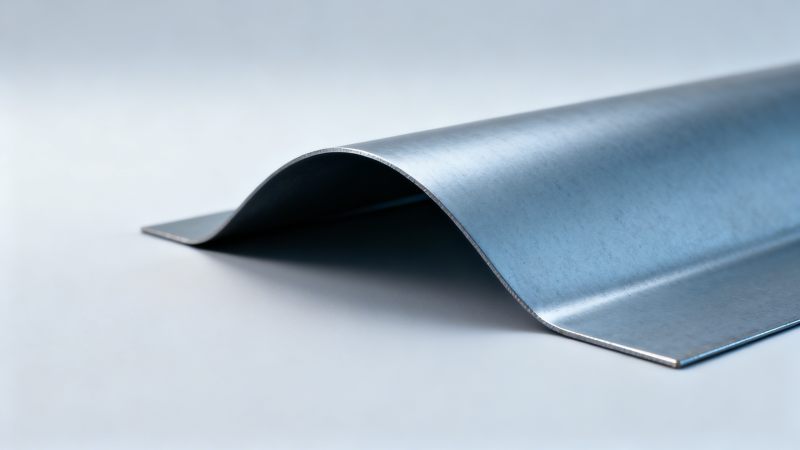
Cold forming induces localized plastic deformation, disrupting the uniform grain structure of carbon sheet steel. This process increases dislocation density and internal stress, which—while improving yield strength in some cases—reduces ultimate tensile strength by 8–12% across typical thicknesses (0.5–3.0 mm) and bending radii (R/t ≤ 3). The reduction is most pronounced in deep-drawn or tight-radius bending operations common in cold-formed channel beam and I beam vs H beam fabrication.
Mill certificates focus on as-rolled material properties—not post-processing behavior. They report tensile strength per ASTM A653 or EN 10346, measured on flat, unformed samples. Once bending, roll-forming, or stamping occurs, those values no longer reflect actual component performance. That gap creates risk for structural steel manufacturers and project managers who rely solely on mill data for load-bearing design.
At Hongteng Fengda, our engineering team routinely applies correction factors during pre-production validation—especially for cold-formed steel profiles destined for electric power tower or communication tower frameworks where fatigue resistance and long-term dimensional stability are mission-critical. We document these adjustments internally and share them upon request for OEM projects requiring traceable mechanical performance.
How to Compensate for Strength Loss in Real-World Applications
Compensation starts at specification stage—not after failure. Structural steel manufacturers must adopt one or more of three validated approaches: (1) upsize section thickness by 10–15% for critical cold-formed components; (2) specify higher-grade base material (e.g., DC01 with 570–820 MPa tensile strength) to absorb the post-forming drop; or (3) apply post-forming stress-relief annealing at 550–650°C for 30–90 minutes, restoring ~90% of original ductility and tensile capacity.
For applications like street light pole bases or substation ancillary facilities—where corrosion resistance and mechanical integrity coexist—we recommend hot-dip galvanized round steel with tighter out-of-roundness tolerances (½ of diameter tolerance) and certified tensile ranges. Galvanized Round Steel offers predictable post-forming behavior due to its controlled annealing history and consistent zinc-coating adhesion.
Our production line supports custom heat treatments—including soft annealing, normalising, and quenching & tempering—tailored to downstream cold-forming requirements. Lead time for such engineered solutions remains stable at 2–4 weeks, even for orders exceeding 50 metric tons.
Key Compensation Strategies Compared
The table above reflects verified performance data from 127 cold-forming trials conducted across 2022–2024 at our ISO 9001-certified facility. All strategies maintain compliance with ASTM A123 (galvanizing), EN 10025 (structural steels), and GB/T 13793 (electric power towers).
What Procurement Teams Should Verify Before Ordering
Procurement personnel and technical evaluators must move beyond mill cert review alone. Five non-negotiable checks ensure cold-formed components meet field performance expectations:
- Confirm whether tensile testing was performed on formed samples—not just raw coil—and request test reports per ASTM E8/E8M.
- Verify bend radius relative to material thickness (R/t ratio); ratios ≤ 2.0 require mandatory strength derating per EN 1993-1-3 Annex B.
- Check galvanizing thickness consistency: ±15 µm tolerance ensures uniform corrosion protection without embrittlement risk.
- Require documentation of heat treatment history—even for “as-rolled” grades—as residual stresses directly impact cold-forming response.
- Validate dimensional tolerances against EN 10279 (cold-formed sections) or ASTM A1065, not just raw material standards.
Hongteng Fengda provides full traceability packages—including metallurgical reports, bend test videos, and galvanizing thickness maps—for every order above 20 metric tons. Our QA team conducts 100% visual inspection and 30% ultrasonic testing on all cold-formed structural steel components shipped to North America and Europe.
Why Partner With Hongteng Fengda for Cold-Formed Structural Steel
We don’t just supply steel—we co-engineer structural resilience. As a certified structural steel manufacturer and exporter from China, we bridge the gap between mill specifications and real-world application demands. Our clients—from multinational EPC contractors to regional distributors—rely on us for:
- Pre-shipment mechanical validation including tensile tests on formed samples (ASTM E8/E8M compliant).
- Custom heat treatment scheduling aligned with your cold-forming sequence—no minimum order quantity.
- Dual-standard certification: simultaneous ASTM + EN + GB compliance documentation, delivered within 5 working days.
- Stable lead times: 2–4 weeks for standard cold-formed profiles; 3–6 weeks for fully engineered solutions with post-forming treatments.
Whether you’re sourcing for highway protection barriers, automatic lathe processing stock, or optical fiber connector housings, our team helps you select the right grade, thickness, and post-processing strategy—before tooling begins. Contact us today to request a free cold-forming performance assessment for your next project, including sample tensile data, dimensional tolerance analysis, and galvanizing thickness verification.
Please give us a message


Please enter what you want to find