Choosing the right carbon steel round bar for machining use depends on more than hardness or price. Grade selection affects chip control, tool life, dimensional stability, and downstream heat treatment.
For industrial steel applications, the best machining result comes from balancing carbon content, sulfur level, strength, and final service requirements. A practical comparison helps reduce waste and improve production consistency.
Grade Basics of Carbon Steel Round Bar for Machining
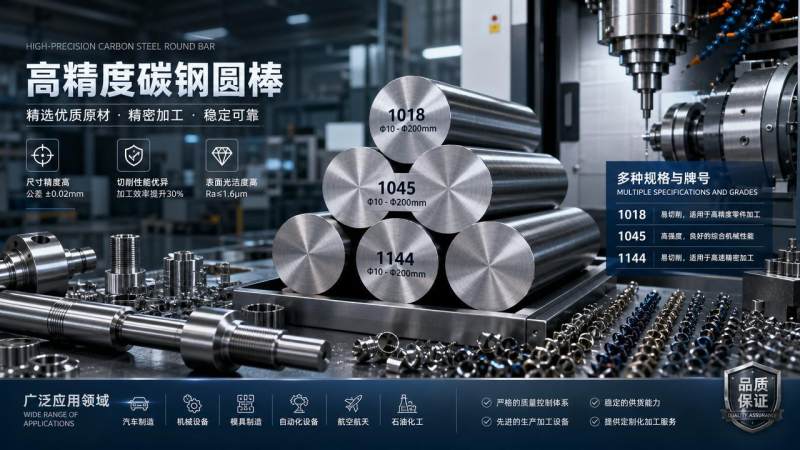
A carbon steel round bar is a solid steel section widely used for shafts, pins, fasteners, bushings, gears, fixtures, and general mechanical parts.
In machining use, common grades are often grouped by low, medium, and free-machining carbon steels. Each group offers different cutting behavior and final mechanical performance.
Low carbon grades are easier to form and weld. Medium carbon grades provide higher strength. Free-machining grades improve cutting efficiency but may reduce weldability or impact toughness.
Typical grade families
- 1018: balanced machinability, good surface finish, common for pins and shafts.
- 1020: slightly lower machinability, good general-purpose structural use.
- 1045: stronger medium carbon option for wear-resistant parts.
- 1144: free-machining grade with strong machinability and good dimensional stability.
- 1215: excellent machinability for high-volume turning and drilling.
When selecting a carbon steel round bar, the final component purpose should lead the decision. Easy cutting alone does not guarantee the right long-term service result.
Current Industry Focus in Machining Steel Selection
Steel buyers and fabrication teams increasingly evaluate materials through total processing cost. The bar price matters, but machining hours, insert wear, and scrap rates often matter more.
Several industry signals influence the choice of carbon steel round bar for machining applications:
This is also why many steel sourcing plans compare bar stock with related flat steel products for fixtures, templates, or support structures.
For example, Flat Rolled Steel Coil in A36, Q235, or S235JR is often used for welded fixtures, bearing plates, frames, and mechanical supports.
Its tensile strength of 400-550MPa, yield strength around 250MPa, and good weldability make it useful where machined round components connect with structural assemblies.
This combination approach helps align material performance across shafts, plates, brackets, and other fabricated steel parts in construction, energy, transportation, and heavy equipment projects.
Machinability and Performance Comparison by Grade
The main question is how each carbon steel round bar grade behaves during turning, drilling, threading, and milling. The answer usually begins with carbon level and chemistry adjustments.
What changes during machining
- Low carbon bars often produce softer chips and may form built-up edge.
- Medium carbon bars resist deformation better during cutting.
- Free-machining grades break chips faster and improve tool life.
- Higher strength grades may require adjusted speeds, feeds, and coolant strategy.
A carbon steel round bar for precision use should also be checked for straightness, decarburization, and internal quality. These details influence final tolerances as much as chemistry.
Application Value Across Industrial Components
Different grades of carbon steel round bar deliver value in different machining environments. The right match can lower unit cost without sacrificing performance.
Common industrial scenarios
- General shafts: 1018 or 1045 depending on load and finish requirements.
- Threaded parts: 1215 for speed-focused production with stable chip evacuation.
- Wear-related components: 1045 when higher hardness and strength are needed.
- Precision machined bars: 1144 for good surface quality and reduced distortion.
- Welded assemblies with machined features: 1018 or 1020 for better fabrication flexibility.
These applications appear in mechanical parts, heavy equipment, infrastructure hardware, transport components, agricultural equipment, and fabricated steel support systems.
A reliable steel supplier can help align bar grades with international standards and project-specific tolerances. This reduces mismatch between design intent and shop-floor results.
Hongteng Fengda, as a structural steel manufacturer and exporter from China, supports global steel needs with stable production, quality control, and customized steel solutions for industrial use.
Practical Selection Factors and Processing Notes
Selecting a carbon steel round bar should involve both material review and machining review. A low purchase price may lead to higher processing cost if machinability is poor.
Key selection points
- Define the final function first, including load, wear, weldability, and heat treatment.
- Check if production volume favors free-machining grades.
- Review dimensional tolerance and surface condition before cutting.
- Match the bar grade with tool material and coolant practice.
- Confirm standard compliance and test certificates for export or regulated projects.
Processing notes that affect results
- Cold drawn bars may machine differently from hot rolled bars.
- Residual stress can influence straightness after rough turning.
- Improper feed rate may cause poor finish even on easy-machining grades.
- Heat treatment after machining should be planned early for medium carbon grades.
When a carbon steel round bar is selected carefully, the full production chain becomes more predictable. That includes cutting efficiency, rework control, and final product reliability.
Implementation Direction for Better Material Decisions
For machining use, the best grade is not always the hardest or the cheapest. It is the one that supports stable processing and meets final performance targets.
Start by comparing service demands, machining method, tolerance level, and finishing route. Then shortlist the most suitable carbon steel round bar grades for trials or specification review.
If the project also involves structural plates, frames, or welded supports, coordinated steel sourcing can simplify procurement and quality control across multiple component types.
A clear material plan helps improve machining efficiency, reduce sourcing risk, and support durable steel parts for construction, industrial, and manufacturing applications.
Please give us a message


Please enter what you want to find