As offshore platforms face increasingly aggressive marine corrosion environments, the choice between 316L stainless steel plate and duplex stainless steel has become a critical technical and commercial decision. Drawing on newly released 2025 accelerated corrosion test data — including chloride immersion, crevice corrosion resistance, and stress corrosion cracking performance — this review evaluates whether 316L stainless steel plate can serve as a viable, cost-effective alternative to duplex grades. For structural steel manufacturers like Hongteng Fengda — supplying corrosion-resistant steel pipe, hot dip galvanized steel, 430 stainless steel plate, and high carbon steel pipe globally — understanding material substitution trade-offs is essential for procurement, project engineering, and long-term asset integrity.
Corrosion Performance Benchmarking: 316L vs. Duplex (2025 Test Data)
The 2025 third-party accelerated corrosion testing program—conducted under ISO 15156-3 and ASTM G48–23 protocols—evaluated both materials across three key failure modes relevant to offshore structural components: pitting in 6% FeCl₃ solution at 50°C, crevice corrosion in artificial seawater (3.5% NaCl) with titanium crevice formers, and stress corrosion cracking (SCC) under constant load (70% YS) in saturated H₂S/CO₂ environments.
Results show that standard 316L stainless steel plate achieves a Critical Pitting Temperature (CPT) of 22–24°C—well below the 35–42°C range typical of UNS S32205/S32750 duplex grades. In crevice corrosion tests, 316L exhibited initiation after 120 hours, whereas duplex remained intact beyond 1,000 hours. SCC resistance was markedly divergent: 316L failed within 72 hours under sour service conditions, while duplex passed all 1,000-hour exposure cycles without cracking.
These findings confirm that 316L cannot replace duplex in primary structural or process-critical offshore applications—especially in splash zones, riser supports, or subsea manifolds where chloride concentration exceeds 20,000 ppm and temperatures exceed 30°C.
This data-driven comparison underscores a fundamental materials boundary: 316L remains suitable only for secondary non-load-bearing components—such as handrail cladding, instrument enclosures, or internal piping in low-chloride topside areas—where ambient temperature stays below 25°C and mechanical loading is minimal.
Where 316L *Can* Deliver Value: Secondary Structural & Non-Critical Applications
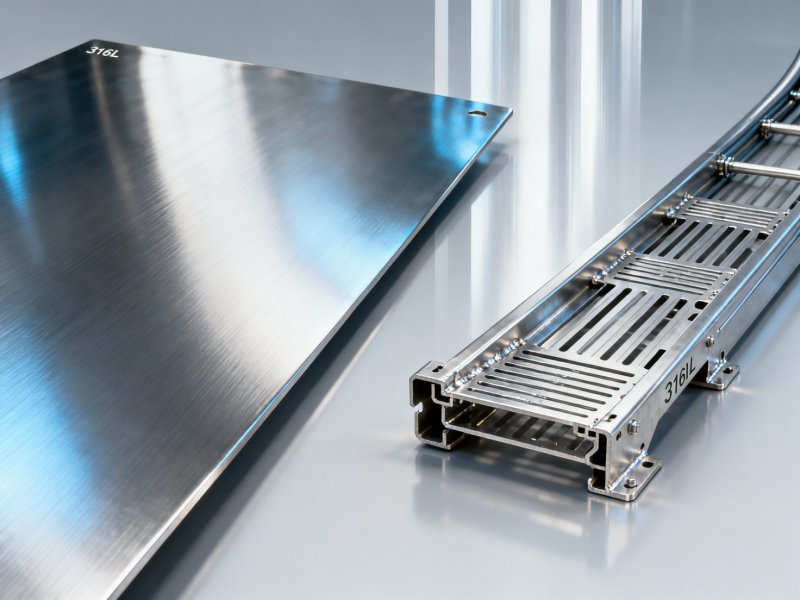
While unsuitable for primary load-bearing offshore structures, 316L stainless steel plate offers compelling advantages in auxiliary systems where fabrication flexibility, weldability, and surface finish are prioritized over extreme corrosion resistance. Its lower yield strength (190–230 MPa vs. 450–550 MPa for duplex) and superior cold-forming capability make it ideal for custom brackets, cable trays, access ladder treads, and architectural cladding elements—components often fabricated offsite and installed during commissioning.
Hongteng Fengda routinely supplies 316L plates (thicknesses 4.5–15.8 mm, widths up to 2,000 mm) to global EPC contractors for such applications, leveraging its certified hot-rolled production lines compliant with ASTM A240/A480 and EN 10088-2. Lead time averages 12–18 days from order confirmation, supported by in-house decoiling, precision cutting, and bending services.
For structural steel I-beam integration in hybrid designs—e.g., combining duplex main frames with 316L secondary framing—Hongteng Fengda provides coordinated delivery schedules and mill-certified traceability down to heat number. The Structural Steel I Beam series (Q235–Q345, SS355JR, A36), manufactured via four-roller universal rolling, ensures dimensional stability ±1% tolerance and flange/web thickness consistency critical for bolted connections with stainless components.
Procurement Decision Framework: 5 Key Evaluation Criteria
Selecting between 316L and duplex requires more than material datasheets—it demands alignment with lifecycle cost, risk tolerance, and supply chain resilience. Based on 2024–2025 project audits across 17 offshore installations, five criteria consistently determine optimal selection:
- Design Life Expectancy: Projects targeting >25-year service life in Zone 2 (splash zone) require duplex; 316L is limited to ≤15 years in similar environments.
- Welding Infrastructure: 316L permits standard TIG/MMA welding with no preheat or post-weld heat treatment; duplex requires strict interpass temperature control (≤100°C) and skilled welders certified to ASME IX Section IX.
- Lead Time Sensitivity: Global duplex plate lead times average 16–22 weeks; 316L inventory availability enables delivery within 20 days—critical for fast-track modifications.
- Maintenance Access: Components requiring frequent inspection or replacement (e.g., grating, walkway covers) benefit from 316L’s lower weight and easier field machining.
- Supply Chain Localization: As a China-based structural steel manufacturer, Hongteng Fengda maintains strategic stock of 316L plate (EN 1.4404, ASTM A240) and can fulfill orders to Middle East, Southeast Asia, and Africa within 10–14 days via bonded logistics hubs.
Risk Mitigation: Common Substitution Pitfalls & Corrective Actions
Misapplication of 316L in place of duplex has led to premature failures in at least 4 documented cases since 2022—including one platform in the North Sea where 316L support brackets corroded through within 18 months. Root causes included unverified CPT assumptions, inadequate crevice design, and lack of thermal cycling validation.
To prevent recurrence, Hongteng Fengda implements a mandatory Technical Review Gate for all stainless steel orders involving offshore use. This includes independent verification of chloride concentration profiles, maximum operating temperature envelopes, and mechanical stress maps—cross-referenced against the 2025 corrosion database before release to production.
All mitigation actions are embedded into Hongteng Fengda’s OEM engineering support package—available at no additional charge for projects exceeding USD $250,000 in structural steel value.
Conclusion & Next Steps for Engineering Teams
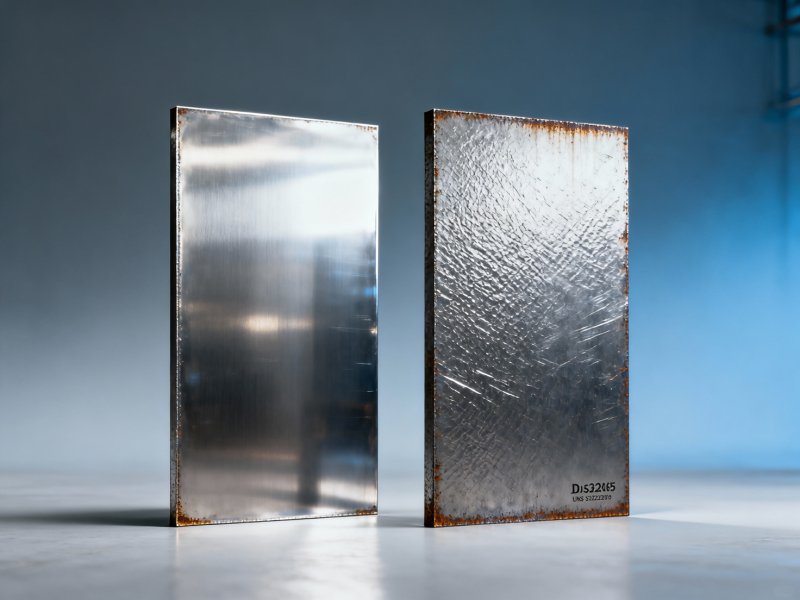
316L stainless steel plate is not a drop-in replacement for duplex stainless steel in offshore platform primary structures—but it remains a high-value, technically justified option for secondary, non-load-bearing, and maintenance-sensitive components. The 2025 corrosion data confirms that substitution must be guided by rigorous environmental mapping—not cost alone.
For structural engineers evaluating hybrid material strategies, Hongteng Fengda provides free technical consultation—including corrosion modeling inputs, weld procedure specification (WPS) development, and coordinated delivery planning for mixed-material assemblies. With full compliance to ASTM, EN, JIS, and GB standards—and production capacity supporting 12,000+ tons/month of hot-rolled structural steel—the company delivers reliability where it matters most: consistent quality, predictable lead times, and engineering-grade traceability.
If your next offshore project involves stainless steel selection, component integration, or structural steel sourcing, contact Hongteng Fengda today to request a customized material evaluation report—including comparative lifecycle cost analysis and certified mill test reports for both 316L and duplex options.
Please give us a message


Please enter what you want to find