Designing safe, code-compliant mezzanine floors in commercial warehouses starts with precise load capacity data — especially for C section steel for mezzanine floors. As a trusted structural steel manufacturer & exporter from China, Hongteng Fengda delivers high-strength, ASTM- and EN-certified C-sections engineered for optimal rigidity, ease of installation, and long-term reliability. Whether you're a project manager sizing components, a procurement officer comparing specs, or a safety officer verifying compliance, our load capacity charts — backed by real-world testing and international standards — help you make confident, cost-effective decisions without compromising structural integrity.
Why C-Section Steel Is Critical for Mezzanine Floor Structural Integrity
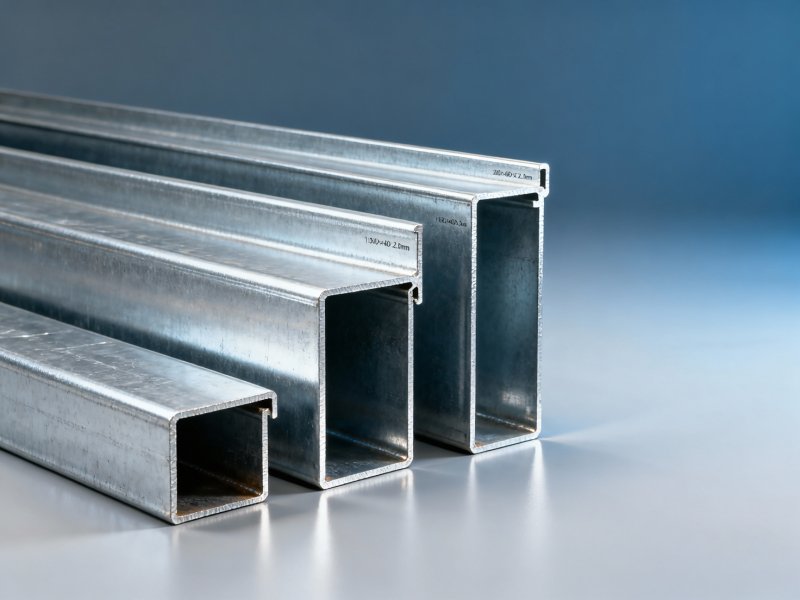
C-section steel (also known as channel sections) serves as the primary framing component for mezzanine floors due to its high strength-to-weight ratio, torsional stability, and compatibility with bolted connections. Unlike I-beams or hollow sections, cold-formed C-sections offer superior adaptability for modular assembly — especially when integrated with decking systems, guardrails, and stair supports.
For commercial warehouses, typical live loads range from 3–12 kN/m² depending on storage density and equipment access. Under such demands, C-sections must resist bending, shear, and lateral-torsional buckling simultaneously. That’s why standardized load capacity charts — derived from finite element analysis and verified through third-party lab tests per ASTM A653 and EN 10147 — are non-negotiable for engineering sign-off.
Hongteng Fengda’s C-sections undergo rigorous quality control across 6 inspection checkpoints: raw material verification, dimensional tolerance check (±0.15mm), coating thickness measurement, tensile strength validation (≥520MPa), weld seam integrity testing, and final packaging audit. This ensures every batch meets both structural performance and corrosion resistance requirements — critical for environments where humidity, dust, and mechanical abrasion accelerate degradation.
How to Read & Apply C-Section Load Capacity Charts Correctly
Load capacity charts are not universal reference tables — they reflect specific boundary conditions: span length (typically 1.5–6m), support type (simple vs. continuous), loading pattern (uniform vs. point), and section orientation (flange-in or flange-out). Misreading these variables leads directly to overdesign (wasted budget) or underdesign (safety risk).
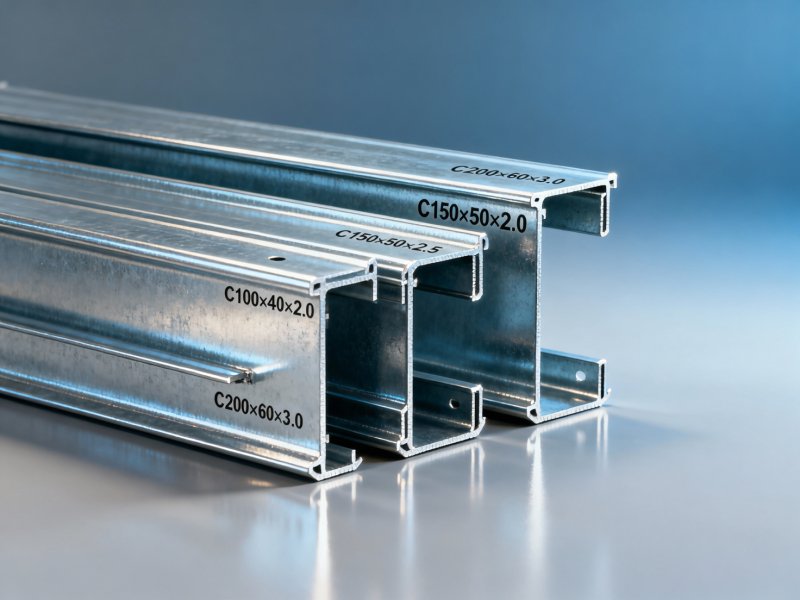
Below is a representative comparison of common C-section configurations used in warehouse mezzanines. All values assume ASTM A653 Grade 50 steel, galvanized finish, and simple-span support:
Note: Deflection compliance at L/240 ensures minimal floor vibration during forklift operation — a key requirement cited in ANSI MH28.1 and EN 1993-1-3. For spans exceeding 4.5m, continuous support or moment-resisting connections become mandatory. Hongteng Fengda provides free structural modeling support for complex layouts — including connection detail drawings and BIM-ready Revit families.
Procurement Considerations: From Spec Sheets to Delivery
Procuring C-section steel isn’t just about matching dimensions — it’s about validating traceability, certification alignment, and logistics readiness. Buyers should verify three core documentation sets before order placement: mill test reports (MTRs) confirming tensile yield strength ≥345MPa, galvanizing thickness certificates (minimum 275g/m² per ISO 1461), and dimensional inspection reports showing ±0.15mm tolerance compliance.
Delivery timelines vary significantly by region and volume: standard orders (≤20 tons) ship within 7–15 days from confirmed PO; OEM or custom-punched sections require 3–4 weeks. All shipments use seaworthy export packaging — waterproof paper + steel strapping — ensuring zero moisture ingress during ocean transit to North America, Europe, or the Middle East.
For projects requiring multi-material integration, Hongteng Fengda also supplies complementary products like Galvanized Steel Electrical Conduit, which shares identical galvanizing specifications and ASTM/EN compliance — simplifying QA across structural, electrical, and fire-protection subsystems.
Common Misconceptions & Risk Mitigation Strategies
Misconception #1: “All galvanized C-sections perform identically.” Reality: Zinc coating adhesion, uniformity, and base steel chemistry impact long-term ductility — especially after cold bending or welding. Hongteng Fengda uses DX52D-grade substrate with guaranteed spangle-free finish for consistent post-fabrication performance.
Misconception #2: “Load charts eliminate need for engineer review.” Reality: Charts assume idealized conditions. Real-world factors — column base stiffness, deck-slab interaction, and dynamic forklift loads — require site-specific calculations. We offer complimentary pre-engineering consultation with licensed structural engineers familiar with local building codes (IBC, Eurocode, AS/NZS).
Misconception #3: “Imported steel always carries higher risk.” Reality: With ISO 9001-certified production lines, 100% automated rolling mills, and third-party SGS audits conducted quarterly, Hongteng Fengda maintains defect rates below 0.12% — consistently lower than industry benchmarks for mid-volume suppliers.
Why Global Warehouse Projects Choose Hongteng Fengda
We go beyond steel supply — we embed ourselves into your project lifecycle. From initial feasibility modeling (delivered in ≤48 hours) to certified mill test reports, custom cutting lists, and just-in-time delivery scheduling, our service model reduces sourcing lead time by up to 30% versus fragmented vendor approaches.
Our technical team supports all decision layers: project managers receive BIM-integrated load charts; procurement officers get dual-standard spec sheets (ASTM + EN); safety officers access full traceability logs; and finance teams benefit from transparent landed-cost breakdowns — including duty, insurance, and port handling estimates.
Ready to validate your mezzanine design? Contact us today for: (1) Free C-section load capacity chart download (customized for your span and load case), (2) Sample kits with full MTRs, (3) Lead time confirmation for your target delivery window, or (4) Engineering support for connection detailing and seismic anchorage.
Please give us a message


Please enter what you want to find