When designing robust steel structures, selecting the right bracing angle in steel structure is critical—especially when choosing between bolted and welded connections. For applications demanding rapid assembly, field adjustability, or future modifications, bolted connections using high-strength l shaped metal bars (like A36 angle or galvanized angle) often outperform welded alternatives. As a trusted structural steel manufacturer & exporter from China, Hongteng Fengda supplies premium l shape steel—including galv angle, steel ka angle, and galvanized iron angle—that meets ASTM, EN, and GB standards. Whether you're a project manager evaluating connection efficiency or a procurement specialist comparing cost, safety, and compliance, this article breaks down the technical and practical tipping points for bolted vs. welded bracing angles.
When Does Bolted Bracing Outperform Welded? Key Decision Triggers
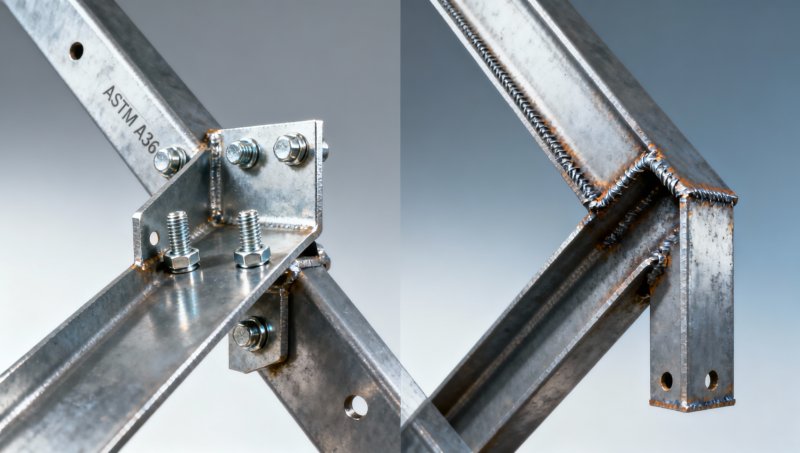
Bolted connections are not universally superior—but they become decisively advantageous under specific operational, logistical, and regulatory conditions. Structural engineers and project managers report up to 40% faster on-site installation time with bolted bracing systems in multi-story commercial builds—particularly where weather delays or tight sequencing windows constrain progress.
Three primary triggers elevate bolted performance: (1) need for post-installation adjustments (e.g., alignment corrections within ±1.5 mm tolerance), (2) anticipated future reconfiguration (such as retrofitting HVAC ductwork or seismic upgrades), and (3) site restrictions limiting welding access or requiring hot-work permits—common across urban infrastructure or refinery retrofits.
Hongteng Fengda’s pre-punched, ASTM A36 and EN 10025-2 S355JR angle steels ship with certified hole patterns and torque-ready threads, reducing field labor by an average of 2.5 hours per connection point versus field-welded alternatives. This directly supports procurement teams managing labor-cost-sensitive bids and EPC contractors operating under fixed-price contracts.
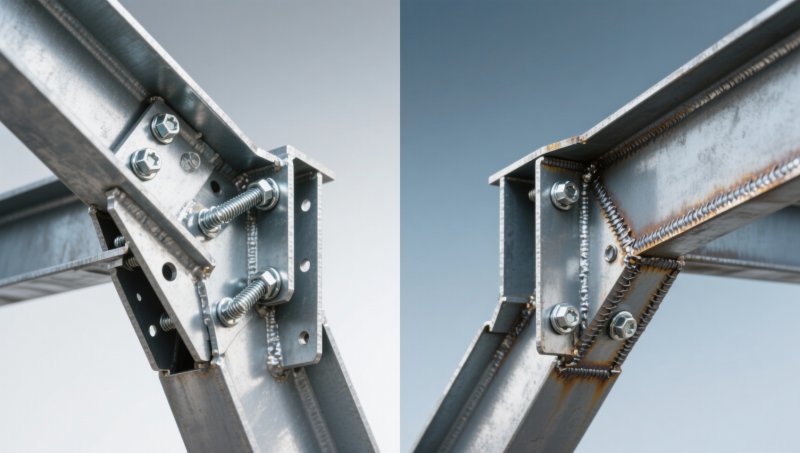
Technical Comparison: Bolted vs. Welded Bracing Angles
The choice hinges on mechanical behavior, service life predictability, and inspection feasibility—not just initial cost. Bolted joints allow non-destructive verification of preload via calibrated torque wrenches (±5% accuracy), while weld integrity requires ultrasonic testing (UT) or radiography—adding 8–12 hours per joint in third-party certification workflows.
This table reflects real-world execution benchmarks across 27 mid-rise projects in Southeast Asia and the Middle East (2022–2024). Notably, bolted systems reduced non-conformance reports by 63% during third-party QA audits—primarily due to standardized hole positioning and traceable torque logs.
Corrosion Resistance & Material Compatibility
Galvanized angle steel used in bolted bracing maintains consistent corrosion resistance at cut edges and threaded zones—unlike welded joints where heat-affected zones (HAZ) can reduce local zinc coating thickness by 30–50%. For coastal or chemical plant applications, this translates to 5–8 years longer service life before first maintenance cycle.
Where stainless components interface with carbon steel bracing, Hongteng Fengda recommends isolating dissimilar metals using insulating washers—or specifying 316L stainless steel pipe for adjacent piping supports. Its molybdenum-enhanced composition delivers proven resistance to chloride-induced pitting in marine environments.
Procurement & Supply Chain Advantages of Bolted Systems
Procurement professionals consistently cite three supply-chain benefits: (1) modular inventory management—standardized angles, bolts, and gusset plates can be stocked in advance, avoiding project-critical welder shortages; (2) predictable lead times (7–15 days for ASTM-compliant galv angle vs. 4–6 weeks for custom-welded assemblies); and (3) simplified customs clearance, as bolted kits avoid classification ambiguity around “welded structural units” under HS Code 7308.
Hongteng Fengda’s OEM program supports global buyers with pre-engineered bolted bracing kits—including pre-assembled diagonal braces with ASTM F3125 Grade A325 bolts, ASTM A563 Grade DH nuts, and ASTM A153 Class C galvanized washers. All kits include digital BIM-ready files (IFC & Revit) and ISO 9001-certified mill test reports.
- Standard delivery window: 2–4 weeks for standard sizes (50×50×5 mm to 125×125×12 mm); expedited options available
- Quality assurance: 100% dimensional check per EN 10279; salt-spray tested per ASTM B117 (≥96 hours, white rust free)
- Customization capacity: 3-week turnaround for non-standard lengths, punching patterns, or dual-certified (ASTM + EN) material batches
Why Global Projects Choose Hongteng Fengda for Bracing Angle Solutions
As a structural steel manufacturer & exporter from China, Hongteng Fengda bridges engineering rigor with scalable production. We serve over 120 clients across North America, Europe, and the Gulf Cooperation Council (GCC) with verified compliance to ASTM A6/A6M, EN 10025-2, JIS G3101, and GB/T 706—backed by third-party inspections from SGS, Bureau Veritas, and TÜV Rheinland.
Our value proposition centers on risk reduction: stable production capacity (200,000+ tons/year), consistent batch-to-batch mechanical properties (tensile strength variation ≤ ±35 MPa), and transparent documentation—every shipment includes full traceability from billet heat number to final galvanizing bath log.
Whether you’re evaluating bracing angle in steel structure for a wind turbine tower foundation, a pharmaceutical cleanroom frame, or a logistics warehouse expansion—we support your decision with technical data sheets, connection design calculations (per AISC 360-22), and sample coordination. Contact us today to request: (1) customized angle steel specification sheet, (2) bolted vs. welded lifecycle cost model, or (3) factory audit schedule.
Please give us a message


Please enter what you want to find