Welding high-carbon steel plates with high HRC ratings presents severe metallurgical challenges. When carbon content exceeds 0.60% or hardness reaches specific HRC levels, the martensite start temperature drops significantly. As the weld pool cools, the transformation from austenite to martensite involves substantial volume expansion, generating immense microstructural stresses. If diffusible hydrogen levels are elevated during this phase, cold cracking becomes an almost inevitable outcome. Resolving this issue does not rely on finding a flawless filler metal, but rather on precisely controlling the thermal cycle and managing the diffusion paths of hydrogen. Understanding the interaction between carbon equivalent, constraint, and hydrogen is the fundamental requirement for achieving sound joints.
Thermal Cycle Management and Microstructural Control
Preheating and interpass temperature management require a dynamic balance rather than rigid adherence to standard charts. Preheating serves to reduce the cooling rate, allowing the heat-affected zone sufficient time to undergo bainitic or pearlitic transformations instead of fully martensitic ones. The transformation kinetics dictate that slower cooling allows carbon atoms to diffuse and form softer, more ductile phases like upper bainite, whereas rapid cooling traps carbon in a supersaturated body-centered tetragonal lattice, forming untempered martensite.
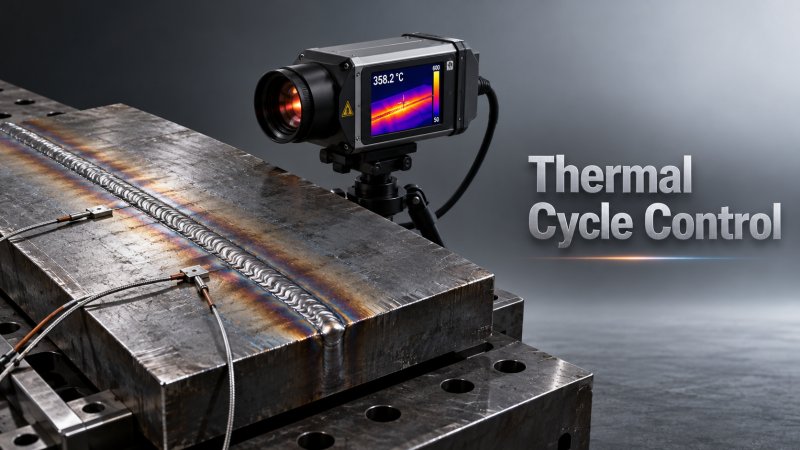
However, interpass temperature is not universally beneficial at higher levels. Excessive interpass temperatures cause severe grain coarsening in the heat-affected zone, drastically reducing impact toughness. In practical applications, the minimum preheat temperature must be calculated based on plate thickness and carbon equivalent, but an upper limit must also be strictly defined. For instance, when plate thickness exceeds 50mm, the interpass temperature is typically maintained between 200°C and 250°C. Exceeding 300°C significantly increases the risk of embrittlement. Measurements must be taken using infrared thermometers at least 75mm away from the weld centerline on both sides, rather than directly on the weld surface, because surface temperatures are affected by radiation and air convection, failing to reflect the true thermal state inside the base metal. Thermocouples attached via magnetic pads or spot welding provide continuous monitoring, offering more reliable data than intermittent spot checks with infrared guns, especially in environments with fluctuating ambient temperatures or strong air drafts.
Hydrogen Mitigation and Filler Metal Selection
Hydrogen control and filler metal selection form the core of preventing delayed cracking. In high-carbon steel welding, hydrogen is the primary catalyst for cold cracks. Strictly baked low-hydrogen electrodes or fluxes are mandatory. Electrodes must be baked at 350°C to 400°C for at least two hours and stored in a holding oven at 100°C to 150°C, transferred to the welding site in portable quivers.
The selection of filler materials involves a trade-off between strength matching and crack resistance. Using filler metals of equal strength to the base metal results in high carbon content in the weld metal, highly prone to producing hardened structures. Therefore, engineering practices often adopt a lower strength matching principle, selecting austenitic stainless steel electrodes or low-alloy high-strength steel electrodes. Austenitic filler metals possess high hydrogen solubility and excellent plasticity, absorbing welding stresses through plastic deformation and preventing crack propagation. This approach sacrifices high-temperature performance and wear resistance. If the component requires operation at hardness levels above HRC 50, low-alloy high-strength filler metals must be selected, accompanied by rigorous post-weld heat treatment.
Operational Techniques and Constraint Reduction
Welding heat input and operational techniques directly dictate the microstructural evolution. Heat input determines the cooling rate. For high-carbon HRC steel plates, excessive heat input leads to heat-affected zone overheating and grain growth; insufficient heat input causes excessively rapid cooling, increasing the martensite transformation ratio. The optimal heat input window must be established through welding procedure qualification. Operationally, employing short arc length, narrow beads, and multi-pass welding are fundamental principles. The thickness of each pass should not exceed the electrode diameter, utilizing the thermal tempering effect of subsequent passes on previous ones to refine grains and reduce hardness. Crater cracking at the end of the weld is a common defect. Welders must use run-off tabs or gradually decay the current to fill the crater completely; directly breaking the arc is strictly prohibited.
Joint design and constraint management significantly influence residual stress distribution. The geometric shape of the welding joint directly affects constraint stress. High-carbon steel is extremely sensitive to constraint levels. When designing grooves, the fusion ratio should be minimized to reduce the dilution effect of the base metal on the weld metal. U-grooves require less filler metal than V-grooves, thereby reducing overall shrinkage stress. During assembly, forced fit-up must be avoided. If misalignment or excessive gaps exist, forcibly pulling the pieces together generates massive residual stresses. These stresses superimpose with welding thermal stresses, highly prone to causing tearing during or after welding.
When utilizing Q195 angle steel as temporary support or tooling fixtures, it is necessary to note that its lower yield strength cannot provide sufficient rigidity to resist the massive shrinkage forces generated during high-carbon steel welding. Furthermore, its welding logic differs entirely from that of high-carbon plates; it should not be directly used as a restraint piece fused with the high-carbon base metal to avoid creating a brittle transition layer at the interface.
Post-Weld Treatment and Inspection Protocols
Post-weld heat treatment timing and curve control are non-negotiable for high-carbon HRC steel plates. Post-heating for hydrogen removal should be performed immediately after welding completion, typically holding between 250°C and 350°C for two to four hours to allow diffusible hydrogen to fully escape. If immediate post-heating is impossible, the workpiece must be placed in an insulated slow-cooling pit. The subsequent stress relief annealing or tempering treatment must be conducted at a temperature below the original tempering temperature of the base metal or the Ac1 critical point to avoid degrading the overall mechanical properties. Heating and cooling rates must be strictly controlled, generally not exceeding 200°C per hour, to prevent generating new thermal stresses.
Non-destructive testing timing and limitations require careful consideration. Non-destructive evaluation of high-carbon steel welded joints cannot be conducted immediately after welding. Due to the nature of delayed cracking, hydrogen-induced cracks may appear hours or even days after welding. Therefore, ultrasonic testing or radiographic testing must be performed at least 48 hours post-weld. For joints exceeding 50mm in thickness or with extremely high carbon equivalents, waiting 72 hours is recommended. Phased array ultrasonic testing offers superior resolution for detecting internal flaws in thick plates compared to conventional methods. Magnetic particle testing is suitable for surface crack detection but must be conducted after the weld cools to ambient temperature and the surface is thoroughly cleaned.
Rework Risks and Environmental Interventions
Repair and rework risk management is critical when defects are identified. Once a defect is found in a high-carbon HRC steel plate welded joint, the difficulty and risk of rework are significantly higher than those for ordinary carbon steel. Every rework cycle subjects the base metal to another thermal cycle, causing further grain coarsening in the heat-affected zone and reducing toughness. Defect removal should preferably use mechanical grinding or carbon arc gouging. If carbon arc gouging is employed, the carburized layer on the surface must be completely ground away, as surface carburization significantly increases cold cracking susceptibility. Following rework, the non-destructive testing clock resets. The repaired joint must again wait for the mandatory holding period before inspection, ensuring that any new hydrogen-induced cracking has sufficient time to initiate and become detectable.
The impact of environmental temperature and humidity on high-carbon steel welding is frequently underestimated. When the ambient temperature drops below 5°C or relative humidity exceeds 80%, the risk of weld metal absorbing hydrogen increases sharply. During outdoor or humid workshop construction, local protective shelters must be erected. Flame heating or electric heating tapes should be used to dehumidify and preheat the groove and the area at least 100mm on both sides. Oil, rust, and moisture on the base metal surface are not only sources of hydrogen but also cause porosity and slag inclusions. After grinding the groove, acetone or a dedicated cleaner must be used to wipe the area, ensuring the welding zone is absolutely clean.
The welding of high-carbon HRC steel plates is a complex systems engineering task involving materials metallurgy, thermodynamics, and mechanical behavior. From joint design and thermal cycle control to post-weld treatment, deviations in any step leave traces in the microstructure, ultimately manifesting macroscopically as cracks or brittle fractures. Precisely understanding the interaction between carbon equivalent, constraint, and diffusible hydrogen forms the foundation for ensuring the reliable operation of welded structures under extreme working conditions.
Please give us a message


Please enter what you want to find