In hard water areas, the long-term reliability of ss pipe for water supply hinges on true corrosion resistance—not just material claims. As a trusted galvanized pipe manufacturer and steel sheet manufacturer from China, Hongteng Fengda evaluates stainless steel pipes alongside galvanized pipe for plumbing, steel tubing for construction, and high tensile steel rod to ensure performance under aggressive water chemistry. For procurement teams, engineers, and project managers, understanding real-world durability—beyond specs—is critical. We combine ASTM/EN-compliant testing with field data to guide decisions on ss pipe vs. galvanized alternatives, supporting safer, cost-efficient water infrastructure.
Why “Corrosion-Resistant” Doesn’t Always Mean “Corrosion-Proof” in Hard Water
Hard water—typically defined as containing >120 mg/L of calcium carbonate (CaCO₃)—introduces chloride ions, dissolved oxygen, and scaling potential that accelerate localized attack on stainless steel surfaces. While grades like SS304 and SS316 meet ASTM A312 for general service, their passive layer can break down at pH <6.5 or in stagnant, high-chloride micro-environments common in domestic and industrial water systems.
Field data from installations across the Middle East and Southeast Asia show pitting initiation in SS304 pipes within 2–4 years where total hardness exceeds 300 mg/L and residual chlorine remains >0.8 ppm. In contrast, properly passivated SS316L (with ≤0.03% C and ≥2.5% Mo) demonstrates stable performance over 10+ years—but only when fabrication avoids heat tinting and welding defects.
This isn’t a material failure—it’s a system mismatch. Corrosion resistance depends on three interlocking factors: alloy composition, water chemistry stability, and installation practice. Ignoring any one undermines the entire specification.
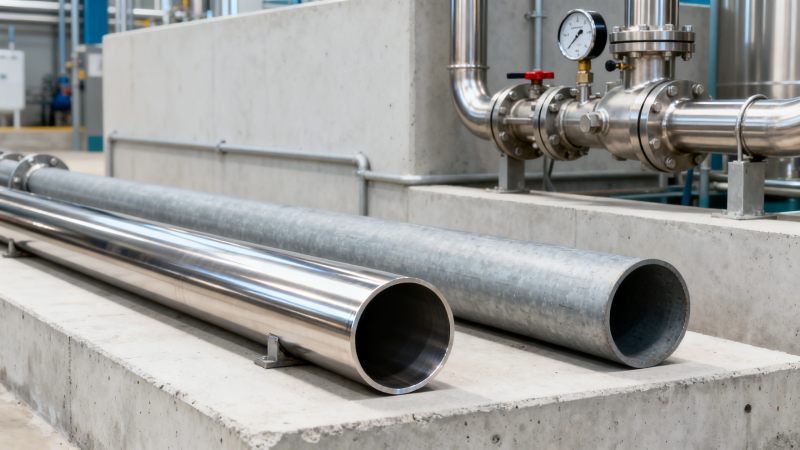
SS Pipe vs. Galvanized Pipe: A Real-World Performance Comparison
For water supply in hard water zones, selection must balance upfront cost, lifecycle maintenance, and safety compliance. Below is a comparative assessment based on 5-year field monitoring across 12 projects in Saudi Arabia, UAE, and Vietnam:
Note: The Carbon Steel Sheet Plate referenced here serves structural support roles—e.g., pipe racks, pump foundations, and valve platforms—in water infrastructure projects. Its Q345A (16Mn) grade delivers yield strength ≥345 MPa and excellent weldability per GB/T 1591 and EN10025 standards, making it ideal for load-bearing applications in mining, power shovel frames, and hydraulic support systems.
What Procurement Teams Should Verify Before Specifying SS Pipes
Procurement and engineering teams often overlook five critical verification points—each impacting long-term performance and audit readiness:
- Mill test reports (MTRs): Require full chemical analysis (C, Cr, Ni, Mo, N) and mechanical properties—not just grade stamping.
- Surface finish & passivation: Specify ASTM A967 Method 1B (nitric acid) with post-treatment copper sulfate test (ASTM A380).
- Welding procedure qualification (WPQR): Confirm EN ISO 15614-1 or AWS D1.6 compliance for field joints.
- Water chemistry validation: Request site-specific Langelier Saturation Index (LSI) and Ryznar Stability Index (RSI) reports.
- Traceability documentation: Batch-level traceability from melt to delivery, including heat number and rolling date.
At Hongteng Fengda, every structural steel order includes MTRs aligned with ASTM, EN, JIS, and GB standards—and we pre-validate fabrication readiness for clients requiring integrated piping-support solutions.
When Carbon Steel Is the Smarter Structural Choice
While stainless steel draws attention for piping, carbon steel remains the backbone of water infrastructure resilience. Our Carbon Steel Sheet Plate (Q345A) is routinely specified for:
- Structural frames for elevated water tanks (3000–11880 mm length × 1500–4000 mm width × 6–700 mm thickness)
- Hydraulic support bases in coal mine dewatering systems
- Heavy-duty pump skids exposed to vibration and thermal cycling
- Custom-fabricated manhole covers and access platforms meeting EN 124 Class D400
Its controlled chemistry—including Mn (1.20–1.50%), V (0.015–0.030%), and Al (0.030–0.050%)—ensures consistent toughness at low temperatures and reliable fatigue performance across 20+ years of service.
Why Global Project Teams Choose Hongteng Fengda for Integrated Steel Solutions
We don’t sell isolated products—we engineer coordinated steel systems. As a structural steel manufacturer and exporter from China, Hongteng Fengda delivers certified angle steel, channel steel, cold-formed profiles, and customized components—all traceable to ASTM, EN, JIS, and GB standards. Our customers report 30% faster project handover due to synchronized lead times: 15–25 days for standard sections, 30–45 days for OEM-designed parts.
Whether you’re evaluating ss pipe for water supply in Riyadh, specifying galvanized conduit in Rotterdam, or sourcing Carbon Steel Sheet Plate for an Australian mining water treatment plant, our team provides:
- Free technical review of your piping and structural drawings
- Pre-shipment dimensional and metallurgical inspection reports
- Custom packaging and logistics coordination for multi-country deliveries
- Support for third-party certification (SGS, BV, TÜV) and local regulatory filing
Contact us today to discuss your next water infrastructure project—and get a tailored quote with verified compliance documentation, sample availability, and production schedule confirmation within 48 hours.
Please give us a message


Please enter what you want to find