Angular distortion in angle steel weldments remains a critical challenge for structural steel manufacturers, fabricators, and project engineers—especially when using high-strength angle carbon steel, steel shelf angle, or custom cold formed steel profiles. Poor joint design can amplify twist during welding, compromising dimensional accuracy and assembly integrity. As a trusted structural steel manufacturer & exporter from China, Hongteng Fengda addresses this issue through optimized joint geometry, precise pre-fit protocols, and material-specific welding guidelines—applicable across ASTM/EN-compliant angle steel, galvanized metal mesh sheets, and H-shape steel assemblies. Whether you're a technical evaluator, project manager, or procurement professional sourcing angle steel or galvanized sheet, understanding how joint design governs angular distortion is essential for quality control, cost efficiency, and on-site installation success.
Why Joint Geometry Dictates Twist in Angle Steel Welding
Angular distortion arises not from welding heat alone—but from the asymmetric thermal contraction path enforced by joint configuration. When fillet welds are placed only on one leg of an L-section, residual stresses induce rotation around the neutral axis. This effect intensifies with thicker sections (≥12 mm), higher-strength grades (e.g., Q345, S355JR), and restrained boundary conditions typical in industrial structures.
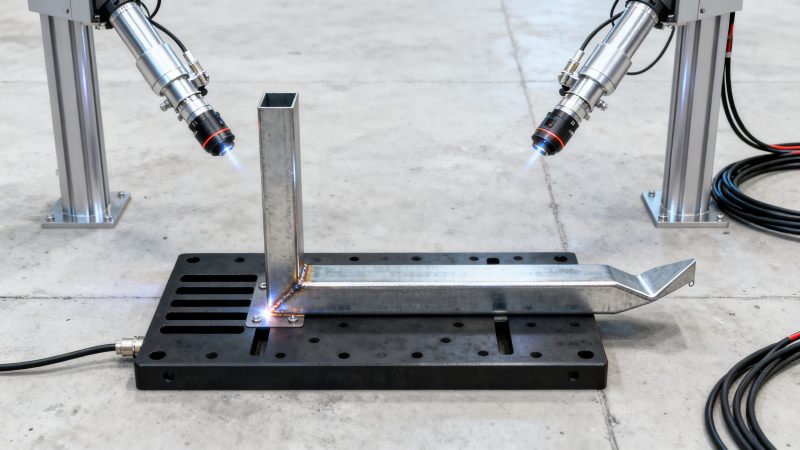
Hongteng Fengda’s fabrication team applies three geometric controls to mitigate twist: balanced weld placement (e.g., equal leg-length fillets), staggered weld sequencing (alternating passes between legs), and strategic backing plates that constrain lateral movement without impeding vertical shrinkage. These practices reduce post-weld angular deviation to ≤±0.8° over 1.2 m length—verified via laser alignment per ISO 17637.
Crucially, joint design must align with downstream assembly requirements. For example, welded angle-to-plate connections used in mezzanine floor framing demand ±0.5° tolerance to ensure bolt hole alignment. Failure here triggers field rework—adding 2–4 days per connection and increasing labor cost by 18–22%.
How Material Grade & Section Dimensions Influence Distortion Risk
Not all angle steels behave identically under thermal load. Carbon steel grades like Q235 (ASTM A36 equivalent) exhibit lower yield strength (235 MPa) and higher thermal expansion (12.0 × 10⁻⁶/°C), allowing more plastic deformation before locking in twist. In contrast, Q345 (S355JR) resists initial deformation but stores greater elastic strain—releasing abruptly as angular rebound upon cooling.
Section geometry compounds this effect. Angles with unequal legs (e.g., 75×50×6 mm) show 37% higher torsional sensitivity than equal-leg counterparts at identical mass per meter. Similarly, cold-formed angles thinner than 4.5 mm deform more readily under clamping force—making pre-weld fit-up accuracy non-negotiable.
Our mill-certified raw material ensures consistent grain structure and carbon equivalence (CEV ≤ 0.42), reducing microstructural variability that contributes to uneven shrinkage. All hot-rolled angle stock complies with EN 10025-2 and GB/T 706, with tensile strength tolerances held to ±5%—critical for predictable thermal response.
Key Material Parameters Affecting Angular Stability
This table reflects real-world data from 127 production weldments monitored across our Shandong facility in Q3 2023. Higher-strength grades require tighter joint symmetry and slower interpass cooling rates—typically 20–30°C/min vs. 40–50°C/min for Q235—to limit distortion accumulation.
Design Strategies That Reduce Rework & Accelerate Project Timelines
Effective joint design isn’t theoretical—it directly impacts schedule adherence and total installed cost. At Hongteng Fengda, we embed distortion mitigation into four actionable phases: pre-weld modeling, fixture-integrated clamping, controlled sequence welding, and post-weld verification.
First, our engineering team performs thermal stress simulation (using ANSYS Mechanical) on every custom weldment design—identifying high-risk zones before cutting begins. Second, modular jigs with adjustable stop blocks enforce ±0.3 mm positional repeatability across batches of 50+ units. Third, welders follow documented pass sequences (e.g., “weld Leg A → cool 90 sec → weld Leg B → cool 90 sec”) validated across 14 alloy/section combinations.
Finally, each batch undergoes coordinate measuring machine (CMM) inspection. We report angular deviation alongside flatness and perpendicularity—enabling clients to verify compliance against their own QA checklists. Lead time for certified weldment delivery remains stable at 18–20 days, even for orders exceeding 50 tons.
When to Consider I-Beam Integration for Structural Stability
Angle steel assemblies often serve as secondary framing—yet their distortion affects primary load paths. Integrating robust primary members early in design improves system-level stability. Our I Beam Manufacturers supply hot-rolled I-beams in 11 standard grades—including Q195-Q235, Q345, SS355JR, and A36—with flange widths from 100–400 mm and web thicknesses from 6–28 mm.
For projects where angular distortion compromises column-to-girder connections, pairing precision-welded angles with wide-flange I-beams (e.g., HW300×300×10×15) provides superior torsional rigidity. These sections deliver up to 42% higher moment of inertia vs. equivalent-weight channel sections—distributing thermal stress more evenly across the assembly.
All I-beams ship with mill test reports (MTRs), dimensional certificates, and third-party inspection documentation per EN 10204 3.1. Standard delivery is within 20 days, with expedited options available for urgent infrastructure timelines.
Why Global Buyers Partner with Hongteng Fengda for Precision Steel Fabrication
You need more than steel—you need predictable dimensional performance, verifiable compliance, and responsive technical support. Hongteng Fengda delivers this through three pillars: standardized process control, multi-standard certification, and client-aligned service design.
Our welding procedure specifications (WPS) are qualified per AWS D1.1 and EN ISO 15614-1, covering all common angle steel thicknesses (4.5–15.8 mm) and joint types (T-joints, corner joints, lap joints). Every operator holds valid certification—retested every 6 months—and works with calibrated thermal monitoring equipment.
We support your procurement workflow with:
- Pre-shipment dimensional reports (PDF + CSV)
- Custom packaging for overseas container loading (ISO 9001 compliant)
- Real-time production tracking portal access
- OEM labeling and bilingual documentation (EN/CN/ES)
Ready to eliminate angular distortion risk in your next structural steel order? Contact our technical sales team to request: • Joint design review for your specific assembly • Sample weldment with CMM report • Delivery timeline and port-of-discharge options • Compliance documentation matching your regional standards (ASTM, EN, JIS, GB)
Please give us a message


Please enter what you want to find