Choosing the right angle iron for trailer frames is not just about size—it starts with thickness, load demands, and long-term durability. Whether you source steel angle for construction, compare angle iron for shelving, or evaluate an angle stainless steel supplier for corrosion resistance, understanding practical thickness choices helps buyers, fabricators, and project teams avoid failure, control cost, and build trailer structures that hold up in real working conditions.
For trailer builders, thickness is where structural judgment becomes practical engineering. Two angle sections may share the same leg dimensions, yet perform very differently once road vibration, point loading, torsion, impact, and repeated start-stop cycles are introduced. In steel procurement, that difference affects safety margin, weld quality, service life, and the total cost of the finished trailer.
This article is written for fabricators, technical evaluators, buyers, project managers, distributors, and business decision-makers who need clear guidance on angle iron for trailer applications. It focuses on how thickness choices affect frame strength, fabrication efficiency, corrosion resistance, inspection, and sourcing decisions in a steel supply context.
Why Thickness Matters More Than Many Trailer Buyers Expect
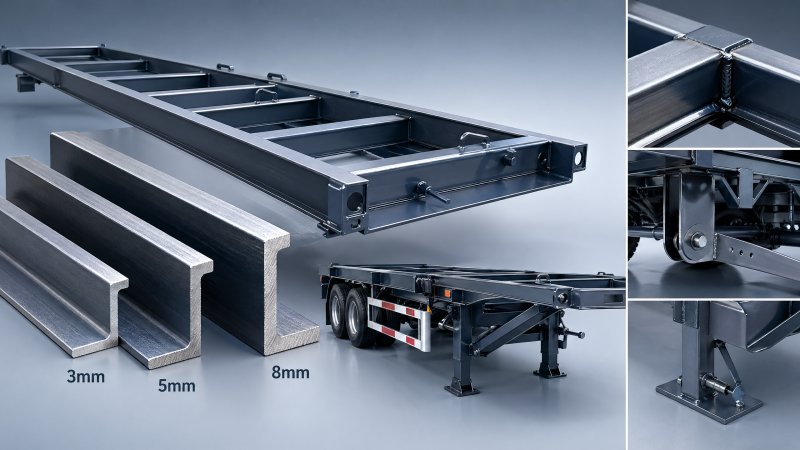
In trailer design, angle iron thickness is not just a dimensional detail. It directly influences section stiffness, resistance to local buckling, weld heat behavior, and fatigue performance under cyclic service. A trailer frame rarely experiences a single static load only. It usually sees 3 types of stress at the same time: vertical payload, torsional movement from uneven ground, and repeated vibration during transport.
Thin angle iron may appear cost-effective at the purchasing stage, but if thickness drops below the practical requirement for the trailer category, the frame can deflect excessively or crack near the weld toe over time. In many light-duty builds, the jump from 3 mm to 5 mm thickness can significantly improve rigidity, especially in drawbar members, cross supports, and perimeter rails that see concentrated load transfer.
For steel manufacturers and exporters, this is also where buyer communication becomes important. Customers often specify only leg size, such as 50 x 50 mm or 75 x 75 mm, while overlooking wall thickness. From a structural standpoint, a 50 x 50 x 3 mm angle and a 50 x 50 x 6 mm angle are not interchangeable for the same trailer duty level, even if the outer profile looks similar.
Typical stress conditions in trailer frames
A trailer frame may operate under agricultural use, factory transport, construction logistics, or road hauling. Each environment creates a different stress profile. A small garden trailer may see short trips and lower speeds, while a utility or equipment trailer may face 60–100 km/h transport, sharp braking, uneven loading, and frequent exposure to moisture, mud, or de-icing salts.
That means thickness should be selected with at least 4 evaluation points in mind: expected gross load, span length between supports, frequency of use, and road or site conditions. For buyers comparing multiple quotations, these 4 factors are often more useful than unit price alone when deciding between lighter and heavier angle steel options.
Main failure risks when thickness is underspecified
- Excessive frame flexing that accelerates joint loosening and deck distortion.
- Cracking near welds after repeated vibration cycles, especially on cross-member intersections.
- Leg twisting or edge deformation during impact loading and off-center cargo placement.
- Higher maintenance frequency within 6–12 months of service in rough-duty applications.
In practical sourcing, angle iron for trailer use should therefore be treated as a structural decision, not a commodity purchase based only on appearance or nominal size. Reliable manufacturers help buyers evaluate thickness alongside grade, tolerances, standards, and downstream fabrication conditions.
Practical Thickness Ranges for Different Trailer Applications
Although final specification should be verified by design calculations and local requirements, the market uses some common thickness ranges as a starting point. These ranges help technical teams filter suitable options before moving into detailed engineering. The key is to match thickness not only to weight capacity, but also to trailer geometry and service frequency.
For example, a small light-duty trailer carrying occasional household or landscaping loads may function with 3–4 mm angle iron in selected members. By contrast, commercial utility trailers, livestock trailers, machinery haulers, or construction service trailers often move toward 5–8 mm thickness in major frame rails, depending on span, axle layout, and local reinforcement strategy.
The table below gives a practical comparison framework often used during procurement discussions. It is not a substitute for engineering approval, but it helps align purchasing, fabrication, and project management teams around realistic structural expectations.
The key takeaway is that “thicker” is not always universally better, but under-specifying thickness is often the more expensive mistake. Oversized material increases dead weight, transport cost, and sometimes fabrication time, yet material that is too thin may create rework, warranty issues, and service failures that cost far more than the initial steel savings.
How thickness interacts with leg size
A larger leg dimension does not automatically compensate for insufficient thickness. For instance, a larger but thin section may still twist or buckle locally under concentrated loading. That is why buyers should review section geometry as a combined profile: leg size, thickness, length, support spacing, and weld layout all matter.
Many procurement teams compare only 2 dimensions when requesting quotations. A better approach is to submit at least 5 specification points: leg size, thickness, steel grade, length tolerance, and surface condition. This reduces the risk of receiving commercially acceptable material that is not ideal for real trailer fabrication.
Material, Corrosion, and Mid-Project Product Choices
Thickness selection should never be separated from material environment. A trailer used indoors for occasional warehouse movement has very different corrosion demands from a trailer exposed to rain, coastal air, fertilizers, livestock conditions, or chemical splash. In corrosive service, the effective life of angle iron depends on both initial section thickness and the protection system applied to the steel.
This is one reason galvanized components remain important in broader trailer and support-frame fabrication. While angle steel is often the primary frame member, auxiliary structures, protective assemblies, fluid lines, rack systems, and secondary support elements may benefit from galvanized tubing. In these cases, a suitable insert option is Galv Steel Tube, especially where corrosion resistance, low-pressure fluid routing, or support-frame integration is part of the project scope.
This product is available in DX52D material and can be supplied in lengths from 1–12 m, widths from 0.6–3 m where applicable to supply format, and thicknesses from 0.1 mm to 300 mm or as required, with thickness tolerance around ±0.15 mm. It is commonly used across construction, light industry, automobile-related manufacturing, agriculture, low-pressure pipeline systems, mining support frames, and other industrial applications where corrosion resistance extends service life.
When galvanizing changes the selection logic
Protective coating does not replace structural thickness, but it can improve long-term durability and reduce maintenance intervals. For buyers evaluating trailer subassemblies or accessory systems, galvanized steel may lower repainting frequency and help preserve dimensional integrity in outdoor service. Coating systems such as 5 micron primer plus 20 micron color top coat, with 5–7 micron back coat layers where relevant, are often discussed in projects requiring additional surface protection.
A practical procurement point is to separate structural necessity from environmental necessity. If a frame member needs 6 mm to safely handle loading, dropping to 4 mm just because the surface is galvanized is not sound engineering. Coating protects against corrosion loss, but it does not make an undersized section structurally equivalent to a thicker section.
Relevant standards and supply checks
- Confirm whether the steel is produced to ASTM, EN, JIS, GB, DIN, or other requested standards.
- Check thickness tolerance and straightness before fabrication starts.
- Review surface condition for welding, painting, or direct outdoor use.
- Match corrosion protection level to service exposure, not only to initial budget.
For global buyers, a structural steel supplier with experience in standard and OEM production can reduce sourcing risk by aligning material grade, coating choice, fabrication requirements, and delivery scheduling before production begins. That is especially valuable when trailer projects combine frame members, channels, beams, cold-formed profiles, and corrosion-protected auxiliary steel in one package.
How Buyers and Fabricators Should Evaluate Angle Iron Before Ordering
A good trailer steel purchase starts with a technical checklist, not just a price inquiry. Fabricators need material that cuts cleanly, fits jigs accurately, and welds consistently. Procurement teams need predictable lead time, standards compliance, and low risk of thickness deviation. Quality teams need traceable inspections and surface condition suitable for downstream coating or assembly.
For many B2B buyers, the most efficient process is to define requirements in 3 stages: application review, technical confirmation, and commercial approval. This avoids a common problem in steel sourcing where commercial teams negotiate on incomplete specifications, then discover fabrication mismatches after material arrives at the workshop.
The table below can be used as a practical decision sheet during quotation comparison for angle iron for trailer production.
In most steel sourcing projects, thickness should be measured at multiple points rather than assumed from nominal specification. For critical trailer parts, buyers often inspect at 3–5 random positions per bundle or per heat-related lot. This simple step helps detect rolling variation before material enters cutting and welding operations.
A practical 5-step sourcing process
- Define trailer type, target payload, route condition, and expected duty cycle.
- Specify angle size, thickness, standard, length, and surface requirement clearly.
- Request mill-related documentation and tolerance confirmation before order release.
- Inspect incoming steel for thickness, straightness, and weld-preparation suitability.
- Record supplier performance across quality, delivery, and consistency for future lots.
For import buyers, working with a manufacturer and exporter that already serves North America, Europe, the Middle East, and Southeast Asia can simplify standard matching and shipment planning. Stable production capacity and dependable lead times matter as much as the steel itself when trailer projects have fixed build schedules.
Common Mistakes, FAQ, and Final Selection Advice
The most common mistake in trailer steel buying is reducing the decision to cost per ton. That approach ignores thickness fitness, fabrication losses, corrosion environment, and maintenance burden. A low initial price can quickly become a high life-cycle cost if the frame needs repair after one heavy season or if distortion slows down production on the shop floor.
Another frequent issue is mixing unrelated use cases. Angle iron for shelving, angle steel for building bracing, and angle iron for trailer frames may share a general profile type, but they do not share identical structural demands. Trailer frames experience moving loads and fatigue, so selection must reflect transport-specific stresses rather than static indoor usage assumptions.
The following questions reflect common concerns from buyers, fabricators, and project teams comparing trailer frame steel options.
How do I know if 3 mm angle iron is enough for a trailer?
It may be sufficient for a small, lightly loaded trailer with short spans and limited duty, but it is often inadequate for regular commercial use. If the trailer carries concentrated loads, travels frequently, or operates on uneven ground, 4–6 mm or more may be the safer starting range for key members. Final acceptance should still depend on actual design review.
Is thicker angle iron always better?
No. Excessive thickness adds self-weight, can reduce payload efficiency, increase fuel or towing demand, and raise fabrication cost. The right choice is the thickness that meets structural and durability requirements with reasonable manufacturing efficiency. Good design aims for balance, not maximum mass.
What should procurement teams ask suppliers before placing an order?
At minimum, ask for 6 things: material standard, actual thickness tolerance, available lengths, surface condition, corrosion protection option, and lead time. For export projects, also confirm packing method, shipment schedule, and whether OEM dimensions or customized structural components can be supplied in the same order.
Final advice for decision-makers
- Match thickness to real load and duty cycle, not to visual preference.
- Review corrosion exposure early, especially for outdoor and coastal service.
- Compare quotations using technical criteria and not price alone.
- Choose suppliers that can support standard grades, OEM requests, and consistent delivery.
For companies sourcing structural steel from China, Hongteng Fengda supports global buyers with angle steel, channel steel, beams, cold-formed profiles, and customized structural components produced under strict quality control and aligned with major standards such as ASTM, EN, JIS, and GB. If you need help selecting angle iron thickness for trailer production or want to review corrosion-resistant steel options for related assemblies, contact us to get a tailored solution, discuss product details, and explore the most suitable steel supply plan for your project.
Please give us a message


Please enter what you want to find