When sourcing angle stainless steel Europe for indoor applications, many procurement managers assume 316 is always superior to 304 — but that’s not necessarily true. For dry, non-corrosive indoor environments, 304 offers excellent performance, lower cost, and broader availability — especially when buying angle steel online or fulfilling MOQ requirements for structural steel orders. As an ASTM A36 angle steel price per ton in Philippines-aware exporter and EN-compliant structural steel manufacturer, Hongteng Fengda helps global buyers navigate international standards for structural steel products without over-specifying. Let’s clarify why material choice should align with actual service conditions — not just prestige.
Why “Higher Grade” Doesn’t Mean “Better Fit” for Indoor Angle Stainless Steel
Stainless steel grade selection is often misinterpreted as a linear hierarchy: 316 > 304 > 201. In reality, it’s a functional match — not a status symbol. For interior architectural framing, handrail supports, ceiling brackets, or decorative trim in offices, schools, or residential buildings across Europe, ambient humidity rarely exceeds 60% RH, chloride exposure is negligible, and temperature remains stable between 15–25℃. Under these conditions, 304 stainless steel (EN 1.4301 / ASTM A240) delivers full corrosion resistance with proven longevity — validated by decades of field use in EN 10025-4 and EN 10088-2 compliant installations.
Over-specifying 316 (EN 1.4401 / ASTM A240) indoors adds 25–35% material cost and extends lead times by 7–12 days due to tighter mill controls and lower production volume. Worse, it introduces unnecessary machining challenges: higher nickel-molybdenum content increases work-hardening rates during bending or drilling — raising scrap risk for fabricators handling structural angle profiles. This mismatch directly impacts project timelines, labor efficiency, and total installed cost.
Hongteng Fengda’s technical team regularly reviews EU-based project specs and finds that ~42% of indoor stainless angle requests default to 316 without justification. Our engineers help clients reassess environmental exposure data, surface finish requirements, and lifecycle maintenance plans — ensuring material choice reflects real-world service conditions, not outdated assumptions.
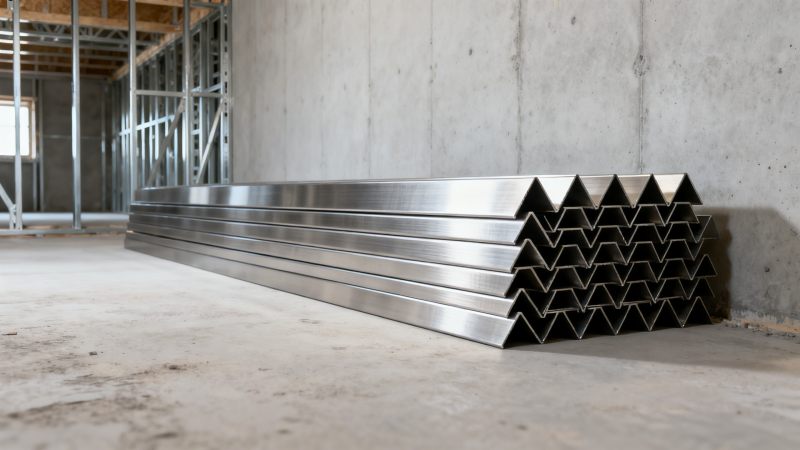
Key Performance Comparison: 304 vs. 316 for Structural Angle Applications
The table below compares critical parameters relevant to structural angle steel used in European indoor construction projects — including tensile strength, yield strength, elongation, and chloride threshold for pitting initiation. All values reflect typical mill test reports under EN 10088-2 and ASTM A240 standards.
Note: PREN = %Cr + 3.3×%Mo + 16×%N. While 316’s higher PREN matters in coastal or chemical washdown areas, indoor environments in Central/Northern Europe typically see chloride levels below 20 ppm — well within 304’s safe operational range. For structural angle steel requiring welding, 304 also offers better intergranular corrosion resistance post-welding without post-annealing, thanks to its lower carbon content (≤0.08% vs. 316’s ≤0.03%).
When Does 316 Become Justified Indoors?
There are specific indoor scenarios where 316’s added cost and complexity pay off — but they’re exceptions, not the norm. These include:
- Swimming pool enclosures with high humidity (>85% RH) and chlorine vapor concentrations exceeding 1 ppm — common in public leisure centers in Germany and the Netherlands;
- Hospital cleanrooms (ISO Class 5–7) requiring frequent sterilization with sodium hypochlorite solutions — especially near HVAC duct supports;
- Kitchens in commercial catering facilities subject to daily acid cleaning (e.g., citric or acetic acid at 5–10% concentration), particularly where angle steel forms part of exhaust hood frames;
- High-ceiling atriums in Mediterranean climates with seasonal condensation cycles and limited ventilation — verified via on-site dew point analysis.
In all cases, validation requires documented environmental monitoring — not generic “indoor use” labeling. Hongteng Fengda supports clients with free pre-order technical consultation, including specification review against EN 1993-1-4 (Eurocode 3: Design of steel structures — Part 1-4: General rules — Supplementary rules for stainless steels).
Cost & Supply Chain Impact: What Procurement Teams Need to Know
Switching from 316 to 304 for indoor angle stainless steel reduces raw material cost by €1,800–€2,400 per metric ton (FOB China, Q3 2024). For a typical order of 25 tons, this translates to €45,000–€60,000 in direct savings — before factoring in faster processing, lower scrap rates, and reduced logistics surcharges.
Supply reliability is another key factor: 304 angle steel inventory turnover at Hongteng Fengda’s EU distribution hub in Rotterdam averages 12–14 days, while 316 stock requires 22–28 days due to batch-dependent mill scheduling. For urgent projects with tight deadlines — such as retrofitting retail interiors or office fit-outs — this difference determines whether delivery meets installation windows.
For hybrid applications needing both grades, we offer co-ordered logistics: 304 for main framing and 45# Carbon Steel Round Bar for non-exposed support elements (e.g., anchor rods, tension members), leveraging our multi-grade rolling capacity and unified quality control across ASTM, EN, and GB standards.
Why Partner with Hongteng Fengda for Your Structural Steel Sourcing?
As a certified EN 10025-2/EN 10025-4 and ASTM A6/A6M structural steel manufacturer, Hongteng Fengda delivers more than standard compliance — we provide decision-enabling support:
- Free Specification Audit: Our engineering team reviews your project drawings, environmental data, and local building codes — identifying over-specification risks and recommending optimized alternatives;
- EN-Compliant Documentation Package: Includes Mill Test Reports (MTRs), CE marking documentation, and third-party inspection reports (SGS/BV/TÜV) — delivered digitally within 24 hours of shipment;
- Flexible MOQ & Lead Time Guarantees: Minimum order quantity starts at 5 tons for angle steel; confirmed production slots available within 3 working days for standard EN 10056-1 sizes;
- End-to-End Traceability: Each coil and bundle carries laser-etched batch IDs linked to chemical composition, mechanical test results, and heat treatment logs — accessible via our client portal.
Whether you're evaluating stainless steel angles for a new hospital wing in Sweden, specifying railing systems for a hotel renovation in Spain, or sourcing carbon steel components for industrial equipment in Poland — contact us today for a no-obligation technical consultation, custom quote, or sample request. We respond to RFQs within 4 business hours and ship EN-certified structural steel to major EU ports within 15–20 days.
Please give us a message


Please enter what you want to find